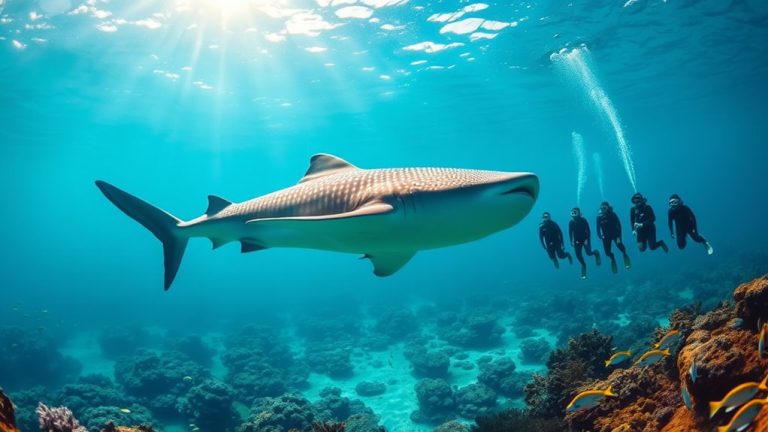
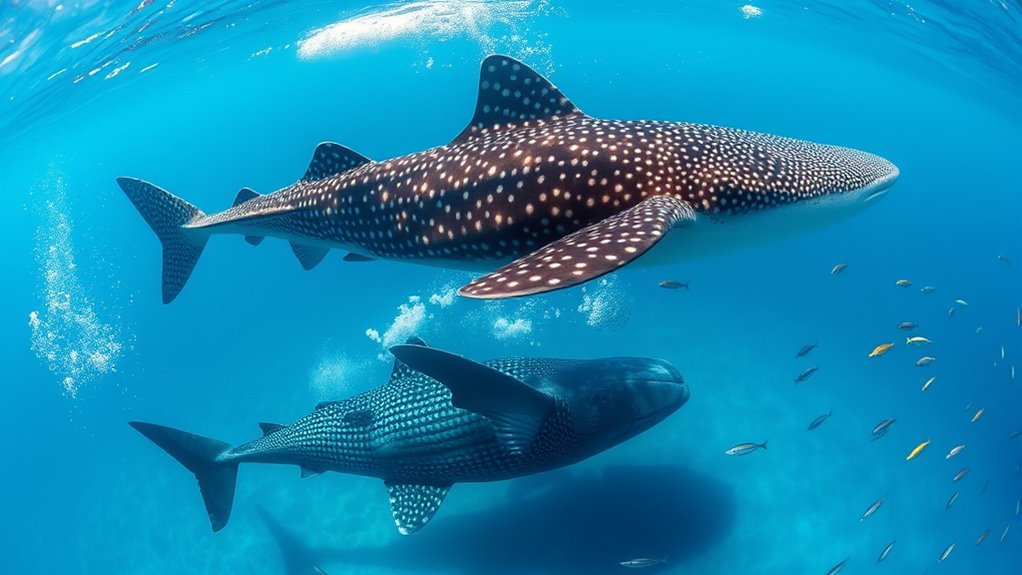
Are Whale Sharks Bigger Than Whales?
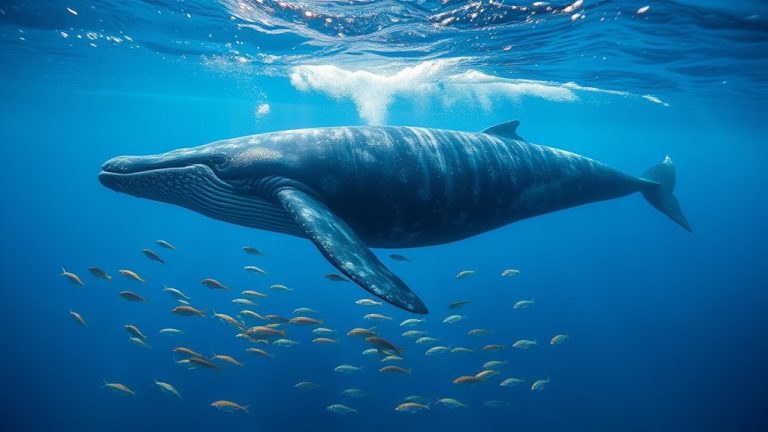
You might think whale sharks are bigger because they’re the largest fish, but whales, especially blue whales, grow much larger—over 100 feet compared to whale sharks’ 60 feet.
Whale sharks have cartilage skeletons limiting their size, while blue whales’ bony frames support massive growth.
Their feeding methods and habitats also shape their size differences. If you want to understand why these giants differ so much, keep exploring how their biology and evolution influence their impressive sizes.
How Big Are Whale Sharks Compared to Whales
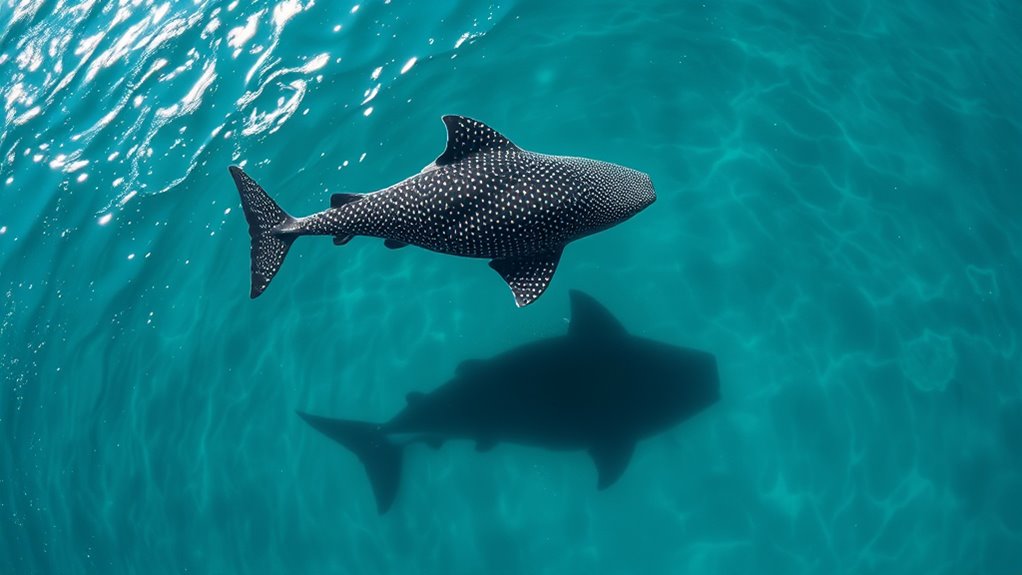
How big are whale sharks compared to whales? Whale sharks, the largest fish, typically grow to about 18-20 meters (59-62 feet). While these marine giants are impressive, they’re still smaller than the biggest whales.
The blue whale, the largest whale species, can reach over 30 meters (98 feet), dwarfing whale sharks in size. In fact, the longest recorded blue whale measures just over 33 meters (108 feet), nearly twice the length of an average whale shark.
Although whale sharks exceed most whale species in size, none come close to the massive blue whale. So, while whale sharks hold the title of largest fish, blue whales remain the true giants of the ocean.
Why Blue Whales Are the Largest Animals
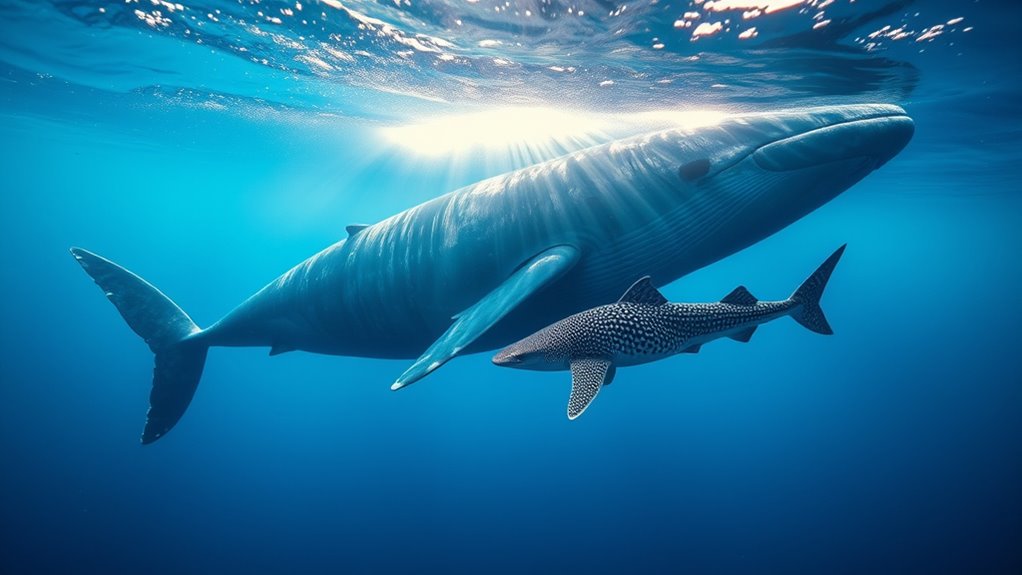
While whale sharks impress with their massive size, blue whales surpass them by a wide margin, holding the record as the largest animals ever to live. You’ll find that the blue whale’s extraordinary growth size stems from its unique adaptations:
- They can grow over 100 feet long, making the blue whale the largest animal known.
- Their weight reaches up to 219 tons, far exceeding other marine creatures.
- Blue whales use baleen plates for filter feeding, allowing them to consume vast amounts of krill efficiently.
- Their enormous size aids in swimming efficiency and insulation in chilly ocean waters.
This incredible growth size is a direct result of evolutionary adaptations tailored to their filter feeding lifestyle and ocean habitat, setting blue whales apart as giants of the sea.
Differences in Body Structure Between Whale Sharks and Whales
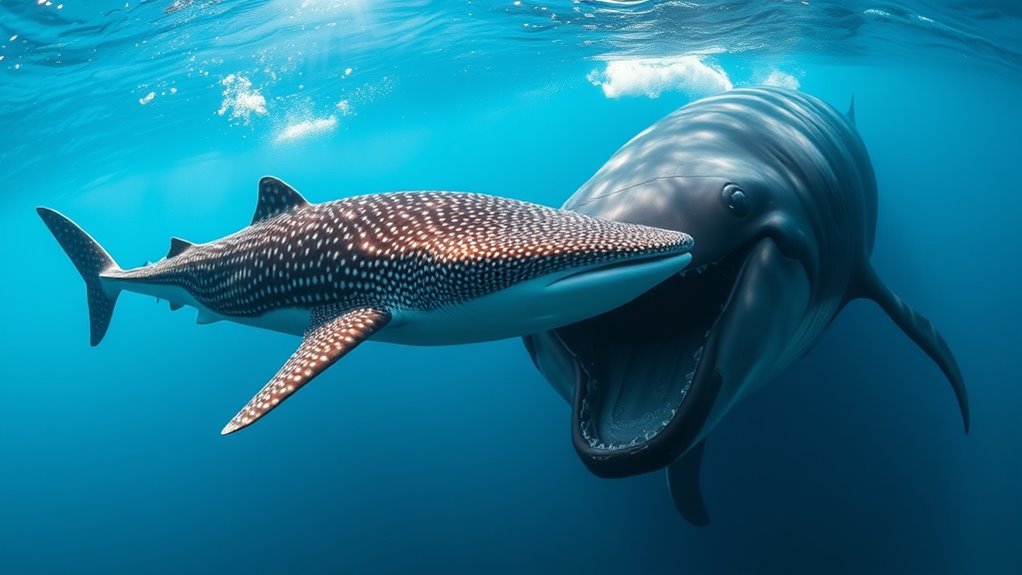
When you compare whale sharks and whales, you’ll notice key differences in their skeletons—whale sharks have cartilage, while whales have bones. You’ll also see how their breathing methods contrast, with whale sharks using gills and whales relying on blowholes.
Plus, their reproduction varies: whale sharks lay eggs, but whales give birth to live young.
Skeletal Composition Differences
Because whale sharks have a skeleton made of cartilage rather than bone, their body structure differs considerably from that of whales. This skeletal composition affects their buoyancy and flexibility in the water. You’ll notice these key differences:
- Whale sharks possess a cartilaginous skeleton, which is lighter and more flexible than the bony skeleton whales have.
- Whales’ bony skeletons provide solid structural support and protect internal organs.
- The cartilaginous skeleton of whale sharks is less dense, enhancing their buoyancy.
- Unlike whales’ rigid vertebral column and rib cage, whale sharks’ skeletons are reinforced with tiny calcified areas for added strength.
Understanding these skeletal composition differences reveals how each species has evolved uniquely to thrive in aquatic environments.
Respiratory Systems Compared
The differences in skeletal composition between whale sharks and whales set the stage for how each breathes underwater. Whale sharks, as fish, use five pairs of gill slits on their heads to breathe underwater. Water must continuously flow over these gills for respiration, extracting oxygen efficiently.
In contrast, whales rely on a lung system and surface periodically to breathe air through blowholes atop their heads. Unlike whale sharks, whales have a muscular diaphragm aiding lung function, allowing them to hold their breath for long dives. Whale sharks lack lungs entirely and depend solely on water passing through gill slits.
Reproduction Methods Contrast
Although whale sharks and whales both reproduce to guarantee their species’ survival, their methods reflect their distinct biological classes. You’ll notice significant differences between these fish and mammals in how they bring new life into the world.
- Whale sharks reproduce via ovoviviparity; eggs hatch inside the female before live birth. They produce the largest shark eggs, some over 30 cm, but don’t lay eggs externally.
- Whales, as mammals, give birth to fully developed live calves after about 11 months of gestation. Unlike whale sharks, whales produce milk and have mammary glands for feeding their young.
Understanding these contrasts highlights the unique reproductive strategies shaped by their fish and mammal classifications.
How Whale Sharks and Blue Whales Eat to Support Their Size
You’ll notice both whale sharks and blue whales use filter feeding to gather food, but their techniques differ. Whale sharks swim with mouths open, filtering plankton and small fish, while blue whales lunge through krill swarms using baleen plates.
Understanding these strategies helps explain how they support their massive sizes.
Filter Feeding Techniques
When you watch a whale shark or a blue whale feed, you see two giants using very different techniques to consume tiny prey. Both rely on filter feeding to support their immense size in the ocean. Whale sharks swim with mouths wide open, passively filtering plankton through special pads, while blue whales actively lunge toward krill swarms, using baleen plates to sieve their meal.
Here’s how their techniques differ:
- Whale sharks filter up to 614,000 liters of water per hour by swimming steadily.
- Blue whales gulp up to 220 tons of krill-filled water in a powerful lunge.
- Whale sharks use passive ram filtration, relying on continuous movement.
- Blue whales employ active lunge feeding, accelerating to capture dense prey.
These methods perfectly suit their massive bodies and feeding needs.
Dietary Differences and Strategies
Since both whale sharks and blue whales need vast amounts of food to sustain their enormous bodies, they’ve developed distinct dietary strategies. Blue whales, as baleen whales, actively lunge through dense swarms of krill, swallowing huge volumes of water and filtering out tiny prey with their baleen plates. This active filter feeding supports their massive size difference by maximizing energy intake quickly.
In contrast, whale sharks use a passive filter feeding strategy, slowly swimming with their mouths open to trap plankton, small fish, and crustaceans on their gill-mounted filter pads. While both rely on filter feeding, blue whales’ energetic lunges contrast with whale sharks’ steady cruising, illustrating how these feeding strategies evolved to meet their nutritional needs despite different lifestyles and environments.
How Whale Shark Size Affects Growth and Lifespan
Although whale sharks grow slowly, they reach impressive sizes by the time they’re 20 to 30 years old, with females often outgrowing males and living longer. Their whale shark size directly influences their growth rate and lifespan, allowing them to thrive for decades.
You should know these key points:
- They reach a maximum size of about 60 feet, smaller than some whale species.
- Their slow growth rate is due to a low metabolic rate and the energy needed to maintain their massive bodies.
- Whale sharks typically live between 70 and 100 years, giving them ample time to reach full size.
- Their extended lifespan supports their filter-feeding lifestyle, especially in nutrient-poor tropical waters.
Understanding these factors helps you appreciate how size affects whale shark growth and longevity.
Where Whale Sharks and Blue Whales Live and Migrate
If you want to understand where whale sharks and blue whales live and migrate, it helps to know that both species cover vast oceanic ranges but favor different habitats. Blue whales migrate seasonally between polar feeding grounds and tropical breeding areas, traveling up to 10,000 miles. Whale sharks prefer warm tropical and subtropical waters, often following plankton blooms.
| Species | Habitat | Migration Pattern |
|---|---|---|
| Blue Whales | Major oceans except Arctic | Seasonal, long-distance (up to 10,000 mi) |
| Whale Sharks | Tropical & subtropical waters | Food-driven, following plankton blooms |
Both are highly mobile, but blue whales have some of the longest mammal migrations, while whale sharks move extensively to find food and suitable habitats.
How Size Influences Predators and Threats to Whale Sharks and Whales
When you compare whale sharks and blue whales, their size plays a crucial role in shaping the predators they face and the threats they encounter. The blue whale’s massive size protects it from most natural predators, while whale sharks, though large, face more risks, especially when young. Here’s how size influences their predators and threats:
- Blue whales have few predators due to their enormous size, but humans pose significant threats like ship strikes and hunting.
- Whale sharks can fall prey to large sharks and predatory fish, mainly when they’re young.
- The slow movement and large migration of blue whales make them vulnerable to human-related threats.
- Whale sharks’ threats often come from fishing and habitat disturbances rather than natural predators.
Size directly affects the level and type of threats both species face.
How Size Shapes Conservation for Whale Sharks and Whales
Because whale sharks and whales grow to such impressive sizes, their conservation faces unique challenges that you need to understand. Their massive size increases their vulnerability to threats like ship strikes and habitat loss, making protective efforts critical. You’ll notice that their slow reproduction and small populations further complicate conservation strategies, requiring careful management.
This immense size also highlights their ecological importance, urging you to support habitat protection and international cooperation. Recognizing the size differences between these giants helps you appreciate their distinct conservation needs and promotes public awareness.
What Evolution Tells Us About Whale Shark and Whale Sizes
Although whale sharks and whales share the ocean as their home, their sizes reveal fascinating evolutionary stories. The evolution of these giants shows how their size reflects different adaptations shaped by millions of years.
Whale sharks evolved over 265 million years ago as ancient cartilaginous fish, growing up to around 60 feet. Blue whales, emerging about 50 million years ago from land mammals, can exceed 100 feet with massive bony skeletons.
The enormous size of blue whales supports energy-efficient lunge feeding on dense krill swarms. Whale sharks’ large size aids passive filter feeding on plankton, reflecting a distinct evolutionary strategy.
Why Whale Sharks Are the Largest Fish, Not the Largest Animals
While whale sharks hold the title for the largest fish, they don’t come close to being the largest animals in the ocean. You’ll find that blue whales easily surpass whale sharks in size, growing over 30 meters long compared to the whale shark’s 18.8 meters.
Whale sharks are cartilaginous fish, meaning their skeletons are made of cartilage, which limits their maximum size. On the other hand, blue whales are mammals with bony skeletons and have evolved mammalian adaptations that allow them to grow much larger and heavier.
Frequently Asked Questions
Are Whales Bigger Than Whale Sharks?
Yes, whales are bigger than whale sharks. You’ll find blue whales, the largest animals, grow over 100 feet and weigh much more, making them considerably larger than the biggest whale sharks in both size and weight.
Do Whales Eat Whale Sharks?
Imagine a giant’s shadow passing peacefully; whales don’t eat whale sharks. You won’t find them hunting each other because whales focus on different prey, and whale sharks simply glide harmlessly, filtering tiny meals from the sea.
What Are the Top 3 Biggest Fish?
You’ll find the top three biggest fish are the whale shark, basking shark, and megamouth shark. The whale shark leads, reaching up to 62 feet, while the basking and megamouth sharks are smaller but still massive.
Could a Whale Shark Hurt a Human?
You won’t find yourself in any trouble with a whale shark; they’re gentle giants who prefer plankton snacks over causing harm. Their slow, calm nature means you can admire them without worry or fear.
Conclusion
When it comes to size, whale sharks may be giants of the fish world, but blue whales truly take the cake as the largest animals on Earth. You might think they’re neck and neck, but their differences run deeper than just length.
Understanding these gentle giants helps you appreciate the delicate balance of our oceans. Remember, every big fish in the sea plays its part—don’t let the grass grow under your feet when it comes to protecting them.
Whale sharks and whales both play crucial roles in marine ecosystems, highlighting why conservation of these majestic creatures is essential for ocean health.