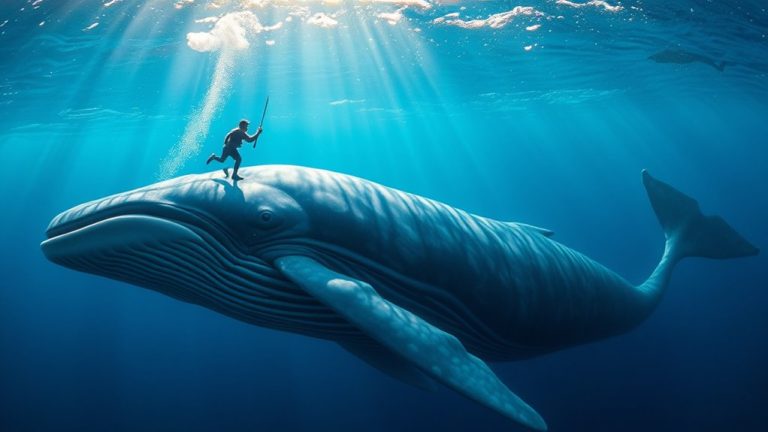
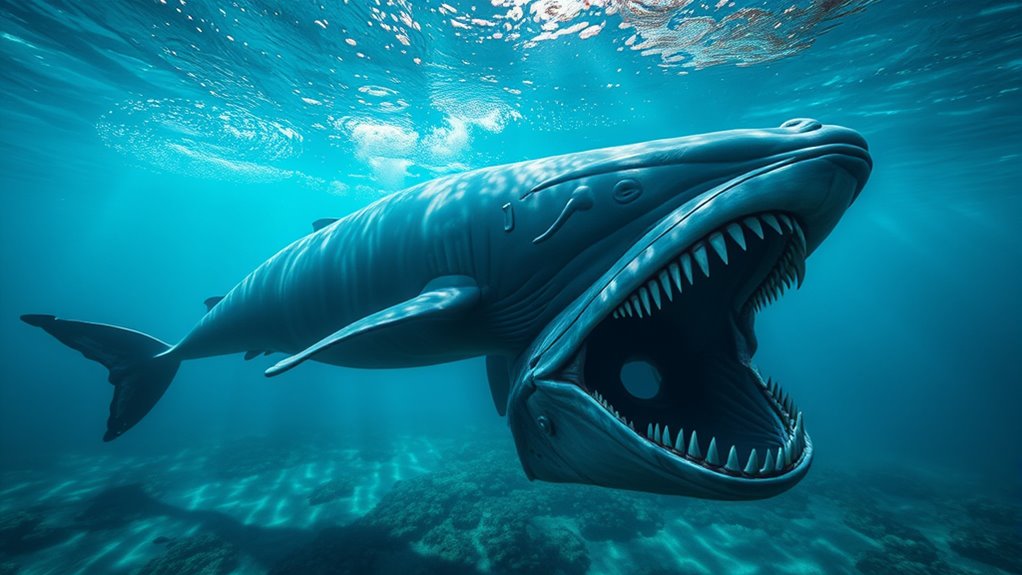
Can a Blue Whale Eat a Megalodon?
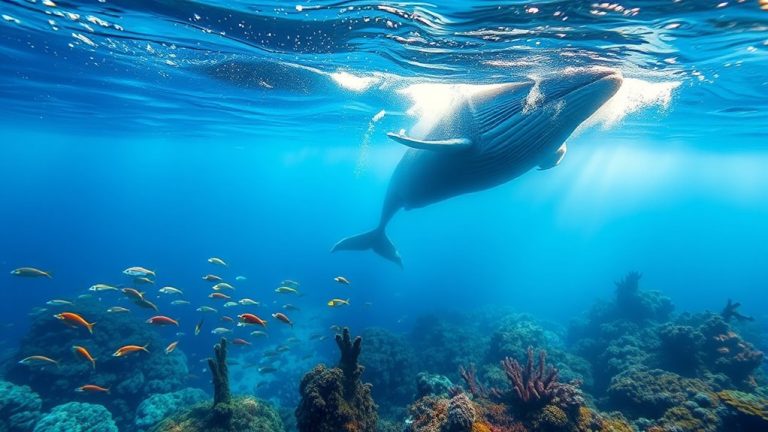
You can’t expect a blue whale to eat a Megalodon because blue whales only feed on tiny krill using baleen plates. They lack teeth or the hunting skills necessary for big prey.
Megalodons, on the other hand, were fierce predators with powerful jaws.
Blue whales are gentle giants that filter-feed peacefully, posing no threat to massive creatures like the Megalodon. Additionally, Megalodons likely avoided fully grown blue whales due to their immense size and strength.
If you want to understand the fascinating differences between these giants and why one thrived while the other vanished, keep exploring. The contrast between their feeding habits and lifestyles reveals much about their survival and extinction.
Why Blue Whales Would Never Eat a Megalodon
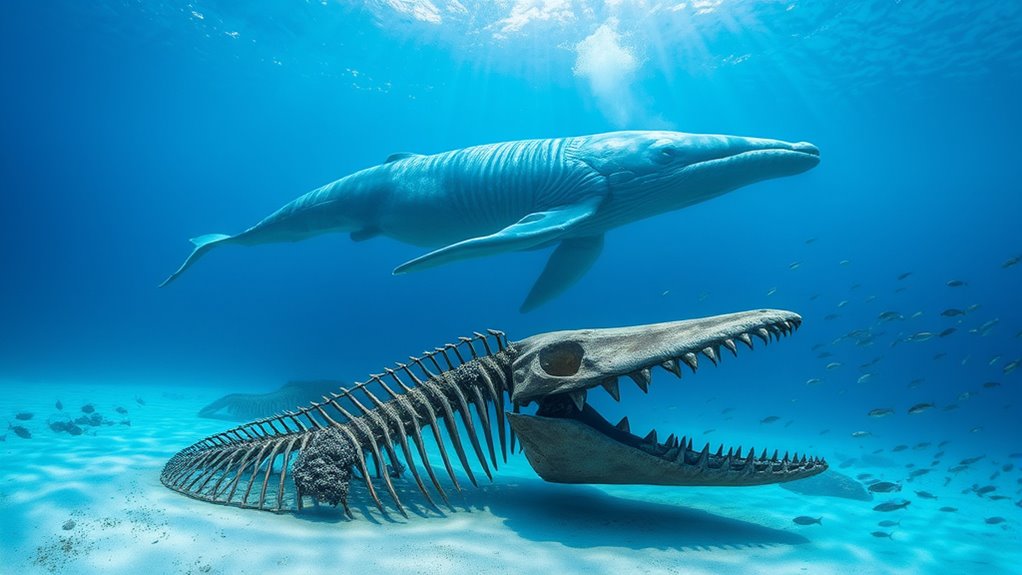
Although you might imagine a giant blue whale devouring a fearsome Megalodon, blue whales simply don’t eat large predators. Their feeding habits focus on tiny krill, not massive carnivores like Megalodon. As large marine mammals, blue whales have evolved to filter-feed, lacking teeth or hunting skills needed to attack predators.
Megalodon, an apex predator itself, wouldn’t be on their menu. The blue whale’s body size and feeding adaptations make it incompatible with hunting or consuming such large prey. So, despite their massive size, blue whales and Megalodon occupy entirely different roles in the ocean ecosystem.
Blue whales peacefully graze and Megalodon preys on other marine creatures—not each other.
How Megalodons and Blue Whales Differ in Size and Behavior
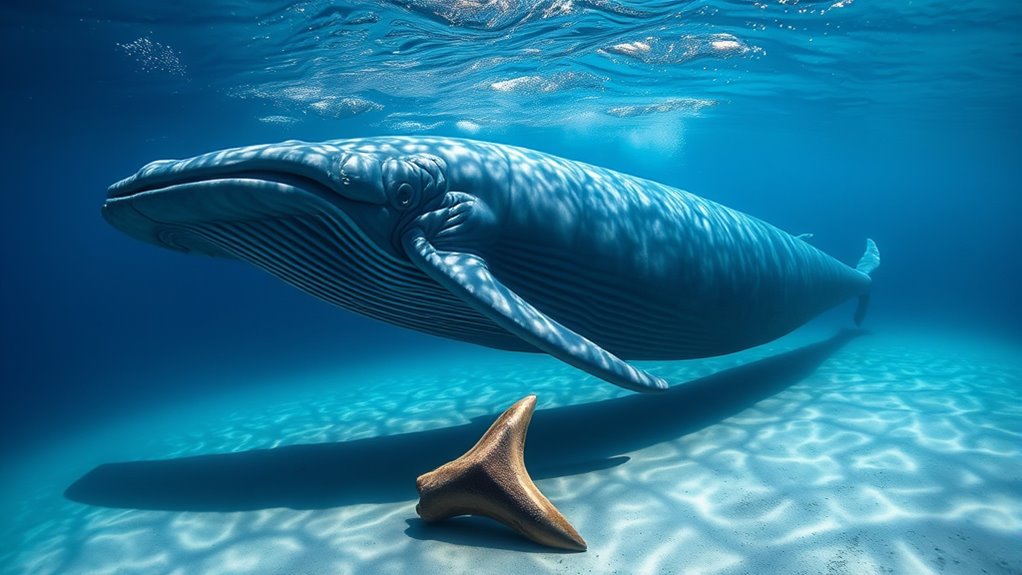
While blue whales and Megalodons never crossed paths as predator and prey, comparing their size and behavior reveals fascinating contrasts. You’ll notice blue whales, the largest animal alive today, can reach up to 100 feet and weigh over 110 tons, dwarfing the Megalodon’s estimated 67 feet and 50 tons.
Behaviorally, they differ even more. Megalodon, a fierce apex predator with sharp teeth and aggressive hunting tactics, hunted mid-sized whales millions of years ago. Blue whales, on the other hand, are gentle marine mammals that filter-feed on krill, showing calm and non-aggressive behavior.
These differences in size and behavior stem from their distinct evolutionary paths—Megalodon as a massive carnivorous shark, and blue whales as peaceful baleen whales.
What Blue Whales Eat and Why They Can’t Hunt Megalodons
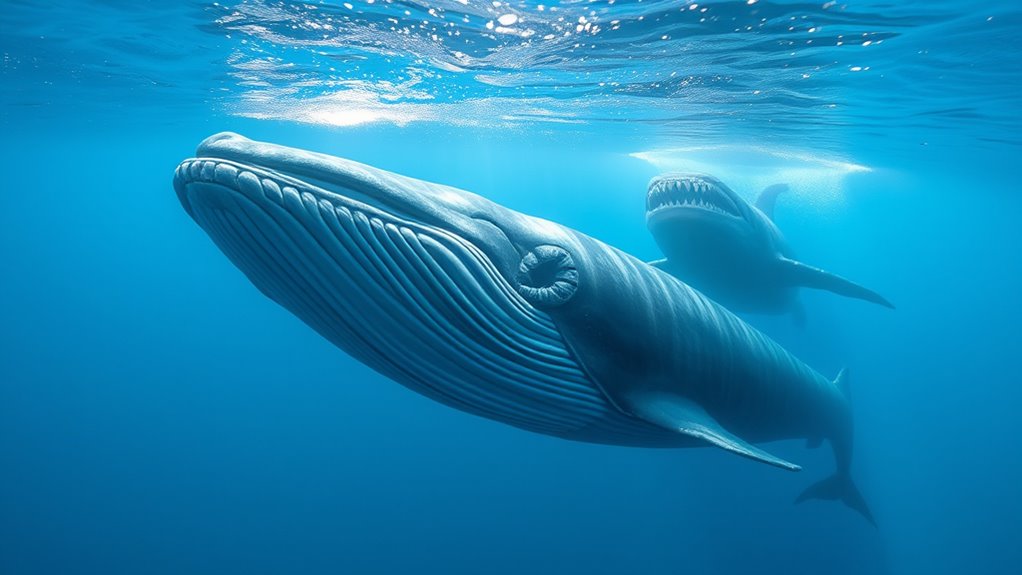
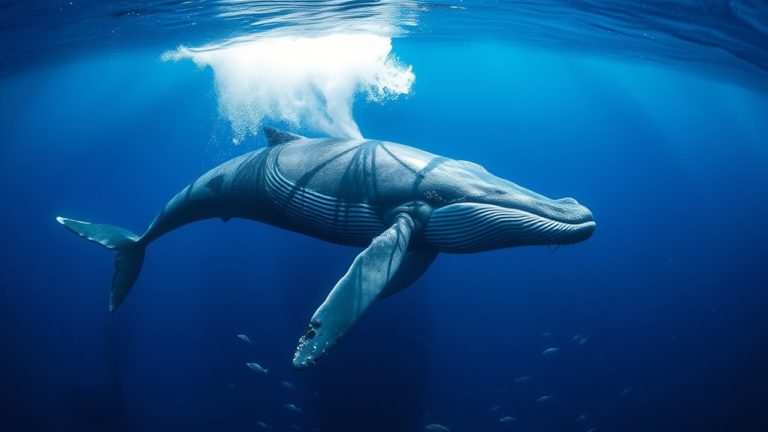
Because blue whales feed by filtering tiny krill from the water, they don’t have the teeth or hunting skills to catch large prey like a Megalodon. Unlike predatory sharks, blue whales lack teeth altogether, relying instead on baleen plates to trap small prey. Their feeding strategy suits their immense size, focusing on massive quantities of tiny shrimp-like krill rather than large animals.
As one of the large baleen whales, the blue whale’s diet is specialized for efficiency in consuming small, abundant prey. They don’t hunt sharks or other marine mammals. So, even though Megalodon was a fearsome shark that preyed on mid-sized whales, the blue whale’s feeding habits and anatomy make it impossible for them to hunt or eat a Megalodon.
Could Megalodons Have Ever Attacked Blue Whales?
Even if Megalodons were powerful predators, they probably didn’t target fully grown blue whales due to their enormous size and strength. As a prehistoric predator, Megalodon favored smaller, mid-sized whales like Minkes as prey, avoiding the risks involved in attempting to attack whales as large as blue whales.
The sheer size and power of mature blue whales would make a Megalodon vs blue whale confrontation dangerous and unlikely to succeed. Fossil evidence supports this, showing Megalodon primarily hunted smaller cetaceans rather than the largest whales.
While you might imagine a Megalodon injuring a blue whale, no concrete proof confirms it actively attacked fully grown blue whales. So, Megalodons likely focused on more manageable prey instead of challenging the ocean’s largest creature.
Why Megalodon Went Extinct but Blue Whales Survived
Megalodon’s failure to dominate blue whales wasn’t just about size—it also shaped their long-term survival. You see, megalodon faced extinction due to limited adaptability amid climate cooling and habitat loss.
Blue whales, evolving after megalodon’s disappearance, thrived by developing baleen filtering and migration strategies, allowing them to survive changing ocean ecosystems.
| Factor | Megalodon | Blue Whale |
|---|---|---|
| Era | Prehistoric, extinct | Prehistoric, survived |
| Adaptability | Low, habitat-specific | High, migratory |
| Feeding Method | Predatory, specific prey | Baleen filtering |
| Climate Impact | Negative, led to extinction | Adapted, survived |
| Ecological Niche | Lost due to changes | Occupied post-extinction |
This table shows why adaptability saved blue whales while megalodon vanished.
Frequently Asked Questions
Can Blue Whales Eat Megalodon?
No, you can’t expect blue whales to eat megalodons. They’re filter feeders that only consume tiny krill, so they lack the teeth or ability to eat large predators like the massive megalodon shark.
Which Animal Can Defeat Megalodon?
You’d find that extinct Livyatan and modern orca pods could defeat Megalodon.
Livyatan’s size, speed, and bite power, plus orcas’ cooperative hunting, give them the edge against this massive prehistoric predator.
What Actually Killed the Megalodon?
You can’t pin the tail on one factor for Megalodon’s demise; climate shifts, shrinking prey, and new predators all played their part.
It wasn’t one event but a perfect storm that sealed its fate.
Could a Blue Whale Eat a Shark?
No, you can’t expect a blue whale to eat a shark. Blue whales filter-feed tiny krill and don’t have teeth or hunting skills to catch or consume sharks, which are fast, aggressive predators in the ocean.
Conclusion
You might imagine a blue whale chomping down on a megalodon, but that’s just a pipe dream. Blue whales glide through oceans eating tiny krill, not giant sharks. Megalodons were the ocean’s apex predators long before blue whales showed up, and their paths never crossed in a predator-prey dance.
So, don’t expect a blue whale buffet anytime soon—it’s like asking a gentle giant to hunt dragons that disappeared millions of years ago. In reality, the idea of a blue whale eating a megalodon is pure fantasy. Blue whales and megalodons occupied very different ecological niches, making such an encounter impossible.