How Long Can a Whale Hold Its Breath?
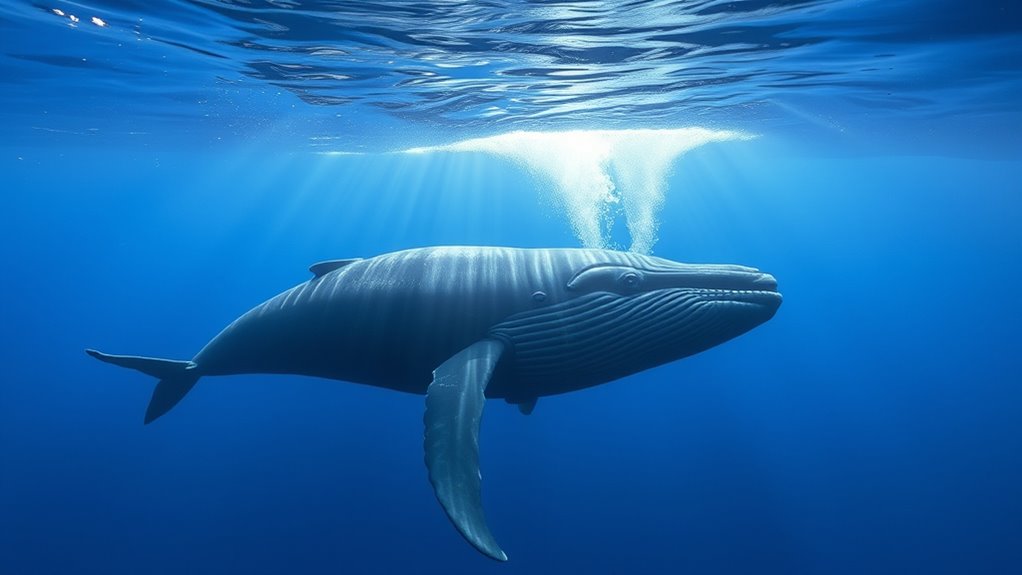
You can hold your breath for about a minute or two, but some whales dive for much longer. Species like sperm whales can last up to 90 minutes, while Cuvier’s beaked whales reach over two hours.
They do this thanks to unique adaptations such as high hemoglobin levels and controlled blood flow that prioritize oxygen use. Their amazing breath-holding ability helps them explore deep waters.
If you want to understand how they manage this feat, keep exploring their incredible biology and survival strategies.
How Long Can Different Whale Species Hold Their Breath?
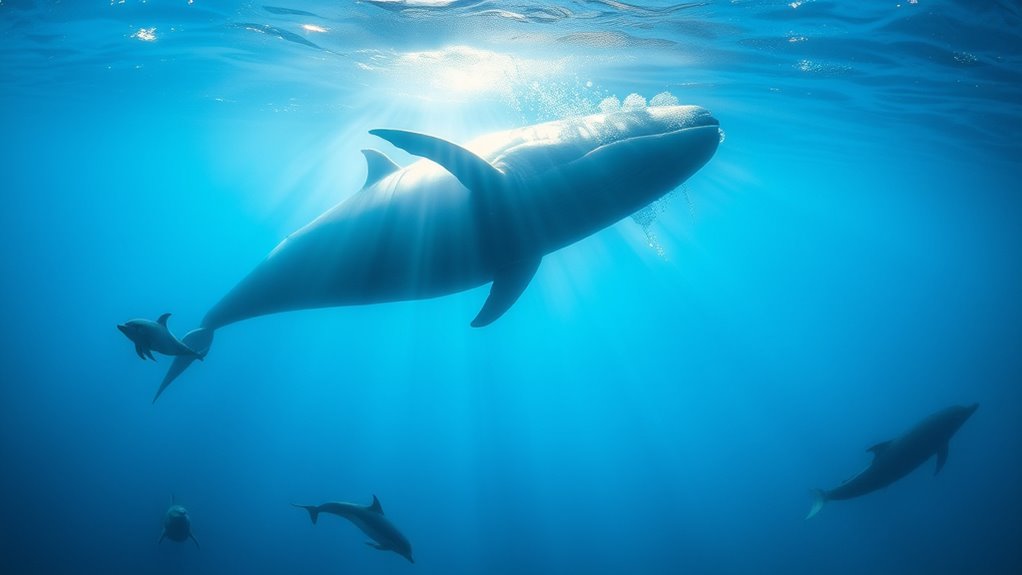
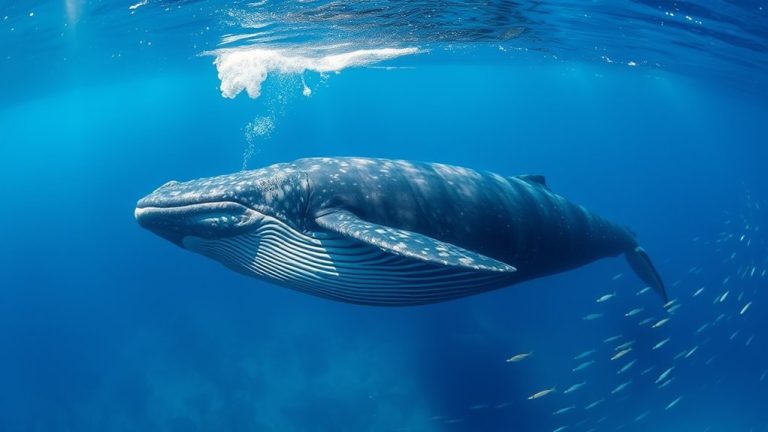
How long can whales really stay underwater? Different whale species hold their breath for varying diving durations, thanks to their impressive oxygen capacity. For example, sperm whales can hold their breath for up to 90 minutes during deep dives, while humpback whales usually stay submerged for 4 to 7 minutes but can extend that to about an hour.
Killer whales, on the other hand, surface every 3 to 5 minutes, with a maximum breath-hold near 15 minutes. The record-holder is the Cuvier’s beaked whale, which can hold its breath for around 138 minutes. These variations show how whales hold their breath differently depending on species, all supported by their ability to store more oxygen per breath compared to humans, allowing extended underwater exploration.
How Physical Adaptations Help Whales Hold Their Breath Longer
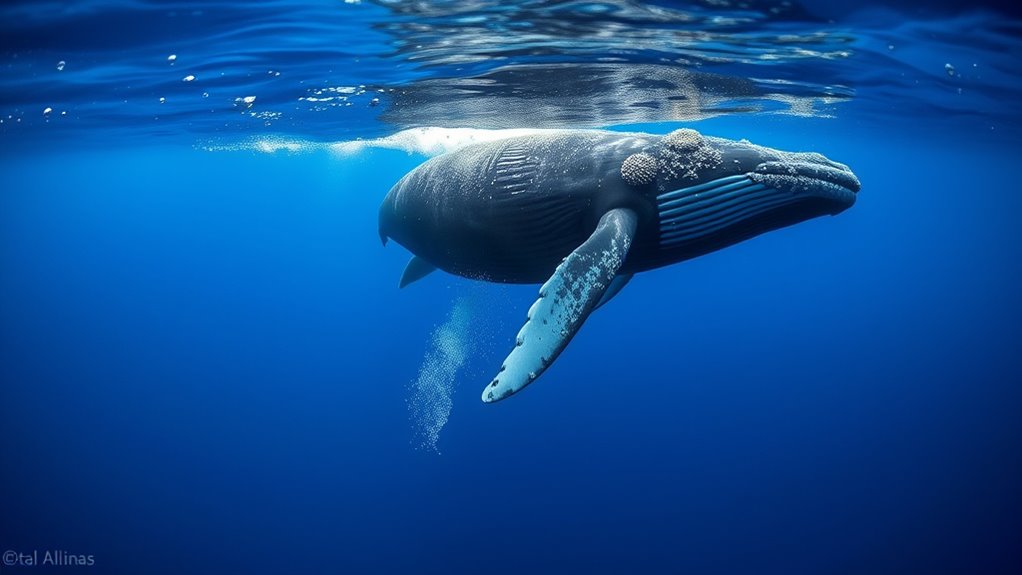
The incredible breath-holding abilities of whales come down to unique physical adaptations that let them make the most of every oxygen molecule. You’ll notice their hemoglobin levels are twice as high as yours, boosting oxygen storage in their blood profoundly. Plus, their lungs efficiently transfer oxygen, absorbing up to 90% with each breath—far more than humans.
When diving, whales control blood flow by directing it to essential organs, ensuring oxygen is used where it’s needed most. They also exhale about 90% of lung air before diving to reduce buoyancy, optimizing oxygen use further. These adaptations work together seamlessly, enabling whales to stay underwater for extended periods without needing to surface for air.
How Whales Store and Use Oxygen During Deep Dives
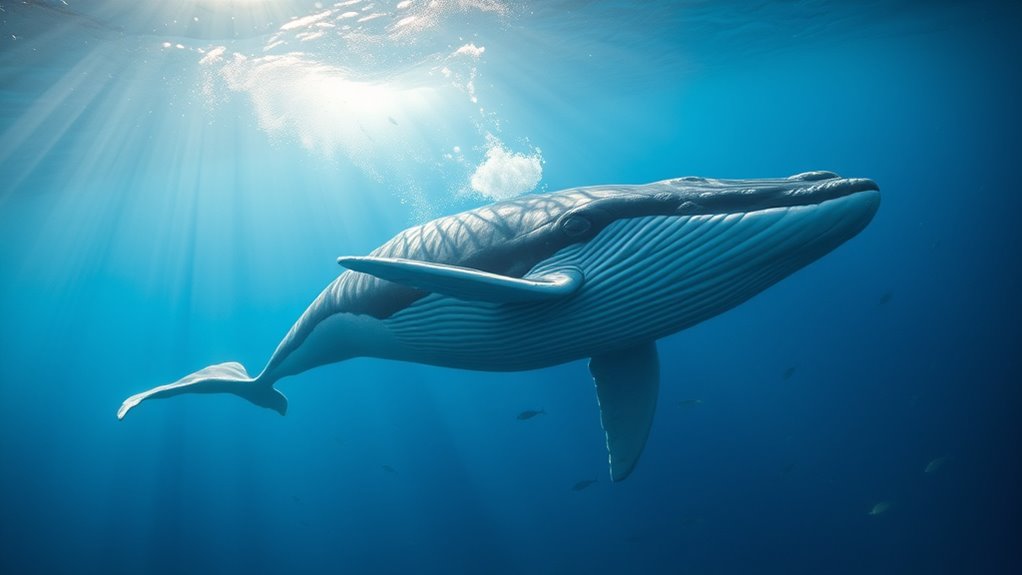
Though you might assume whales rely solely on their lungs for oxygen, they actually store significant amounts in their blood and muscles. This allows them to hold their breath for long periods during profound dives. Whales absorb up to 90% of the oxygen in each breath, much more than humans.
Their muscles contain high levels of myoglobin, storing oxygen efficiently. Hemoglobin in their blood is twice as abundant as in humans, boosting oxygen transport. Before diving, whales exhale most lung air to reduce buoyancy and maximize oxygen use.
During profound dives, blood flow prioritizes vital organs, conserving oxygen where it’s needed most.
| Oxygen Storage | Concentration Compared to Humans | Function During Profound Dives |
|---|---|---|
| Lung Absorption | Up to 90% | Maximizes oxygen intake |
| Myoglobin in Muscles | High | Stores oxygen for muscle use |
| Hemoglobin in Blood | Twice as high | Transports more oxygen |
| Blood Flow | Selective | Prioritizes brain and heart |
How Whales Conserve Energy to Extend Their Underwater Time
You might be surprised to learn whales slow their heart rate to just a few beats per minute to save oxygen. They also redirect blood flow to essential organs like the brain and heart while storing oxygen in muscles with myoglobin.
These clever energy-saving strategies help whales stay underwater much longer than you’d expect.
Slowing Heart Rate
When whales dive deep, they slow their heart rate dramatically, sometimes dropping it to as low as 4 beats per minute. This significant reduction, known as bradycardia, is part of their natural diving response that helps conserve oxygen during a breath-hold. By slowing the heart rate, whales decrease cardiac output, allowing their bodies to use oxygen more efficiently.
This means oxygen is prioritized for essential organs like the brain and muscles, extending how long they can stay underwater. This reflex is controlled by the autonomic nervous system and plays a critical role in prolonging their underwater endurance from mere minutes to over an hour. So, when you think about a whale holding its breath, remember bradycardia is a key factor that makes those long dives possible.
Selective Blood Flow
Because oxygen is limited during profound immersions, whales actively redirect blood flow away from less critical areas like their digestive system and extremities. This selective blood flow allows oxygen conservation by prioritizing essential organs such as the brain, heart, and muscles.
Alongside a dramatically lowered heart rate—sometimes as low as 4 beats per minute—this mechanism helps whales extend their underwater time efficiently.
| Organ/System | Blood Flow Priority |
|---|---|
| Brain | High |
| Heart | High |
| Muscles | Moderate |
| Digestive System | Low |
| Extremities | Low |
Oxygen Storage Mechanisms
Although whales spend extended periods underwater, they’ve evolved remarkable oxygen storage mechanisms that let them conserve energy and breathe efficiently. You’ll find that their muscles contain high levels of myoglobin, a protein that stores oxygen and prolongs their breath-hold.
Whales absorb up to 90% of the oxygen from each breath, far surpassing humans, which fuels longer dives. Their hemoglobin levels are twice as high as yours, speeding oxygen transport in their blood. Before diving, whales exhale most lung air to reduce buoyancy and optimize oxygen use.
During extended breath-holds, they redirect blood flow from less critical organs and slow their heart rate, conserving oxygen for essential tissues. These adaptations make whales masters of underwater oxygen storage and energy conservation.
How Whales Sleep Without Drowning While Breathing Voluntarily
You might wonder how whales manage to sleep without drowning since they have to breathe consciously. They actually rest with one half of their brain at a time, a state called hemispheric sleep, which lets them stay alert enough to surface for air.
Hemispheric Sleep Explained
When a whale sleeps, it keeps one half of its brain awake to control breathing and stay alert. This process, called hemispheric sleep, lets the whale rest one brain hemisphere at a time, while the other monitors its surroundings. You might wonder how a whale can breathe underwater yet still avoid drowning.
Since whales breathe voluntarily, they must consciously surface for air. Hemispheric sleep lets them manage this by alternating rest between hemispheres every two hours, ensuring they get oxygen in a single breath before diving again. One eye stays open during this time to watch for predators or obstacles.
This remarkable adaptation balances the need for rest with the continuous control of breathing, allowing whales to survive and thrive in aquatic environments without ever fully losing consciousness.
Voluntary Breathing Control
Since whales must consciously breathe, they can’t rely on automatic breathing like humans do. You might wonder how they manage to sleep without drowning. Whales use voluntary breathing, meaning they decide when to breathe air.
During sleep, they engage in hemispheric sleep, resting one half of their brain while the other half stays alert. This alert side controls breathing and allows them to surface for air even while half-asleep. You’ll notice whales close one eye, signaling which brain hemisphere is resting.
After about two hours, they switch sides to rest the other half. This remarkable system lets whales sleep underwater safely, maintaining voluntary breathing control to avoid drowning while still getting the rest they need.
How Whale Breath-Holding Compares to Human Records
Although humans can train to hold their breath for impressive lengths—Budimir Šobat’s record stands at 24 minutes and 37 seconds—whales far surpass these feats underwater. When you compare a whale hold to human breath-holding, the difference is staggering.
For example, Cuvier’s beaked whales perform long dives lasting around 138 minutes, while sperm whales can stay submerged for up to 90 minutes. In contrast, most humans hold their breath between 30 seconds and 2 minutes without training.
Whales achieve these long dives thanks to their unique physiological adaptations that allow efficient oxygen use and delayed oxygen depletion. So, while you might try to push your limits, whales naturally excel at breath-holding, making their long dives truly extraordinary compared to human records.
Why Whale Breath-Holding Insights Are Vital for Conservation
Whales’ remarkable breath-holding abilities offer more than just impressive records—they provide essential clues about their health and well-being. Understanding whale breath-holding helps you grasp how these giants manage oxygen conservation, which is vital for their survival.
This knowledge directly supports conservation efforts by informing strategies to protect whales from human threats and environmental changes. When you study their breath patterns, you learn how to shield their habitats and migration routes effectively.
Consider these key points:
- Evaluating whale health and stress through breath-hold capabilities
- Informing conservation efforts during increased ocean activity
- Minimizing noise pollution that disrupts breathing and resting
- Enhancing rescue and rehabilitation techniques based on physiology
Frequently Asked Questions
Which Animal Can Hold Breath Longest?
You’ll find the Cuvier’s Beaked Whale holds the breath longest, staying submerged for about 138 minutes.
Its incredible oxygen storage lets it outlast other animals, even beating the sperm whale and human breath-hold records.
Do Whales Sleep Underwater?
Yes, whales do sleep underwater. They rest one brain hemisphere at a time, letting you know they stay partially alert. This way, they control breathing and avoid drowning, sleeping in short bouts throughout the day.
What Animal Can Hold Its Breath for 6 Days?
You’ll be amazed to learn that the Cuvier’s beaked whale can hold its breath for about 6 days straight.
Its incredible physiology lets it dive deep and stay underwater longer than any other animal.
Can a Whale Live for 200 Years?
Just like Methuselah in ancient tales, the bowhead whale can live over 200 years.
You’ll find their slow growth and unique DNA help them defy time, making them the ocean’s true centenarians.
Conclusion
You might hold your breath for a minute or two, but whales can stay underwater for up to 90 minutes—an incredible contrast that highlights their unique adaptations. While you rely on willpower, whales depend on specialized physiology and energy conservation to dive deep and long.
Understanding these differences not only amazes you but also shows why protecting these magnificent creatures is essential for maintaining the ocean’s delicate balance. Whale breath-holding capabilities reflect their remarkable evolution, underscoring the importance of conserving marine life and their habitats.