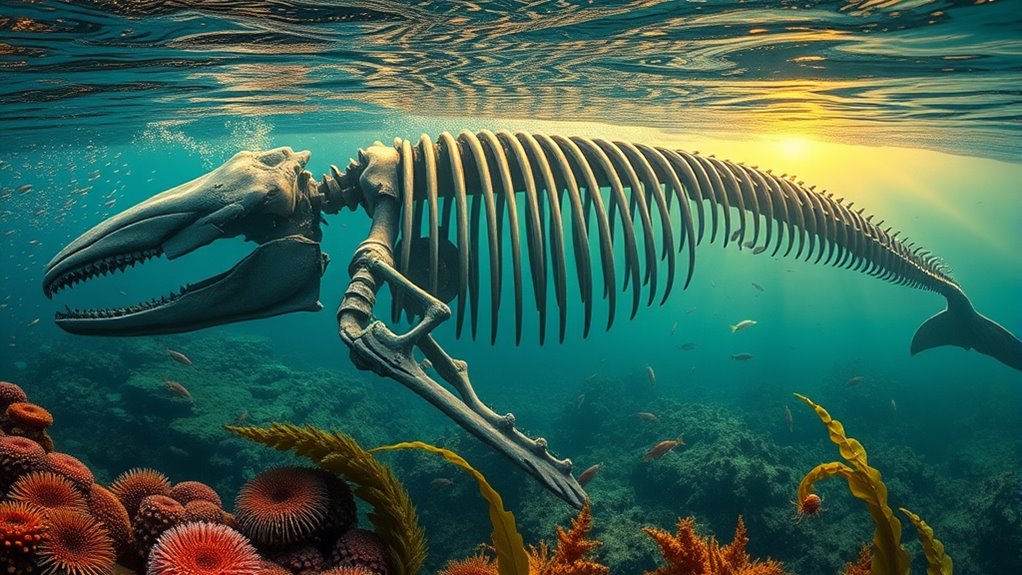
What Eats a Whale After It Dies?
When a whale dies, it creates a whale fall, a remarkable event that sustains deep-sea ecosystems. Sharks, crabs, and hagfish quickly devour its soft tissues, capitalizing on this rich food source.
Next, bone-eating worms like Osedax bore into the skeleton, extracting nutrients with acids. Meanwhile, microbes break down the remaining material, fueling chemosynthetic bacteria that support unique deep-sea life.
This process transforms the carcass into a rich habitat lasting decades, recycling essential nutrients. If you want to understand the fascinating stages and creatures involved, there’s much more to explore about whale falls.
What Is a Whale Fall and Why It Matters
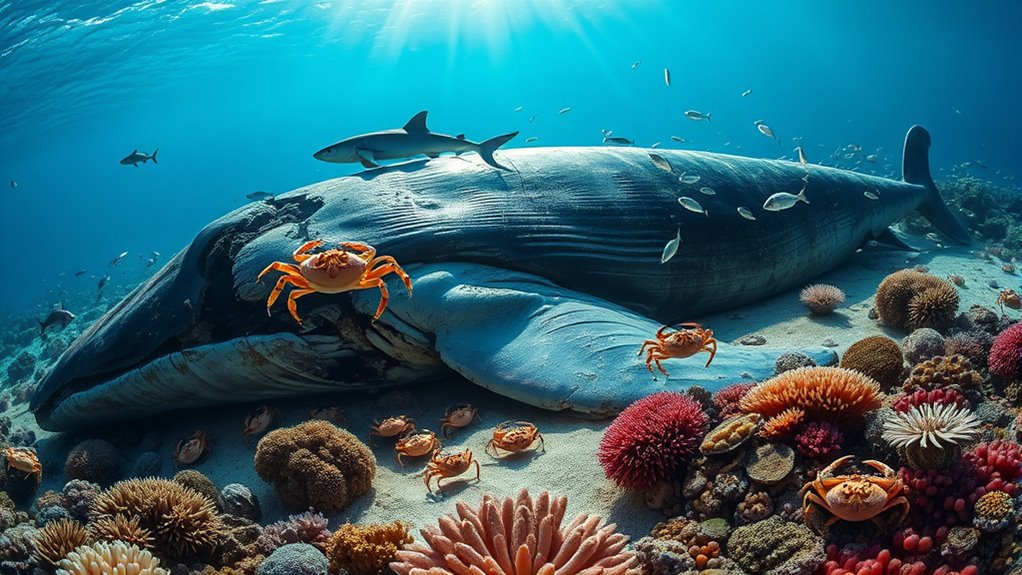
When a whale dies and its carcass sinks to the deep-sea floor, it creates a whale fall—a rare but vital event that supports diverse marine life for decades. You might not realize it, but a whale fall transforms the deep sea into a thriving ecosystem. The whale’s soft tissues and bones become a rich source of nutrients, fueling various marine communities.
Over time, distinct stages unfold: scavengers arrive first, followed by specialized organisms like bone-eating Osedax worms and chemosynthetic bacteria that recycle nutrients. This process sustains unique species and even forms reefs. Since whale falls were discovered, scientists have gained invaluable insights into deep-sea ecology and nutrient cycles, showing how large vertebrate carcasses play a crucial role in ocean life.
First Scavengers That Feed on Whale Carcasses
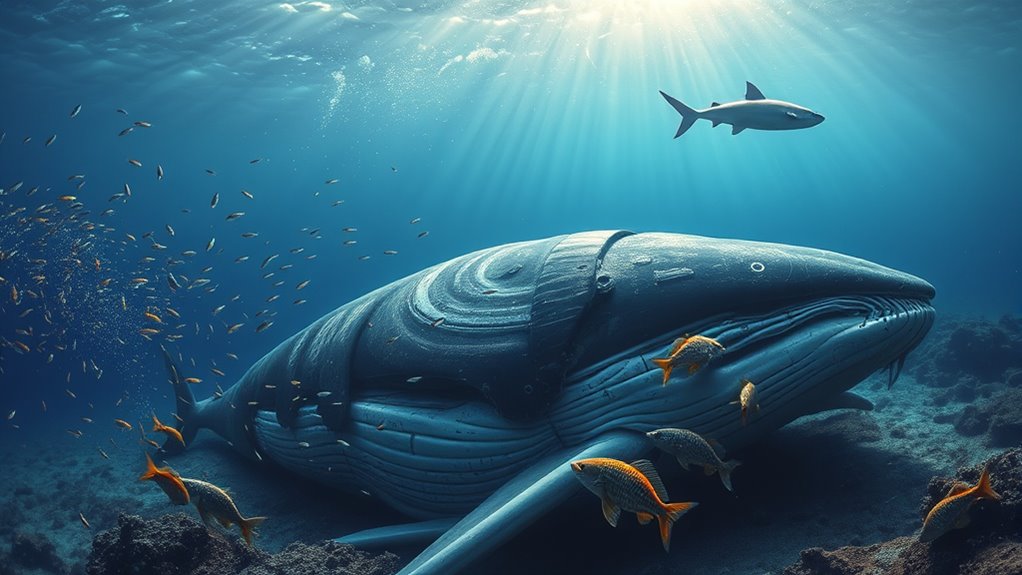
Although a whale carcass quickly sinks to the ocean floor, you might be surprised to learn that scavengers begin feeding even before it settles. Large scavengers like white sharks and tiger sharks actively consume the whale’s soft tissues soon after it sinks. Seabirds such as gulls and albatross often scavenge the floating carcass, feeding on blubber and flesh before the whale reaches the seafloor.
In some regions, marine mammals like orcas join the feast, taking advantage of the easy meal. Once the carcass settles, benthic feeders like certain cod and eelpouts start consuming remaining tissues. Even small invertebrates such as amphipods and crustaceans quickly begin scavenging, kickstarting decomposition.
These first scavengers play a vital role in breaking down whale carcasses and recycling nutrients in the deep ocean.
How Sharks Consume Whale Carcasses
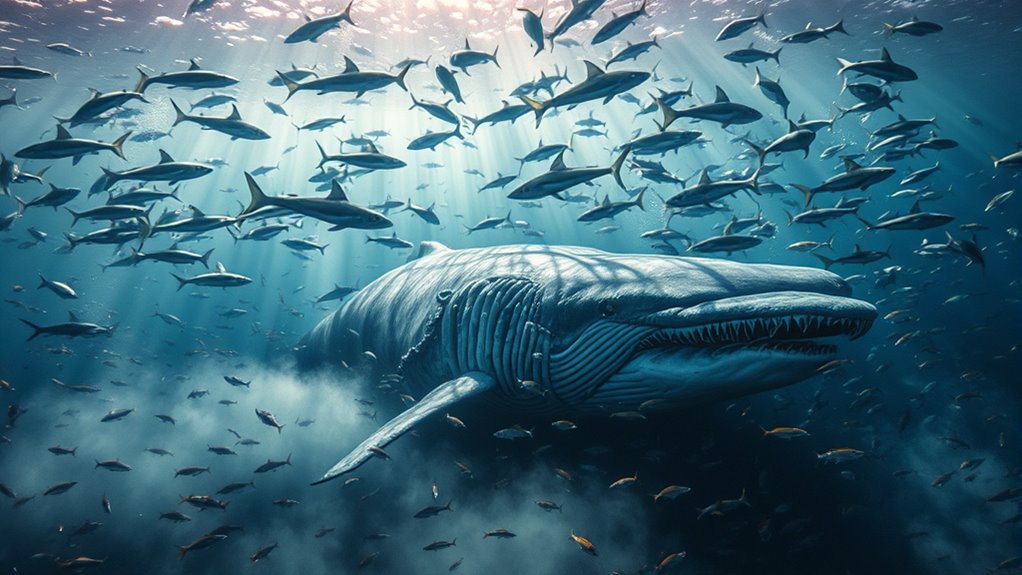
When you watch sharks feed on whale carcasses, you’ll notice their unique scavenging behaviors like test biting and careful tearing to access soft tissues. These actions not only help sharks get their meal but also play a vital role in distributing nutrients throughout deep-sea ecosystems.
Understanding how sharks consume whale remains reveals just how important they are in maintaining ocean health after a whale’s death.
Shark Scavenging Behavior
If you’ve ever wondered how sharks consume massive whale carcasses, observations off the coast of New South Wales, Australia, offer fascinating insights. There, shark scavenging involves species like white and tiger sharks feeding with minimal aggression. You’ll notice behaviors such as test biting, head shaking, and even ocular rotation as sharks explore the carcass.
White sharks, in particular, prefer softer tissues and show increased palatoquadrate protrusion while feeding, avoiding tougher areas like fins or bones. This scavenging behavior is consistent across different whale and shark species, though some variability occurs.
Most of what we know about these shark scavenging habits comes from grey literature, revealing a surprising gap in formal scientific studies. Still, these observations highlight sharks’ vital role in recycling nutrients from whale falls.
Impact On Deep-Sea Ecosystems
How do sharks feeding on whale carcasses influence deep-sea ecosystems? When sharks like white and tiger sharks scavenge whale falls, they kick-start nutrient recycling essential to the Ecology of Whale Falls. By consuming whale remains at both the surface and depth, sharks help break down massive organic matter, making nutrients available to a wide range of deep-sea organisms.
Their specialized scavenging behaviors—test biting, head shaking, and ocular rotation—efficiently strip carcasses with minimal conflict, promoting a balanced decomposition process. This scavenging accelerates the transfer of energy through the food web, supporting diverse communities that rely on whale falls. Although scientific documentation is limited, these interactions highlight sharks’ critical role in sustaining deep-sea ecosystems after a whale dies.
Large Scavengers: Crabs, Hagfish, and Others
Although a whale carcass might seem like a massive and overwhelming feast, large scavengers like crabs, hagfish, and certain fish quickly move in to consume the soft tissues and even burrow into bones. You’ll find king crabs and squat lobsters tearing through flesh and sometimes digging into bones or sediment nearby.
Hagfish, known as slime eels, actively feed on the organic material, even gnawing on bones over time. These large scavengers play a crucial role in breaking down the whale carcass into smaller, manageable pieces. Their feeding not only accelerates decomposition but also recycles nutrients back into the deep-sea ecosystem.
This process sets the stage for other deep-sea organisms to thrive, making the whale fall a hotspot of marine life activity.
Bone-Eating Worms on Whale Falls
You might not realize it, but Osedax worms play a crucial role in breaking down whale bones once larger scavengers have left. These worms use acid and enzymes to bore into the skeleton, relying on symbiotic bacteria to digest the nutrients locked inside.
Osedax Worm Adaptations
When a whale’s body sinks to the ocean floor, Osedax worms spring into action, using their root-like structures to burrow deep into the bones. These worms don’t have a traditional digestive system; instead, they depend on symbiotic bacteria to break down the complex components of whale bones. By secreting enzymes, Osedax worms dissolve the mineral matrix, extracting nutrients directly from the calcified tissue.
Remarkably, they can survive up to 10 years on a single whale bone, slowly eroding it over time.
| Adaptation | Function |
|---|---|
| Root-like structures | Penetrate bones to access nutrients |
| Symbiotic bacteria | Aid in digestion of complex bone components |
| Enzyme secretion | Dissolve mineral matrix in whale bones |
These adaptations make Osedax worms uniquely suited for life on whale falls.
Role in Bone Decomposition
Osedax worms don’t just survive on whale bones—they actively break them down, playing a key role in bone decomposition on the ocean floor. You’ll find these bone-eating worms boring into whale bones using acid secretions, which dissolve the tough calcium matrix. Their root-like structures penetrate deep, releasing enzymes and acids that help break down and absorb nutrients.
Since Osedax lack a traditional digestive system, they rely on symbiotic bacteria to process the bone material, extracting nutrients crucial for survival. By accelerating the decomposition of whale bones, Osedax worms recycle valuable nutrients back into the deep-sea ecosystem. This process supports other marine life and contributes to the overall nutrient cycling, making Osedax an essential part of breaking down whale carcasses in the ocean’s depths.
Microbes Breaking Down Whale Bones
Although whale bones might seem inert, they host a bustling community of microbes that break down organic material through complex chemical processes. You’ll find microbial communities like sulfate-reducing bacteria and methanogenic archaea colonizing the bones, decomposing organic matter and releasing nutrients back into the deep sea.
Chemoautotrophic and chemosynthetic organisms, such as sulfur-oxidizing bacteria, thrive on inorganic chemicals released from the bones, producing energy that fuels these unique ecosystems. These microbes play a crucial role in recycling carbon and sustaining deep-sea life for decades.
Bone-eating worms like Osedax assist by boring into bones and secreting enzymes that dissolve minerals, making the organic components more accessible to microbes. Together, these processes transform whale bones into a hotspot of microbial activity and nutrient cycling.
Chemosynthetic Animals Living off Whale Fall Chemicals
Because whale falls release chemicals like hydrogen sulfide, they create unique habitats where chemoautotrophic bacteria thrive by deriving energy from these substances. These bacteria form the foundation of chemosynthetic communities that include mussels, clams, and tube worms. Unlike most ecosystems relying on sunlight, these animals depend on bacteria that oxidize sulfur compounds from decomposing whale bones.
This process transforms inorganic chemicals into usable energy, supporting diverse invertebrates living off whale fall organic matter. Many of these animals host symbiotic bacteria, which enables them to survive in the deep sea’s nutrient-poor, dark environment. By relying on chemosynthesis rather than photosynthesis, these remarkable communities turn whale falls into hotspots of life.
They sustain organisms that wouldn’t exist without the chemical bounty released during whale decomposition.
How Whale Falls Support Deep-Sea Ecosystems Over Decades
The unique chemical environment created by whale falls doesn’t just support bacteria and specialized worms in the short term—it sustains a complex deep-sea ecosystem for decades. When a whale fall occurs, it triggers a long-lasting nutrient supply that fuels deep-sea life.
Whale falls create lasting nutrient-rich habitats that sustain deep-sea ecosystems for decades.
You can observe this support through three key stages:
- Scavenging: Large predators feast on soft tissues within months.
- Opportunistic colonization: Smaller organisms and bacteria break down remaining tissues.
- Chemosynthetic phase: Specialized bacteria convert bone chemicals into nutrients, sustaining worms like Osedax and other lifeforms for up to 100 years.
This extended succession enriches the deep-sea ecosystem, creating habitats in oxygen-poor environments and boosting biodiversity. Whale falls are essential hotspots that maintain deep-ocean life over decades, far beyond initial decomposition.
Scientific Insights From Whale Decomposition Studies
When you study whale decomposition, you uncover a fascinating sequence of events that supports diverse deep-sea communities. A whale fall triggers stages beginning with large scavengers like sharks and hagfish consuming soft tissues. Then, bone colonization kicks in, as specialized organisms such as Osedax worms bore into the bones using enzymes and root-like structures.
Microbial communities, including sulfur-oxidizing bacteria and sulfate-reducing archaea, rapidly colonize the carcass, driving chemical processes critical to decomposition. Scientific studies reveal how these processes recycle skeletal material and contribute markedly to deep-sea carbon cycling. In fact, a single whale fall can provide about two tonnes of carbon, nourishing ecosystems for up to 200 years.
This research highlights whale falls as essential, long-lasting habitats in the deep ocean.
Frequently Asked Questions
What Animals Eat Dead Whales?
You’ll find sharks, crabs, and large fish feasting on dead whales first. Then bone-eating worms, seabirds, and deep-sea invertebrates join in, breaking down tissues and recycling nutrients in the ocean’s complex ecosystem.
What Happens to a Whale After It Dies?
You know what they say, “One man’s trash is another man’s treasure.”
When a whale dies, you’ll see its body sink, feeding deep-sea creatures, fueling ecosystems, and slowly recycling nutrients for decades on the ocean floor.
Should Humans Remove Barnacles From Whales?
You shouldn’t remove barnacles from whales unless necessary for health checks. Doing so can injure their skin and cause stress.
Whales naturally tolerate barnacles, and they usually shed them during migration or exfoliation.
Will Sharks Eat a Dead Whale?
You bet sharks won’t pass up a free feast; they swarm like a hungry crowd at a buffet, nibbling on whale carcasses with test bites and shaking heads.
They play a vital role in ocean cleanup.
Conclusion
Imagine a whale fall as an underwater banquet that feeds an entire city. Just like a feast where guests arrive in waves, first come sharks and crabs, then bone-eating worms and microbes, each playing their part.
Over decades, this massive meal sustains deep-sea life, showing how nature recycles even the largest creatures. So, when a whale dies, it’s not an end but the start of a vibrant, lasting ecosystem beneath the waves.
This whale fall creates a unique habitat where scavengers and decomposers thrive. It highlights the incredible process of nutrient recycling in the ocean, proving that even after death, whales continue to support marine life.