How Smart Is a Beluga Whale?
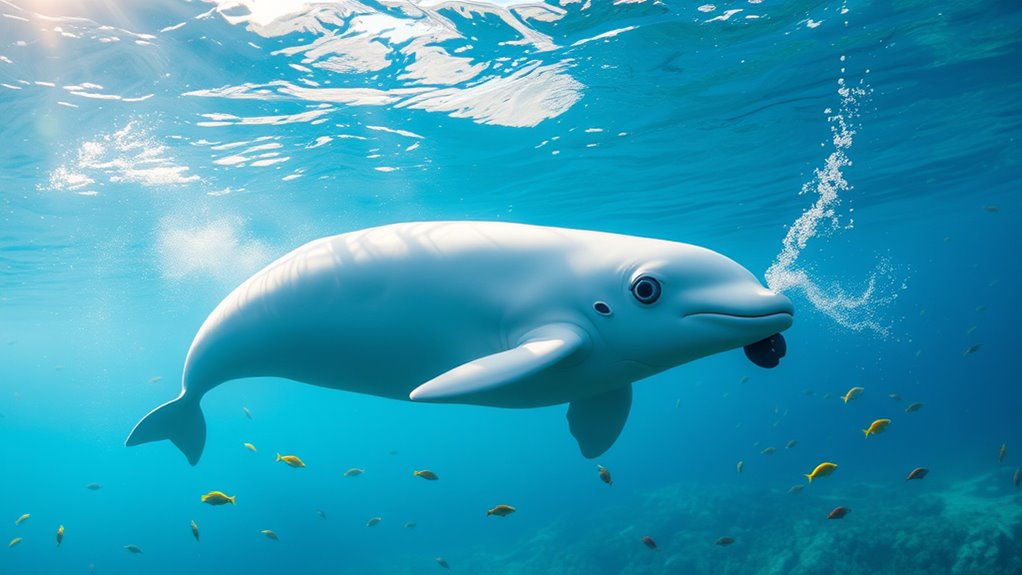
You’d be impressed by how smart a beluga whale is. Beluga intelligence is remarkable, with their brains nearly twice the size of humans’ relative to body size, fueling complex social skills and problem-solving.
Belugas communicate with a rich variety of sounds and even mimic noises around them. They use tools and cooperate to hunt, showing adaptability and teamwork.
Their intelligence shapes crucial social bonds and survival strategies. Stick around, and you’ll discover even more fascinating insights about their remarkable minds.
Key Traits That Reveal Beluga Intelligence
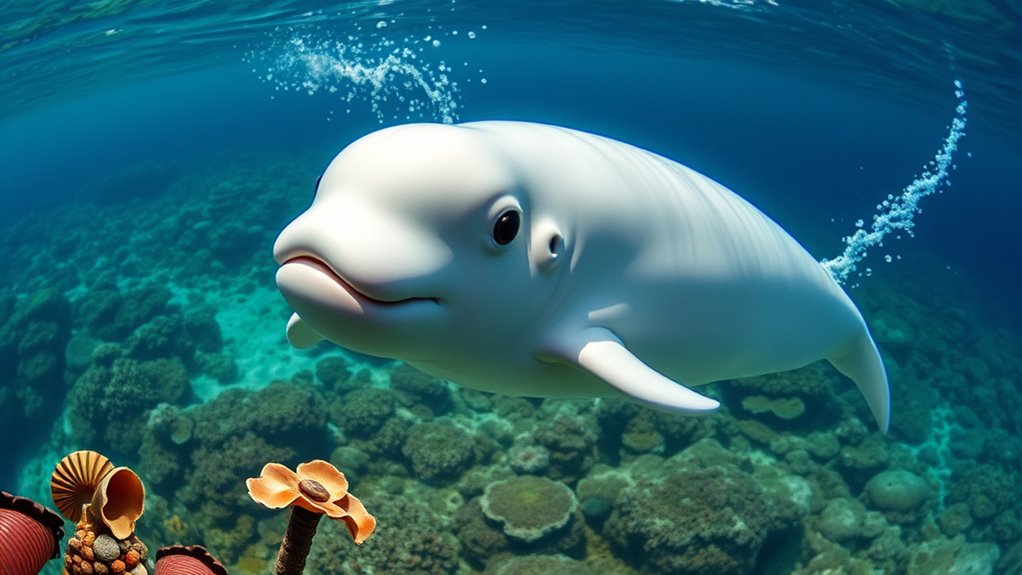
Although you might not expect it, beluga whales show remarkable intelligence through several key traits. One of the most impressive is their vocal learning ability. You’ll find that belugas can mimic human speech and various sounds, which is a rare skill in the animal kingdom.
This ability highlights their advanced communication and social skills. Another important factor is their brain size. Belugas have large, highly folded brains relative to their body size, comparable to other intelligent marine mammals.
This brain structure supports their problem-solving skills and cooperative behaviors you’d observe within their social groups. Together, these traits reveal just how cognitively complex belugas are, far beyond what you might assume at first glance.
What’s Special About the Beluga Brain?
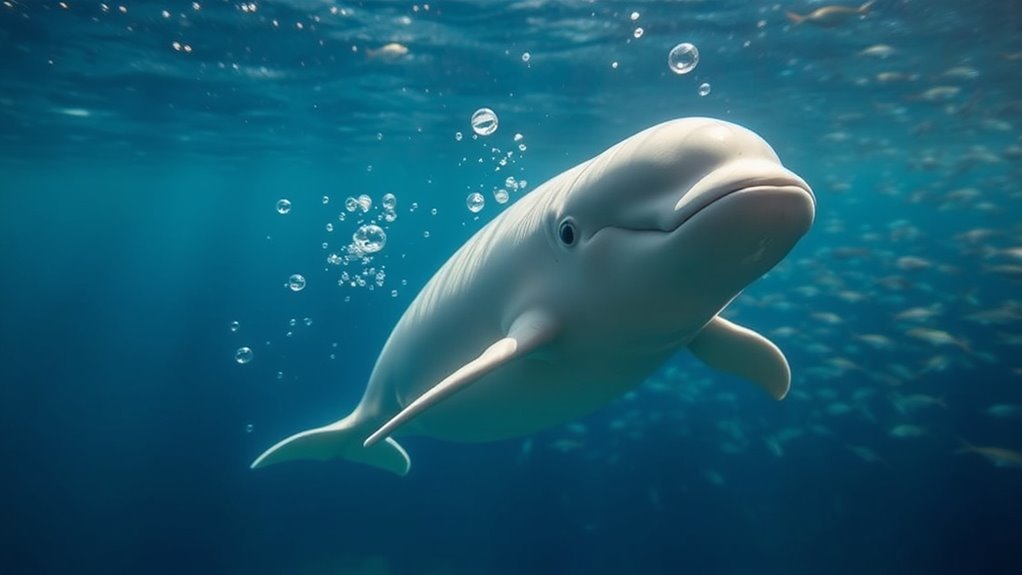
When you examine the beluga brain, you quickly see what sets it apart: its size and intricate structure support remarkable cognitive and social abilities. Beluga whales boast brains nearly twice the size of human brains relative to their body, highlighting their advanced processing power. Their highly folded neocortex reflects complex organization, enabling sophisticated problem-solving and social behaviors.
You’ll also notice specialized auditory regions that let belugas produce and interpret a wide range of sounds, including mimicry. Unique features like the melon, essential for echolocation, and expressive facial muscles further enhance their social interactions. This complex brain design equips beluga whales with extraordinary intelligence, allowing them to navigate and thrive in challenging environments with remarkable adaptability.
What Communication Skills Show Beluga Intelligence?
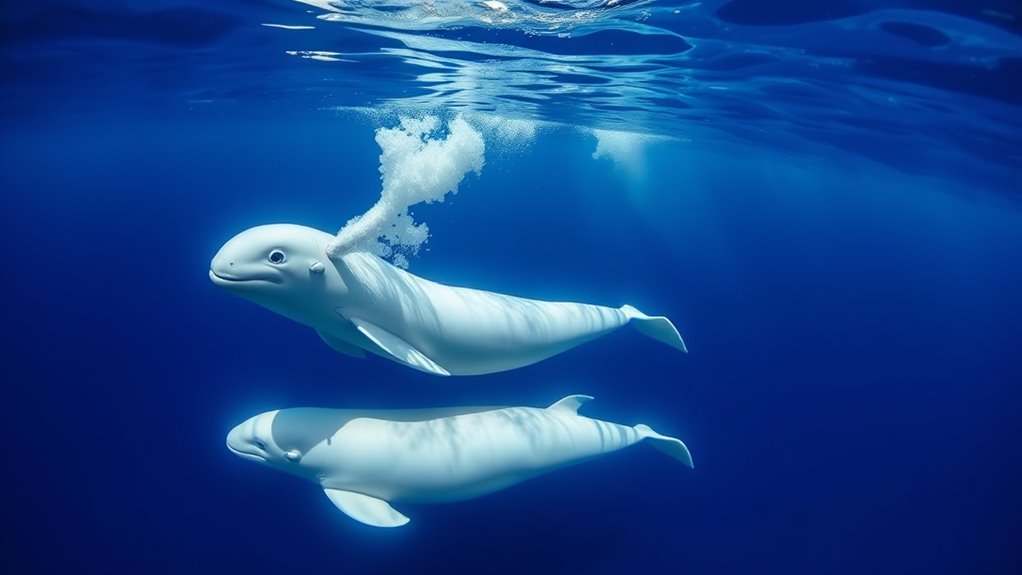
You’ll be amazed by how beluga whales communicate using a wide range of sounds, from whistles to squeals. They can even mimic human speech, showing impressive vocal learning skills. Their complex calls help them coordinate with others and express emotions, proving their intelligence through communication.
Vocal Diversity And Range
Because beluga whales produce an impressive variety of vocalizations—from whistles and squeals to chirps and clicks—they showcase a remarkable vocal range that highlights their intelligence. Their complex social interactions rely heavily on this diverse acoustic repertoire, allowing them to communicate effectively within pods.
You can appreciate how these sounds serve multiple purposes, from social bonding to navigation and echolocation.
| Vocalization Type | Purpose |
|---|---|
| Whistles | Social communication |
| Clicks | Echolocation |
| Chirps & Squeals | Emotional expression |
This vocal diversity reflects their advanced cognitive skills and flexibility in communication, revealing just how smart belugas really are.
Mimicry Of Human Speech
Beluga whales don’t just produce a variety of natural sounds—they can also mimic human speech, showing impressive vocal learning abilities. When you hear a beluga mimic human speech, like saying “Out,” you witness a complex cognitive skill that goes beyond instinct. Their ability to imitate human sounds requires deliberate effort and motivation, highlighting advanced auditory processing.
You’ll notice belugas produce whistles, squeals, and chirps, then modify these sounds to resemble human speech patterns. This flexible communication ability reveals their sophisticated understanding of sound and social cues. By recognizing and attempting to replicate human speech, belugas demonstrate a high level of social cognition, proving their communication skills are far more complex than you might expect.
Social Use Of Sounds
How do these whales use their wide range of sounds to navigate social life? Belugas rely on vocalizations for complex communication that strengthens their social bonds. You’ll find they produce whistles, squeals, and chirps to coordinate group movements and send alert signals.
Their ability to change sounds based on context shows they understand different social and environmental situations, highlighting their intelligence. Belugas even mimic human speech sounds, proving advanced vocal learning. When you listen to their communication, you realize it’s a sophisticated system, reflecting their cognitive depth.
- Imagine hearing a beluga warning its pod of danger through urgent calls.
- Picture a mother soothing her calf with gentle chirps.
- Feel the connection as belugas coordinate playful group activities using varied vocalizations.
Wild Problem-Solving Strategies of Belugas
When you observe these whales in the wild, you’ll notice they use clever problem-solving strategies to thrive. Belugas, as intelligent marine mammals, show impressive adaptability. For instance, they use tools like sponges to protect their noses while foraging on the ocean floor.
They also cooperate to herd fish into tight groups, making hunting more efficient. If their usual routes are blocked, belugas navigate around obstacles by finding alternative paths. During migrations, they choose safer routes to avoid predators and harsh conditions.
These behaviors highlight their ability to tackle challenges creatively and work together. By adapting vocalizations and strategies, belugas prove just how skilled they are at solving problems in their dynamic ocean environment.
Social Behaviors Demonstrating Beluga Intelligence
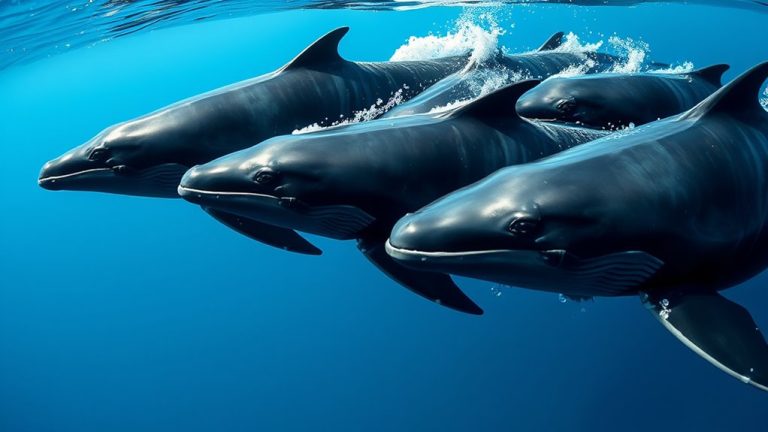
Although you might not immediately notice, the social lives of these whales reveal remarkable intelligence. Beluga whales showcase sophisticated social behaviors and communication that keep their pods—sometimes over a thousand strong—tightly connected. You’d be amazed at how they use whistles, chirps, and squeals to coordinate and bond.
They even mimic sounds from their environment and human speech, showing advanced auditory skills and social interaction. Their expressive faces and head movements help convey emotions, deepening their social bonds.
- Imagine a pod working together, sharing emotions through nuanced facial expressions.
- Picture hearing a beluga mimic a human voice—proof of their learning ability.
- Feel the warmth of strong friendships holding a community tight beneath Arctic waters.
Why Beluga Intelligence Matters for Conservation
You need to understand that a beluga’s cognitive complexity demands strong protection efforts. Their social intelligence shows why preserving their natural environments is vital for their survival.
Recognizing their mental abilities also raises important ethical questions about how we treat these remarkable creatures.
Cognitive Complexity And Protection
Because beluga whales exhibit remarkable cognitive abilities like vocal mimicry and problem-solving, you can appreciate why their intelligence demands serious conservation efforts. Their large, complex brains rival those of humans, highlighting the depth of their mental richness. Protecting these whales isn’t just about saving a species; it’s about preserving beings with sophisticated minds and emotional lives.
When you consider this, the urgency of safeguarding their habitats and preventing exploitation becomes clear.
- Imagine losing a creature capable of complex thought and emotion.
- Think about the silent suffering caused by captivity and habitat loss.
- Picture a world where these intelligent beings thrive, free and safe.
Social Intelligence And Conservation
How do beluga whales use their social intelligence to thrive in the wild? They form large pods with strong bonds and coordinated activities, relying on advanced communication skills like mimicking sounds and using facial expressions. This social intelligence helps them navigate complex environments, find food, and protect each other.
Understanding these behaviors is essential for conservation because belugas depend on social environments to maintain their natural lifestyles. When you recognize their cognitive abilities, you see why protecting their habitats from pollution and climate change matters even more.
Conservation efforts that support social structures help guarantee belugas can continue their intricate social interactions, which are indispensable for their survival and well-being in the wild. Your awareness can drive better protection policies rooted in their social intelligence.
Ethical Implications For Preservation
While beluga whales captivate us with their remarkable intelligence and complex social lives, this awareness calls for a deeper ethical commitment to their preservation. You realize that these marine mammals aren’t just animals; they’re sentient beings with emotions and advanced cognition. Protecting whales means respecting their natural behaviors and social bonds, not exploiting them for entertainment or research.
When you consider their ability to mimic human speech and solve problems, it becomes clear that captivity undermines their well-being and dignity. To honor their intelligence, you must support conservation efforts that safeguard their habitats and promote sanctuary initiatives.
- Imagine the loneliness a captive beluga feels, separated from its pod
- Picture the fragile marine ecosystem collapsing without these key creatures
- Feel the urgency to protect whales as intelligent, emotional beings deserving respect
Frequently Asked Questions
What Is the IQ of a Beluga Whale?
You can’t assign an exact IQ to a beluga whale since no formal test exists, but you can recognize their impressive intelligence through their problem-solving skills, social behaviors, and vocal abilities, which rival some primates’ cognitive levels.
Which Whale Is the Most Intelligent?
You’ll find orcas are the smartest whales, thanks to their large brains, complex social skills, and advanced hunting tactics. They communicate uniquely, learn quickly, and adapt well, showing intelligence that outshines other whale species.
What Is the #1 Smartest Animal IQ?
You’ll find the African elephant is considered the smartest animal, boasting an IQ comparable to primates. Their problem-solving skills, memory, and complex social behaviors put them at the top of animal intelligence rankings worldwide.
Are Beluga Whales Emotionally Intelligent?
Imagine a beluga comforting a distressed pod member—that shows they’re emotionally intelligent.
You can see their empathy in social play and vocalizations, proving they understand and respond deeply to others’ feelings and needs.
Conclusion
When you imagine a beluga whale steering icy waters, solving puzzles with its pod, and chatting through complex sounds, you see intelligence in action. It’s not just a cute face; their brains and social skills prove they’re clever survivors.
Belugas aren’t just smart—they’re vital storytellers of the ocean’s health.
So, next time you think about these “canaries of the sea,” remember how their wit keeps the underwater world thriving, inspiring us to protect them fiercely. Their intelligence and social complexity highlight the importance of conservation efforts for these remarkable creatures.