How Long Can a Whale Live?
You can expect whales to live anywhere from around 45 years up to over 200 years, depending on the species. Understanding whale lifespan is fascinating because it varies widely among different types.
For example, humpback whales live about 45-50 years, while bowhead whales can surpass two centuries thanks to unique genetics and cold Arctic habitats.
Some whales face threats like ship strikes and pollution that shorten their lives. Additionally, captive whales often live less than those in the wild.
Keep exploring to discover how scientists uncover whale ages and what helps them live so long.
How Long Do Different Whale Species Live?
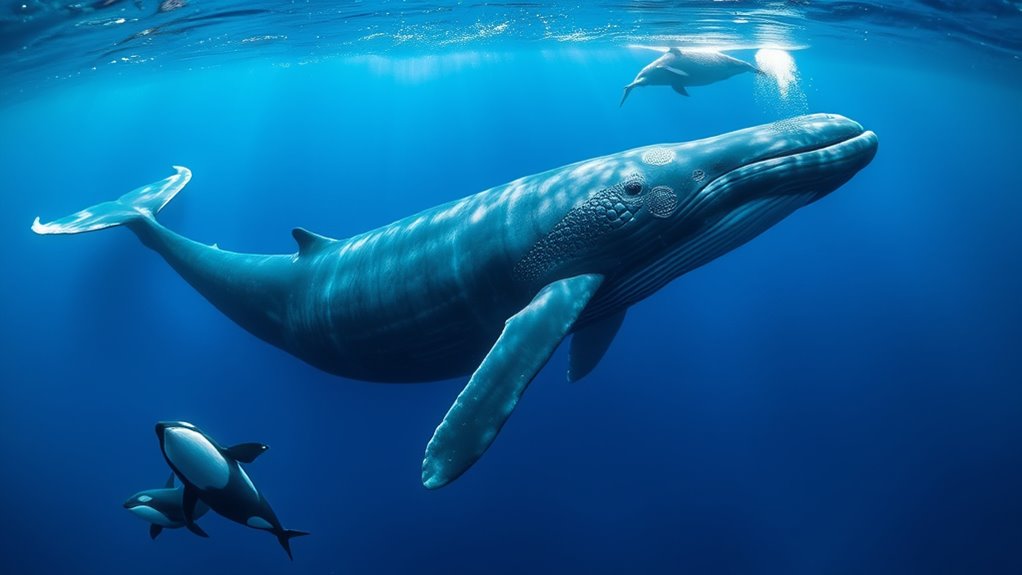
How long do whales live, and does their lifespan vary by species? Yes, it does. The blue whale’s lifespan typically ranges between 70 and 90 years, though some can live past 100. Gray whales usually live 55 to 70 years, with a few reaching over 80.
Bowhead whales hold the record as the oldest known whale species, with some individuals living beyond 200 years. Other whale species like humpbacks live around 45 to 50 years, while sperm whales can reach 60 to 70 years depending on their environment.
Why Baleen Whales Have Longer Lifespans Than Toothed Whales
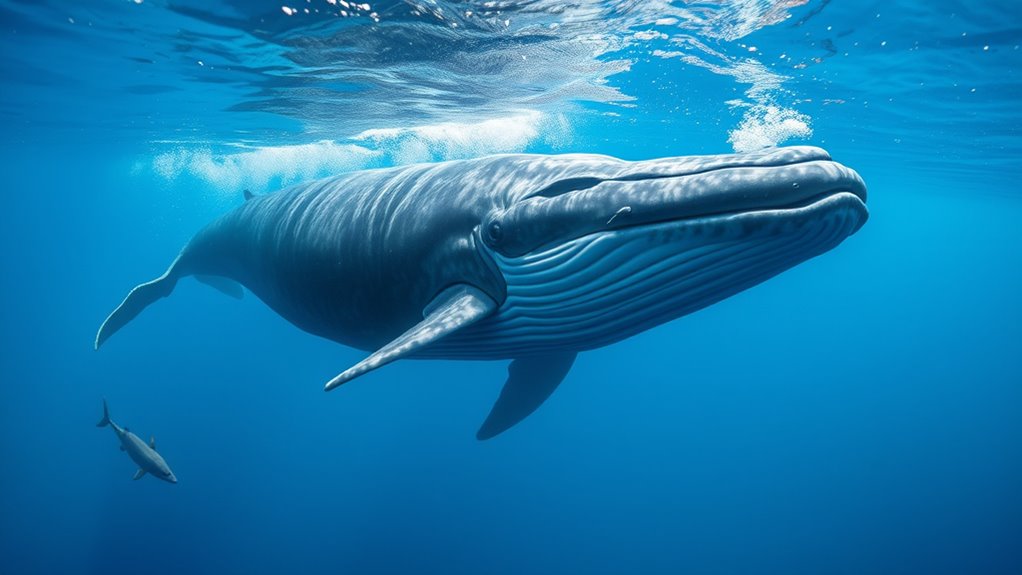
You’ll find that baleen whales live longer partly because their genes help them repair DNA damage more effectively, which slows aging and reduces disease. Their slower growth and colder habitats also protect them from environmental stress.
Let’s explore how these genetic and environmental factors combine to give baleen whales an edge in longevity.
Genetic Longevity Factors
Because baleen whales have specific genetic mutations that boost their DNA repair mechanisms, they enjoy longer lifespans than toothed whales. Their genetic adaptations actively reduce cellular damage, supporting longevity. You’ll find that baleen whales’ DNA repair is more efficient, helping prevent diseases like cancer and enabling them to thrive in harsh Arctic environments.
This contrasts with toothed whales, whose genetic makeup leads to shorter lifespans. Here’s what sets baleen whales apart:
- Enhanced DNA repair genes minimize cellular damage over time
- Genetic traits support slow growth and long lifespan
- Adaptations reduce cancer risk by maintaining cellular health
- Genetic longevity factors suit their cold, challenging habitats
Understanding these factors helps you appreciate why baleen whales live so long compared to their toothed cousins.
DNA Repair Mechanisms
Although both baleen and toothed whales share many biological traits, baleen whales stand out due to their superior DNA repair mechanisms. You’ll find that baleen whales possess unique genetic mutations enhancing their ability to repair DNA damage quickly and efficiently. This advanced DNA repair helps prevent the accumulation of genetic mutations, which often lead to cancer and aging-related decline.
Environmental Influences
How do environmental factors shape the lifespan differences between baleen and toothed whales? Baleen whales benefit from habitats with fewer predators and less human disturbance, often in Arctic regions. Their environment supports longer lives by reducing stress and exposure to threats.
You’ll notice these key influences:
- Stable, colder habitats help baleen whales avoid environmental stresses.
- Their migratory patterns minimize the impact of climate change.
- Reduced human activities in remote areas offer better conservation conditions.
- Efficient feeding methods in rich habitats support health and longevity.
Understanding how habitat, climate change, human activities, and conservation efforts interplay helps explain why baleen whales generally outlive toothed whales. These environmental factors create conditions that favor longer lifespans, promoting resilience and survival in baleen whale populations.
Key Environmental and Human Threats to Whale Lifespan
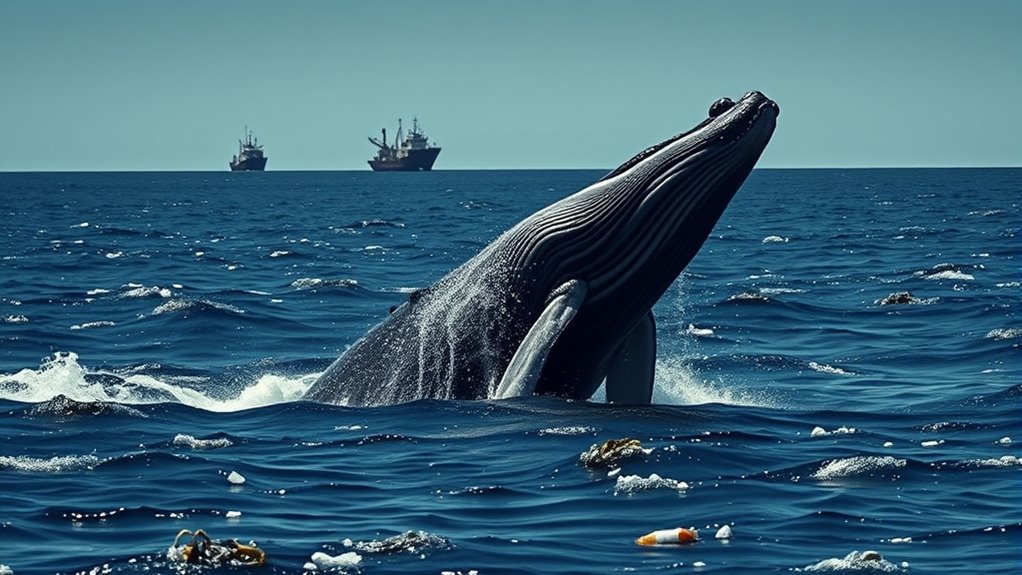
When you consider the challenges whales face today, human activities and environmental changes stand out as key threats that shorten their lifespan. Ship strikes from heavy shipping traffic cause severe injuries or death, drastically lowering whale populations. Pollution, including chemical contaminants and plastic debris, harms their health and raises mortality rates.
Entanglement in fishing gear traps whales, leading to injury, drowning, or prolonged suffering, all of which reduce their longevity. Climate change disrupts whale habitats and the availability of prey, causing malnutrition and stress that weaken their ability to survive and reproduce. These combined factors intensify diseases and parasites, further increasing mortality.
Understanding these threats helps you appreciate the urgent need for conservation efforts to protect whales and ensure they can live to their full natural lifespan.
Why Whales Live Shorter Lives in Captivity
Since whales in captivity face stress from confinement and lack of natural social groups, they typically live only 25 to 35 years—much shorter than their wild counterparts who can exceed 90 years. Captive whales suffer a significant lifespan reduction due to environmental deprivation and stress that disrupts their natural behaviors.
Whales in captivity live just 25 to 35 years, far shorter than wild whales exceeding 90 years.
When you consider their situation, it’s clear why their health declines faster:
- Limited space restricts swimming and social interaction
- Lack of complex stimuli hinders mental and physical well-being
- Absence of natural foraging reduces physical activity
- Emotional distress weakens immune responses
These factors combine to shorten the lives of captive whales dramatically. You can see how captivity strips away the essential elements whales need to thrive, cutting their lifespan by up to 60% compared to life in the wild.
How Scientists Estimate Whale Age
To estimate a whale’s age, you can use photo identification techniques that track unique markings like fluke patterns over time. Molecular aging methods, such as genetic analysis, also provide accurate age estimates by examining cellular changes.
Combining these approaches helps scientists understand whale lifespans without intrusive methods.
Photo Identification Techniques
How do scientists estimate a whale’s age without disturbing it? They use photo identification techniques to track individual whales over time. By capturing images of unique features like fluke patterns and scars, researchers can monitor changes that hint at age or growth stages.
This non-invasive method supports long-term monitoring of whale populations while minimizing stress on the animals. Here’s how it works:
- Photographs capture distinctive fluke patterns and scars unique to each whale
- Researchers compare images taken at different times to track physical changes
- Regular surveys help build detailed life histories of individual whales
- Monitoring these identifiers enables estimation of lifespan and age-related events
This approach lets you understand whale aging through careful observation without ever touching the animal.
Molecular Ageing Methods
Although you can estimate a whale’s age by observing physical features, molecular aging methods offer a more precise approach by analyzing DNA methylation patterns. Scientists use molecular aging to study whale blubber and other tissues, identifying markers that change as whales grow older. Epigenetic clocks, which rely on these chemical DNA modifications, have shown great promise for accurate, non-invasive age estimation.
Since each whale species has unique fatty acid composition and genetics, researchers develop species-specific models to improve reliability. Ongoing work focuses on standardizing these molecular techniques, making it easier to assess whale lifespan accurately without harm. By using these advanced molecular tools, you gain a clearer picture of how long whales live and better understand their biology.
How Scientists Determine Whale Age From Dead Specimens
When you examine a dead whale, one of the most reliable ways to determine its age is by studying its earwax, known as earplugs. These earplugs accumulate growth layers much like tree rings, each representing about six months of life. By sectioning and examining them under a microscope, you can count these layers for accurate age estimation.
Earwax also holds clues about the whale’s life span, revealing stress events and environmental exposures. Here’s how this method works:
- Earwax or earplugs form continuous layers over time
- Scientists count growth layers to estimate age precisely
- Chemical analysis of earplugs uncovers life history details
- Growth equations help estimate age from physical measurements
This non-invasive method lets you study whale age even after death effectively.
New Genetic Tools to Estimate Whale Age
Since traditional methods of estimating whale age can be invasive or limited to deceased specimens, new genetic tools are transforming the field by analyzing DNA methylation patterns. By using molecular markers found in whale blubber samples, researchers apply epigenetic aging techniques to estimate whale age more precisely and less invasively.
These methods, adapted from studies on other mammals, help build reliable age prediction models essential for effective conservation strategies and population management.
| Aspect | Details |
|---|---|
| Technique | DNA methylation analysis |
| Sample Type | Whale blubber |
| Benefits | Non-invasive, precise age estimation |
| Application | Conservation strategies and population data |
Who Are the Oldest Known Whales?
What makes Bowhead whales stand out among their kind is their incredible lifespan, with some living over 200 years. As the oldest whales known, their longevity fascinates scientists and enthusiasts alike. You’ll find their Arctic habitat plays a key role, providing a cold environment that slows aging.
Their unique genetic makeup includes mutations enhancing DNA repair, helping them avoid age-related damage. Here’s what defines these remarkable creatures:
- Some Bowhead whales have harpoon tips found embedded in their tissues, confirming ages over two centuries.
- They grow slowly, contributing to their extended lifespan.
- No other whale species matches their documented longevity.
- Their longevity is linked closely to adaptations for survival in the Arctic habitat.
Understanding Bowhead whales reveals much about nature’s limits on aging.
Conservation Strategies to Extend Whale Lifespans
Protecting whale populations requires more than admiration; it demands concrete conservation strategies that actively extend their lifespans. You can support the creation of marine protected areas, which safeguard essential habitats and reduce human threats. Following vessel speed restrictions and navigation protocols helps prevent deadly ship strikes, directly benefiting whale survival.
You should also advocate for reducing ocean pollution, as chemical contaminants increase health risks and stress for whales. When observing whales, practicing responsible whale watching minimizes disturbances, allowing them to thrive. Finally, backing conservation programs and ongoing research helps develop targeted strategies to improve whale longevity and overall population health.
Frequently Asked Questions
Can Whales Live up to 200 Years?
Yes, some whales, like bowhead whales, can live up to 200 years or more. They’ve evolved unique DNA repair mechanisms helping you understand their impressive longevity compared to other whale species, which usually live shorter lives.
Can Whales Live for 500 Years?
You won’t find a whale as ancient as Methuselah; no whale lives 500 years. Their lifespans, though impressive like ocean giants, max out around 200 years.
Science hasn’t uncovered any such centuries-long sea stories.
What Animal Can Live up to 1000 Years?
You can find animals like the Greenland shark that might live up to 1000 years. Their slow growth, cold Arctic habitat, and unique genetics help them reach such incredible ages, far surpassing most other vertebrates.
How Old Is the Oldest Whale Ever?
The oldest whale ever recorded is a bowhead whale estimated to be over 211 years old. You can find this incredible age through growth rings in their earplugs and genetic evidence showing their amazing longevity.
Conclusion
Now that you know whales can live from decades to over two centuries, you see why protecting them matters. Take the bowhead whale, for example—it can live over 200 years, making it a true ocean elder.
By supporting conservation efforts and reducing threats like pollution and ship strikes, you help guarantee these majestic creatures thrive longer. Every action counts in giving whales the chance to live their full, incredible lives. Protecting whales ensures their longevity and the health of our oceans.