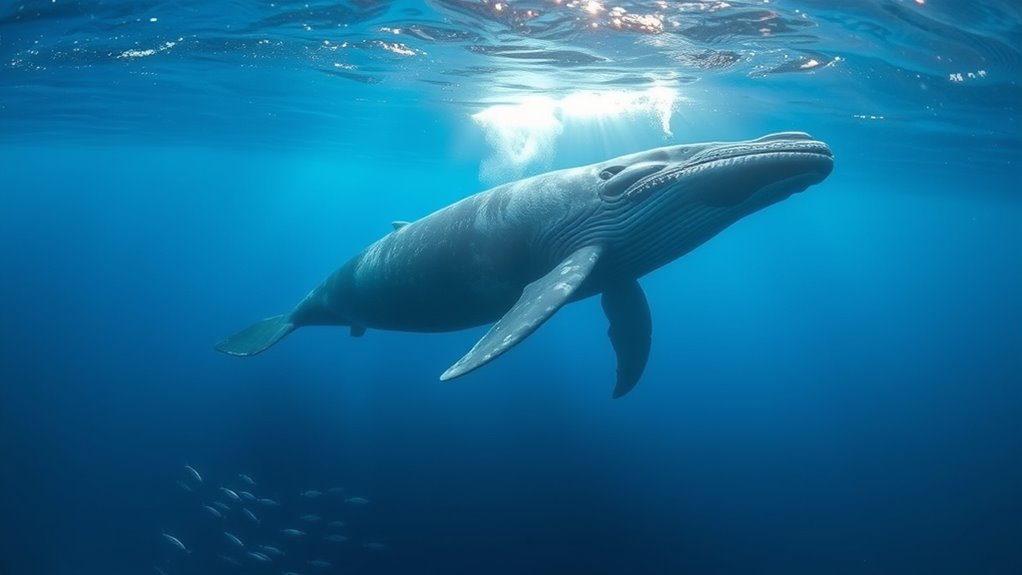
What Determines How Long Whales Hold Their Breath?
You can hold your breath until your oxygen runs low, and whales are built to extend that time way beyond yours. What determines how long whales hold their breath? Their blood has extra hemoglobin, muscles have stored oxygen, and their heart slows to save energy.
They also redirect blood flow to crucial organs and have lungs that quickly exchange gases at the surface. Different whale species vary, and risks like diving deep or getting too cold can limit their time underwater.
Keep going to discover how these amazing adaptations work together.
How Long Can Whales Hold Their Breath?
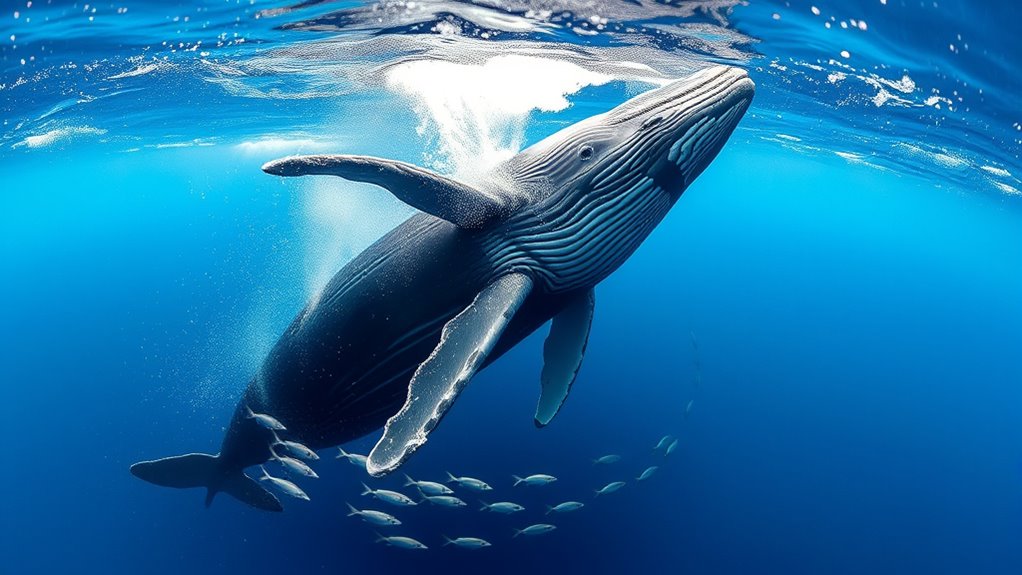
Although different whale species vary, you might be surprised to learn that some whales can hold their breath for over three hours. This incredible diving duration depends largely on how whales manage their oxygen stores. When you dive deep, your body uses oxygen stored in your blood and muscles, but whales have adapted to maximize this process.
They slow their heart rate dramatically, reducing oxygen consumption and allowing their blood to deliver oxygen more efficiently to essential organs. Different species vary: sperm whales often hold their breath for 60 to 90 minutes, while Cuviers beaked whales can surpass 200 minutes. Throughout their dives, whales carefully balance oxygen use and conservation.
Whales surface multiple times when necessary to replenish their oxygen stores before the next long submersion.
How Do Whales Store and Use Oxygen During Breath-Holding?
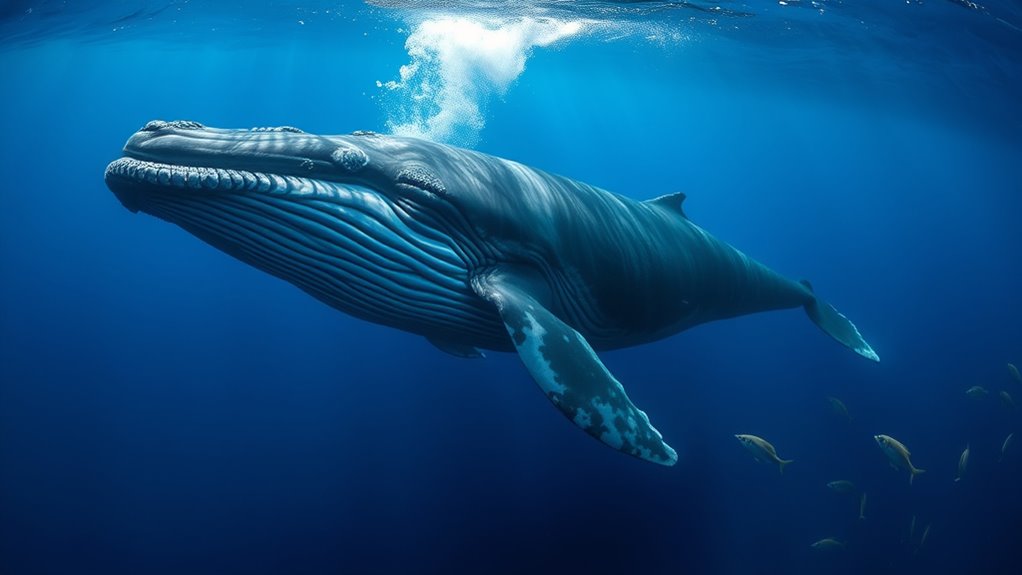
When whales dive, they rely on specialized adaptations to store and use oxygen efficiently, allowing them to stay underwater for extended periods. Their oxygen storage primarily happens in the blood, where hemoglobin concentrations are about twice that of humans. This means their blood can carry much more oxygen.
Additionally, their muscles contain high levels of myoglobin, which holds oxygen directly in muscle tissue for use during long dives. Whales also have a large blood volume—up to 20% of their body weight—providing a substantial oxygen reserve.
During breath-holding, they slow their heart rate through bradycardia, conserving oxygen by reducing blood flow to non-essential organs. These combined adaptations maximize oxygen use, letting whales dive deep and stay submerged far longer than you or I ever could.
How Exactly Do Whales and Dolphins Breathe Underwater?
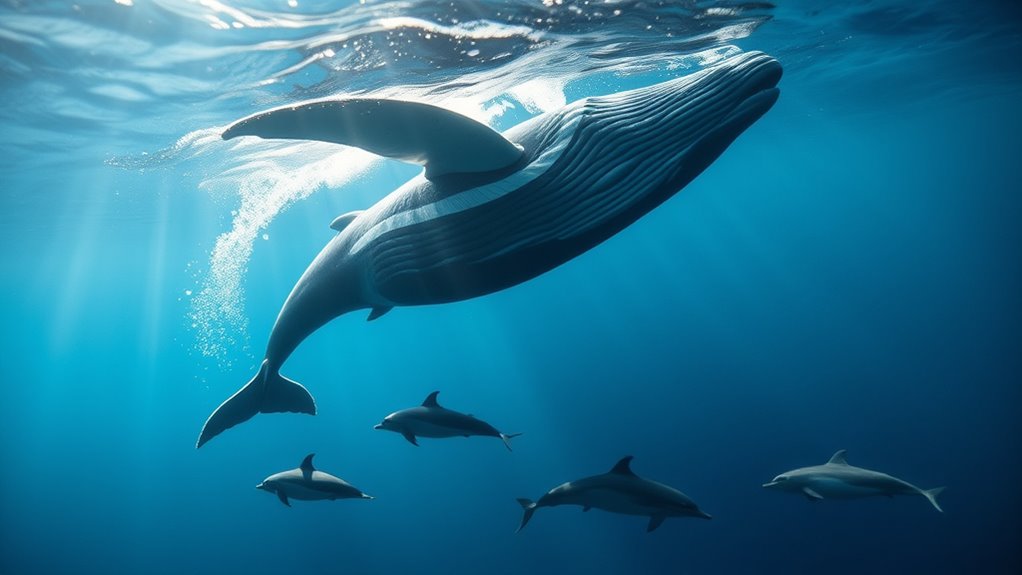
You’ll notice whales and dolphins breathe through blowholes on top of their heads, which seal tightly to keep water out. They exhale forcefully, then quickly inhale fresh air, making their breath timing incredibly efficient.
Let’s explore how their blowhole structure and lung function work together for this precise air exchange.
Blowhole Structure And Function
Since whales and dolphins spend most of their time underwater, they’ve evolved blowholes—specialized nostrils on top of their heads—that let them breathe efficiently at the surface. These blowholes are sealed tightly by muscular flaps when the animals dive, preventing water from entering their respiratory system. The muscular flaps and surrounding cartilage work together to create a watertight seal, vital for conserving oxygen during long dives.
When they surface, whales exhale forcefully through the blowhole, producing a visible spout, then quickly inhale to refill their lungs. This efficient respiration system allows them to spend extended periods underwater without needing to breathe frequently. Because the blowhole sits atop their heads, they can breathe with minimal effort and time at the surface, optimizing their diving capabilities.
Breath Timing And Sequence
How do whales and dolphins manage to breathe so efficiently while spending most of their time underwater? They use precise breath timing and respiratory control during their diving sequence. When they surface, they exhale forcefully through their blowholes, clearing water before quickly inhaling to fill their lungs.
This rapid breath timing lets them maximize oxygen stores in just a fraction of a second. Once underwater, they hold their breath, sometimes for over an hour, by carefully managing these oxygen stores. The length of breath holds varies by species and activity, with timing adjusted to dive depth and energy needs.
This efficient breathing sequence ensures they get enough oxygen while minimizing time at the surface, allowing them to thrive in their aquatic environment.
Lung Air Exchange Efficiency
Ever wondered how whales and dolphins manage to breathe so efficiently in just a few seconds at the surface? Their lung air exchange efficiency is the key. By exhaling forcefully through their blowholes, they clear old air instantly.
Then, they inhale rapidly, filling their lungs with fresh oxygen. Their large nasal passages and strong muscles around the blowhole help maximize the speed and efficiency of this process. Their lungs’ elasticity allows rapid gas exchange, replenishing oxygen quickly to support long dives.
| Feature | Function |
|---|---|
| Blowhole | Seals tightly, prevents water entry |
| Forceful exhalation | Clears lungs, removes stale air |
| Rapid inhalation | Quickly fills lungs with fresh oxygen |
| Elastic lungs | Enables swift oxygen-air exchange |
What Physiological Changes Help Whales Hold Their Breath Longer?
When whales dive deep, their bodies undergo remarkable physiological changes that let them hold their breath much longer than humans can. You’ll notice they have elevated hemoglobin levels—about twice as much as humans—which boosts oxygen storage in their blood. Their muscles contain high myoglobin concentrations, allowing them to store oxygen right where it’s needed most.
Whales also slow their heart rate drastically, sometimes to just 2 beats per minute, conserving precious oxygen. On top of that, they redirect blood flow away from non-essential organs to prioritize essential ones like the brain and heart, minimizing oxygen use. These combined adaptations ensure whales maximize oxygen storage and efficiently manage its distribution, enabling them to stay underwater for extended periods without breathing.
How Do Different Whale Species Vary in Breath-Holding Ability?
Understanding the physiological changes that help whales hold their breath sets the stage for exploring the wide variations among species. Different whale species show remarkable differences in breath-holding ability, influenced by their breath capacity and oxygen storage.
For instance, sperm whales can hold their breath for up to 90 minutes, demonstrating impressive dive duration. In contrast, humpback whales typically dive for 10-15 minutes, though some can reach 45 minutes. Blue whales usually stay submerged around 7.8 minutes during foraging but can extend this to over 30 minutes.
Remarkably, Cuvier’s beaked whales top the list, holding their breath for an astonishing 222 minutes. These variations reflect each species’ size, oxygen storage efficiency, and feeding behaviors, all shaping how long they can dive underwater.
What Risks Limit How Long Whales Can Safely Hold Their Breath?
You need to understand that holding breath too long puts whales at risk of decompression sickness from nitrogen bubbles and oxygen depletion that can harm their organs. Their bodies also face challenges in managing temperature during extended submersion.
Let’s explore how these risks set limits on how long whales can safely stay underwater.
Decompression Sickness Risks
Although whales have evolved remarkable adaptations for deep diving, they still face the risk of decompression sickness if nitrogen bubbles form in their blood during rapid ascents. To stay safe, you need to understand how their bodies manage this risk:
- Lung collapse at depth pushes air into rigid airways, limiting nitrogen absorption but reducing oxygen stores.
- Slow, controlled ascent rates minimize nitrogen bubble formation in the bloodstream.
- Elevated blood and myoglobin oxygen stores let whales rely less on lung oxygen during dives.
- Rapid or erratic surfacing, often from disturbances like sonar, increases decompression sickness risk.
- Decompression sickness occurs when nitrogen bubbles expand, causing tissue damage and pain.
Oxygen Depletion Effects
Because oxygen levels in blood and muscles steadily drop during a dive, whales face a crucial limit on how long they can hold their breath before risking hypoxia. You need to understand that oxygen depletion in blood stores and muscle oxygen restricts their breath-hold duration.
As oxygen runs low, essential organs and the brain receive less oxygen, increasing the risk of unconsciousness or damage. Whales slow their heart rate to conserve oxygen, but once these reserves are exhausted, they must surface to avoid severe consequences.
The balance between how much oxygen they store and how quickly they consume it ultimately sets their safe breath-hold limit. Ignoring this balance can lead to dangerous hypoxia, so whales have evolved to manage oxygen use carefully during dives.
Thermal Regulation Challenges
When whales dive deep and hold their breath for extended periods, they face the challenge of keeping their body temperature stable in cold water. Thermal regulation becomes essential because a drop in body temperature can lead to hypothermia. While their thick blubber helps insulate against the cold, it’s not foolproof during long dives.
You can think of these risks as a balancing act:
- Cold water immersion lowers body temperature
- Reduced body temperature conserves oxygen but stresses tissues
- Hypothermia risk increases with extended dives
- Blubber provides insulation but has limits
- Maintaining core temperature restricts dive duration
Frequently Asked Questions
How Do Whales Hold Their Breath for so Long?
You hold your breath longer by storing oxygen in your blood and muscles, slowing your heart rate, collapsing your lungs to avoid nitrogen buildup, and directing blood only to essential organs, maximizing oxygen use during dives.
Can a Blue Whale Live 200 Years?
You might be surprised, but blue whales typically live around 70-90 years. They don’t live 200 years, as some myths suggest.
The oldest recorded was about 110-115 years based on scientific earplug analysis.
Which Animal Can Hold Breath for 6 Days?
No animal can hold its breath for 6 days. The longest breath-hold recorded is about 3.7 hours by Cuvier’s beaked whale.
How Long Can a Whale Hold Its Breath Underwater?
Think of a whale as a submarine—you can expect it to hold its breath anywhere from 5 up to 222 minutes underwater, depending on its species and how deep it needs to dive to find food.
Conclusion
You might think whales just hold their breath because they’re big and slow, but it’s actually a finely tuned mix of oxygen storage, muscle adaptations, and smart diving tricks.
Ironically, despite their impressive breath-holding, they still have limits—nature won’t let them push too far without risking harm.
So next time you admire a whale’s dive, remember: even these giants have to come up for air, proving that holding your breath forever is still just a dream. The duration whales hold their breath depends on their oxygen reserves, muscle efficiency, and diving strategies.