How to Measure How Big a Baby Blue Whale Is
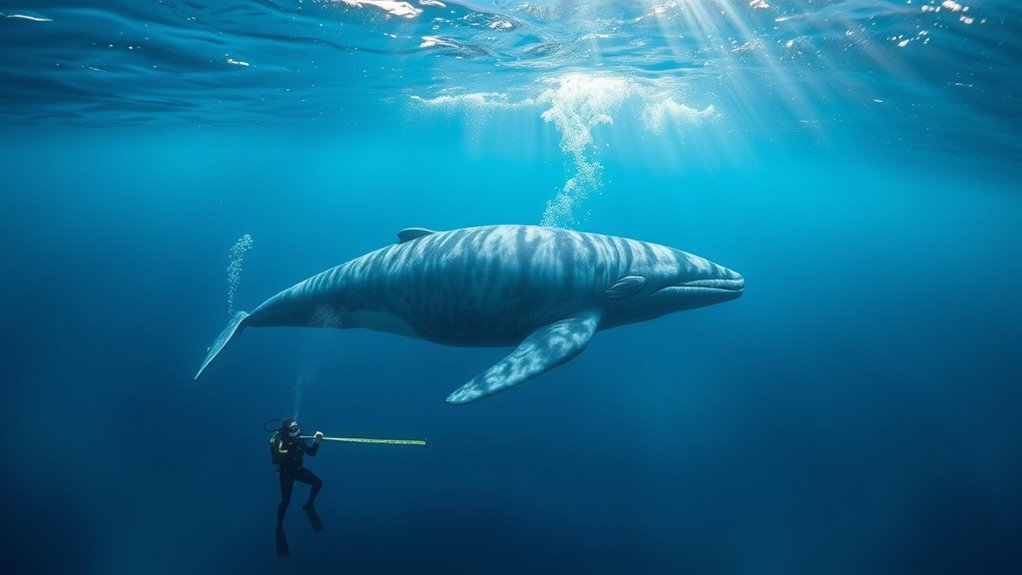
To measure how big a baby blue whale is, you’ll typically use photogrammetry—a technique involving taking multiple photos from drones or boats to capture its length from different angles.
This method is essential for accurately assessing the size of these massive newborn whales.
Then, you scale and stitch these images with specialized software to get precise size estimates without disturbing the whale.
Since newborn blue whales are huge and often underwater, photogrammetry helps you handle challenging conditions while still obtaining reliable data.
Keep exploring, and you’ll discover how these measurements reveal essential insights about their growth and conservation.
Understanding their size is crucial for monitoring the health and development of these magnificent creatures.
How Big Is a Baby Blue Whale at Birth?
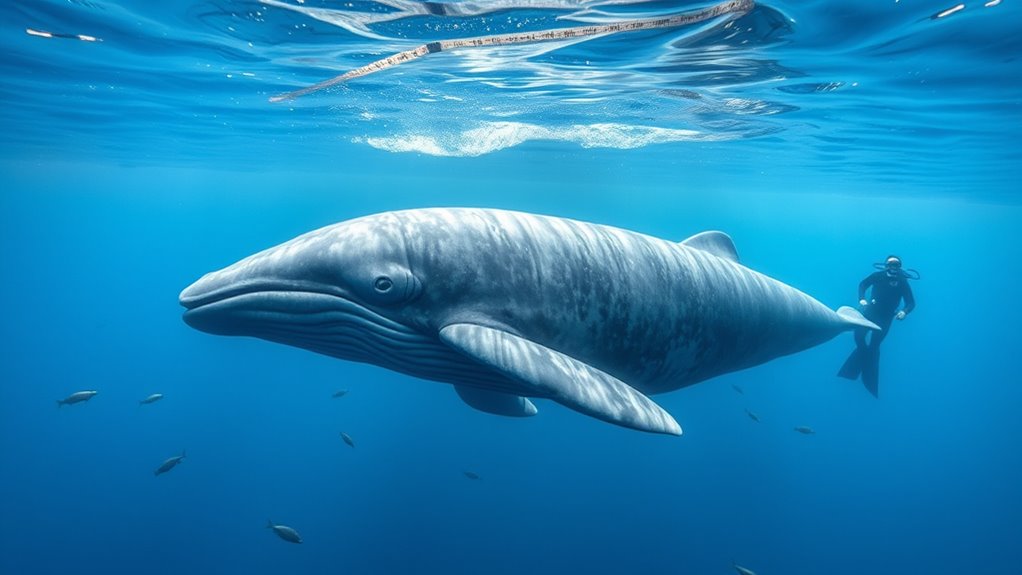
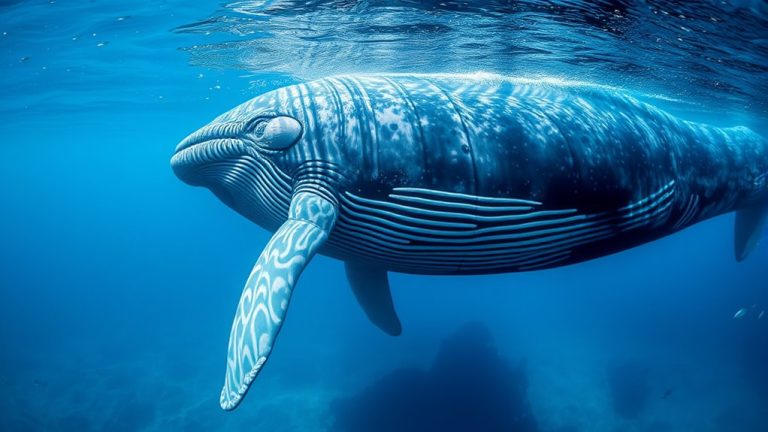
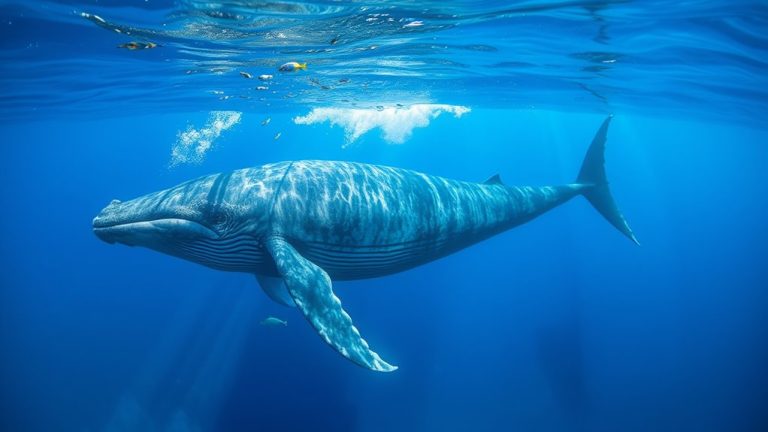
Although you might picture a baby whale as small and fragile, a blue whale calf is enormous from the start. Blue whales are the largest animals on Earth, and their calves reflect that size rather than a typical newborn’s small stature. At birth, a blue whale measures about 23 feet in length—roughly the size of a small school bus.
These newborns weigh between 2 to 3 tons, a massive weight for any infant. You’ll notice blue whale calves have fetal folds on their skin that fade as they grow. Impressively, blue whales can swim and breathe immediately after birth, pushing to the surface within minutes.
This combination of length and ability makes them unique among whale species right from the start.
Comparing Baby Blue Whale Size to Familiar Objects
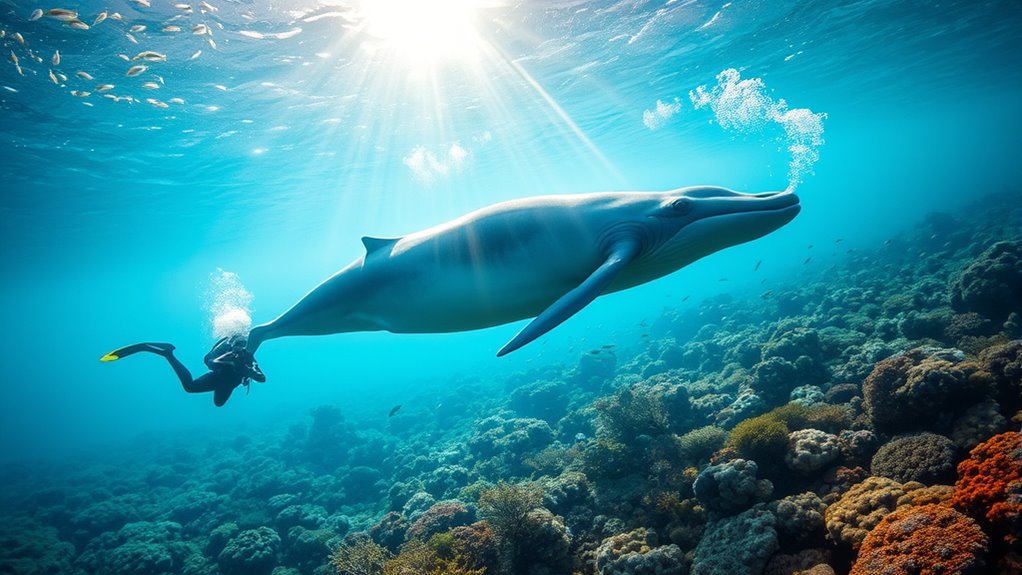
When you picture a baby blue whale, it helps to compare its size to objects you know. A newborn blue whale calf measures about 23 feet long, roughly the length of a small school bus. Imagine standing next to one—it’s nearly four times taller than a 6-foot human.
That size is comparable to a large SUV or three average cars lined up bumper to bumper. This comparison gives you a tangible sense of how massive a baby blue whale is right from birth. Considering its size, it’s no wonder blue whales are the largest creatures in the animal kingdom.
Understanding these familiar references helps you grasp just how giant and impressive this blue giant truly is at the very start of its life.
Measurement Tools for Baby Blue Whales
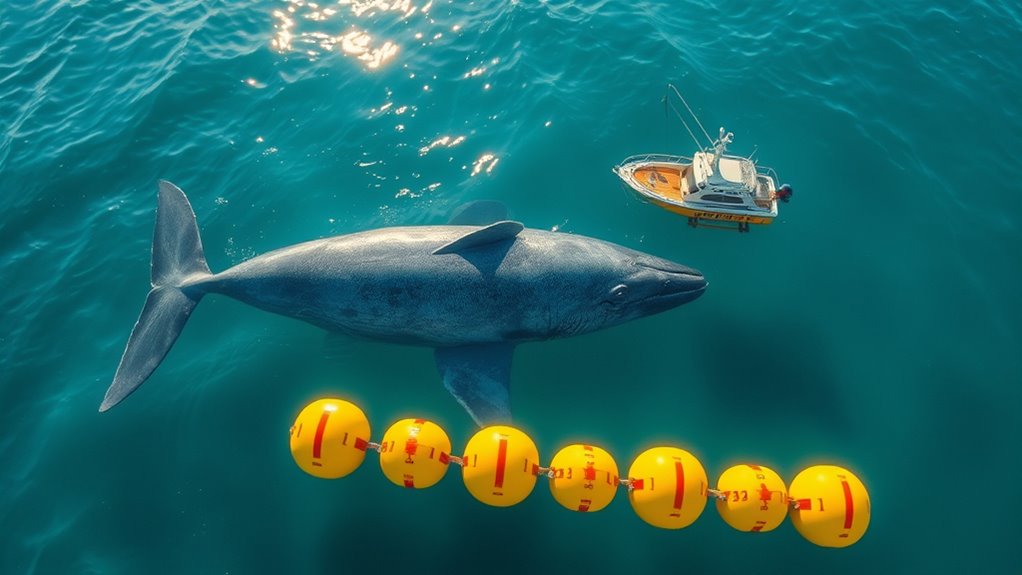
Since baby blue whales measure about 23 feet at birth, you’ll need reliable tools to capture their size accurately. This type of whale demands precise measurement methods to monitor its growth and health. Simple tools like measuring tapes or ropes let you compare their size against known lengths.
Visual markers, such as foetal folds and unique skin markings, help identify newborns and guide your measurements. While these tools provide initial data, remember that the sheer size and aquatic environment of this type of whale can make direct measurement tricky.
Using the right tools guarantees you gather accurate information, which is essential for studying the calf’s development and survival. By selecting appropriate measurement tools, you’re better equipped to understand these magnificent creatures from the start.
How Photogrammetry Measures Baby Blue Whales Accurately
You’ll use photogrammetry by capturing images of a baby blue whale from different angles to measure its body accurately. By analyzing the distance between key points like the blowhole and dorsal fin through specialized software, you can estimate the whale’s total length with impressive precision.
Plus, statistical models help you understand and minimize any measurement uncertainty, keeping your data reliable.
Photogrammetric Measurement Techniques
Although measuring a baby blue whale’s full length directly can be challenging, photogrammetry offers a precise alternative by analyzing sequential images of the whale’s exposed flank. You’ll rely on this technique to estimate size without disturbing the animal.
Here’s how photogrammetric measurement works:
- Capture sequential photos focusing on the whale’s body from the blowhole to the dorsal fin.
- Measure the distance between the whale and camera to establish an accurate scale.
- Use specialized software to stitch images together and correct for any measurement errors.
- Calculate the whale’s total length by relating the measured body parts proportionally.
This approach lets you determine the whale’s size accurately, even when only part of its body is visible.
Accuracy And Uncertainty Analysis
When you measure baby blue whales using photogrammetry, accuracy hinges on precisely scaling the images by accounting for the perpendicular distance between the whale and the camera. This method focuses on measuring the exposed body flank, especially the distance from the blowhole to the dorsal fin, which helps estimate the whale’s length.
To assess how reliable your measurements are, Bayesian statistical models analyze uncertainty, showing that most variability comes from errors in the photo sequence rather than differences in body proportions. Photogrammetry typically achieves precision within 2-3%, giving you dependable size estimates.
Plus, comparisons with aerial photogrammetry confirm that this approach produces unbiased results. Overall, photogrammetry is a cost-effective, non-intrusive way to measure baby blue whales accurately in the field.
Measuring a Baby Blue Whale in the Wild
When measuring a baby blue whale in the wild, you’ll rely on photogrammetry to capture precise images despite challenging conditions. You’ll face obstacles like water movement and limited access, making data collection tricky.
To guarantee accuracy, you’ll combine these measurements with careful analysis and statistical models.
Photogrammetric Measurement Techniques
Because blue whales spend much of their time underwater, measuring a baby blue whale in the wild requires innovative techniques like photogrammetry. This method uses sequential images to estimate size without disturbing the animal. Here’s how it works:
- Capture photos showing the whale’s exposed flank, from blowhole to dorsal fin.
- Measure the perpendicular distance between the camera and the whale to scale images accurately.
- Use specialized software to stitch photos together and calculate total length from body proportions.
- Apply Bayesian statistical models to evaluate measurement uncertainty, achieving 2-3% precision.
Photogrammetry lets you estimate calf size effectively while supporting conservation efforts. It’s a powerful, non-intrusive way to gather essential biological data on these giants in their natural habitat.
Field Measurement Challenges
Photogrammetry offers a promising way to measure baby blue whales, but applying these techniques in the wild presents several challenges. You’ll find that their massive size and constant movement make capturing clear, accurate images tough. Water clarity varies, and waves or glare can obscure key body landmarks, like the blowhole or dorsal fin, which you rely on to estimate length.
Using drones or aircraft helps, but camera angles and distance must be just right to avoid distortion. Real-time measurement is tricky because the whale rarely stays still, and you can’t always get the perfect shot. Despite these obstacles, carefully timed photos combined with reference points allow you to approximate size, though precision demands patience and a bit of luck in the ever-changing ocean environment.
Data Accuracy And Analysis
Although capturing images of a moving baby blue whale in the wild can be challenging, researchers use carefully calibrated photogrammetry to guarantee data accuracy. You’ll want to know how they turn these images into reliable measurements. Here’s how they ensure precision:
- Capture sequential photos or videos from consistent angles to measure the body length from blowhole to dorsal fin.
- Measure or know the distance between camera and whale to scale images correctly.
- Use body proportions and ratios to estimate total length from partial measurements.
- Apply Bayesian statistical models to handle measurement uncertainty and provide confidence intervals.
Challenges and Solutions in Measuring Newborn Blue Whales
Measuring newborn blue whales poses unique challenges since they’re born deep underwater and grow to enormous sizes that make direct measurement nearly impossible. You can’t simply grab a tape measure, so researchers use photogrammetry, taking precise photos to estimate length by measuring distances between features like the blowhole and dorsal fin.
However, water clarity, whale movement, and lighting often complicate accuracy. To tackle these, scientists employ aerial surveys and specialized software that enhance image analysis and reduce errors.
| Challenge | Solution |
|---|---|
| Underwater birth depth | Use aerial photographic tools |
| Large size | Measure key body points |
| Environmental factors | Employ advanced software |
| Whale movement | Capture multiple images |
What Baby Blue Whale Measurements Reveal About Growth and Health
When you track the size of baby blue whales from birth, which is about 23 feet long, you gain valuable insights into their growth and health. Measuring them regularly lets you see how quickly they develop and spot any early health issues. Comparing sizes across different groups helps identify environmental impacts on their growth.
Here’s what these measurements reveal:
- Initial size at birth sets a baseline for healthy development.
- Growth rates indicate overall wellbeing and nutrition.
- Population comparisons highlight environmental influences.
- Long-term data tracks survival chances and health trends.
How Measuring Baby Blue Whales Supports Conservation
Since you rely on accurate data to protect blue whales, tracking the size of baby calves plays a fundamental role in conservation efforts. Measuring their growth rates and health helps you monitor how well they’re developing, which is essential for identifying any threats early on. By noting size variations at birth and during early stages, you can detect environmental changes affecting the population.
This data also lets you estimate survival rates and pinpoint critical habitats where calves thrive. Understanding these growth patterns supports your work to create targeted strategies that guarantee the long-term sustainability of blue whales. In essence, every measurement you take directly informs actions that safeguard these vulnerable calves and contribute to preserving the species for future generations.
Why Measuring Baby Blue Whales Matters to Researchers
Why do researchers focus so much on the size of baby blue whales? Because measuring these giants at birth and throughout their early life helps you track their growth and health, which is crucial for protecting the species. When you gather precise size data, you can better understand survival rates and the challenges these calves face.
Plus, monitoring their size over time reveals how environmental factors and food availability affect them. Here’s why it matters to you as a researcher:
- Tracking growth rates and overall health of calves
- Informing conservation strategies with accurate size data
- Evaluating environmental conditions through size changes
- Studying genetic diversity by comparing sizes across populations
Measuring baby blue whales gives you crucial insights to safeguard their future.
Frequently Asked Questions
How to Visualize the Size of a Blue Whale?
You can visualize a blue whale’s size by comparing it to familiar objects, like three school buses lined up, or measuring a 100-foot rope and seeing how it matches your arm span or nearby classroom items.
Breaking down the length into smaller, relatable segments helps make the immense size easier to grasp.
For example, picture how long a typical classroom is, then imagine that length multiplied several times over.
This way, the colossal size of a blue whale becomes more tangible and understandable.
Is a Blue Whale the Size of a Football Field?
A blue whale isn’t quite the size of a full football field, but it’s close—about two-thirds the length.
What’s the Best Way to Measure a Whale?
You’ll want to use photogrammetry, capturing sequential images from the air or boat, then apply software to stitch photos and measure dimensions accurately.
This method guarantees precise, non-intrusive length estimates for whales in their natural habitat.
Is a Blue Whale Larger Than a Basketball Court?
A blue whale’s length is a slam dunk, stretching about 100 feet—just a bit longer than a basketball court.
When you picture that, you truly grasp how colossal these gentle giants are.
Conclusion
Measuring a baby blue whale might seem tricky, but knowing they’re about 23 feet long at birth—almost the size of a small bus—really puts their incredible growth into perspective.
By using tools like photogrammetry, you can accurately track their size and health in the wild. These measurements aren’t just numbers; they help researchers protect these gentle giants and ensure their survival.
So, every measurement you take contributes to a bigger story of conservation, helping us better understand and safeguard the majestic baby blue whale.