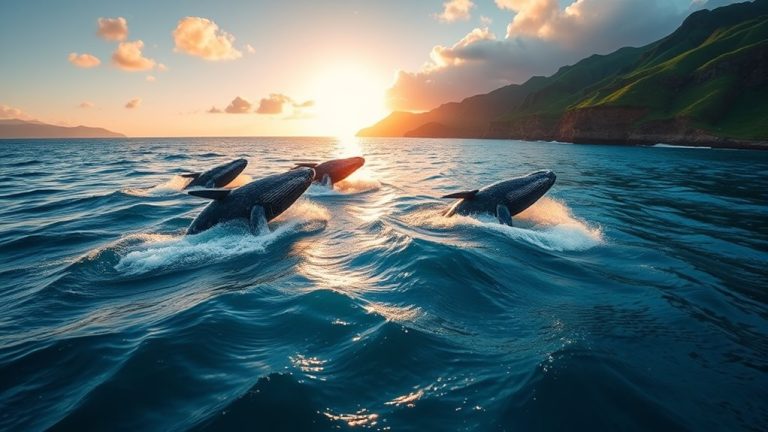
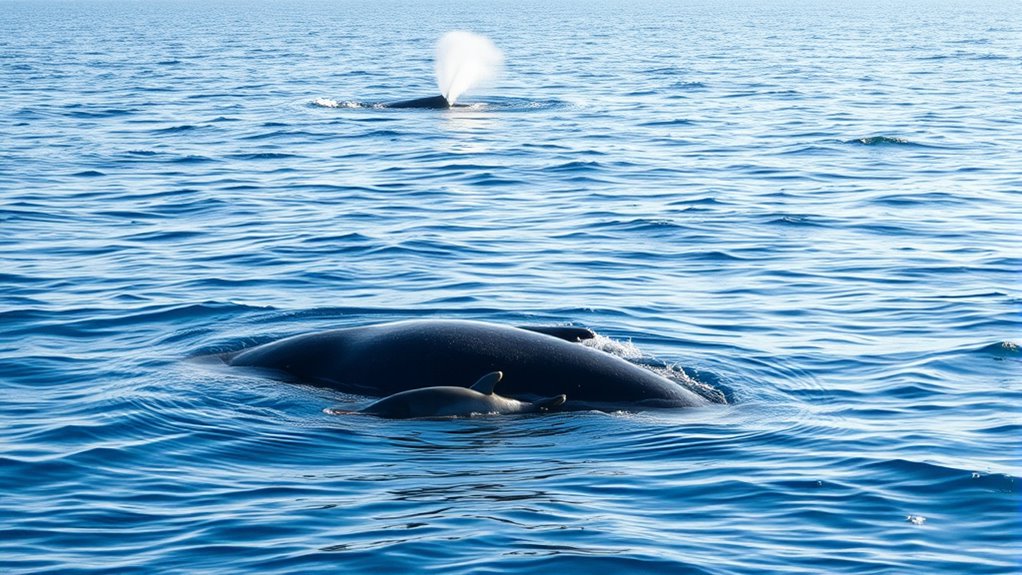
What Are the Stages of a Whale’s Life Cycle?
You start with a whale calf born in warm, shallow waters, relying on rich, fatty milk to grow fast.
As the calf learns to surface and socialize, it gradually shifts to solid food while practicing essential skills.
Next comes long migrations between breeding and feeding grounds.
Followed by adult behaviors like mating and social bonding.
Eventually, when whales die, their bodies support deep-sea ecosystems.
Keep exploring to uncover the full journey of these ocean giants.
The Birth and Early Weeks of a Whale Calf
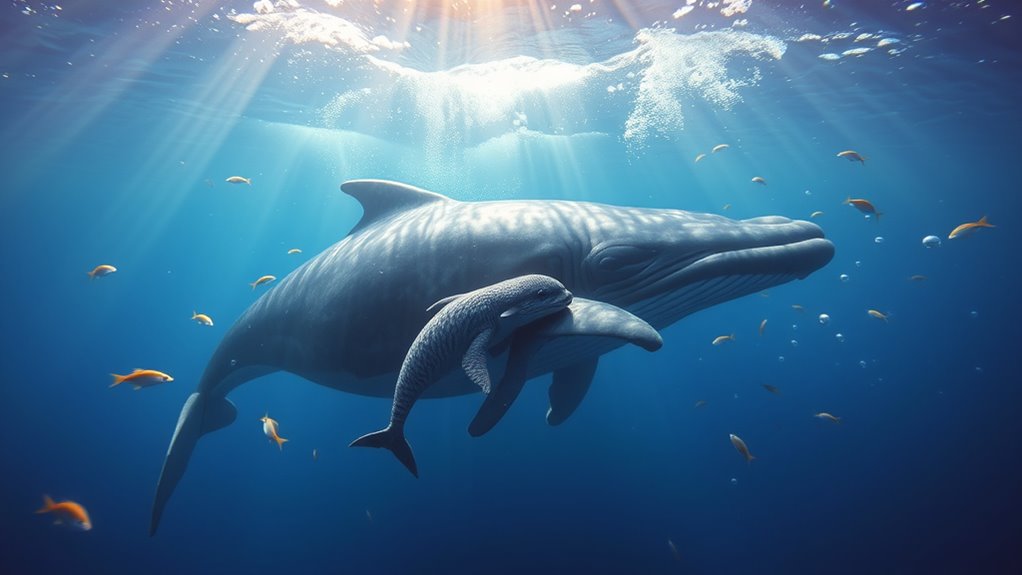
Although whale calves come into the world after a long gestation of 10 to 18 months, depending on the species, they’re already quite large—measuring 10 to 15 feet and weighing up to 1.5 tons at birth. You’ll find that whale calves are born in warm, shallow breeding grounds, which offer a safer environment for their first days.
Right after birth, the calves stay close to their mothers, relying heavily on nursing to gain strength. Their mother’s milk is incredibly rich, with fat contents of 50 to 60%, helping the calves gain about 100 pounds daily.
During these early weeks, you’ll notice the calves starting to learn essential behaviors like surfacing for air while staying protected and nourished by their mother’s care.
How Whale Calves Grow and Learn to Thrive
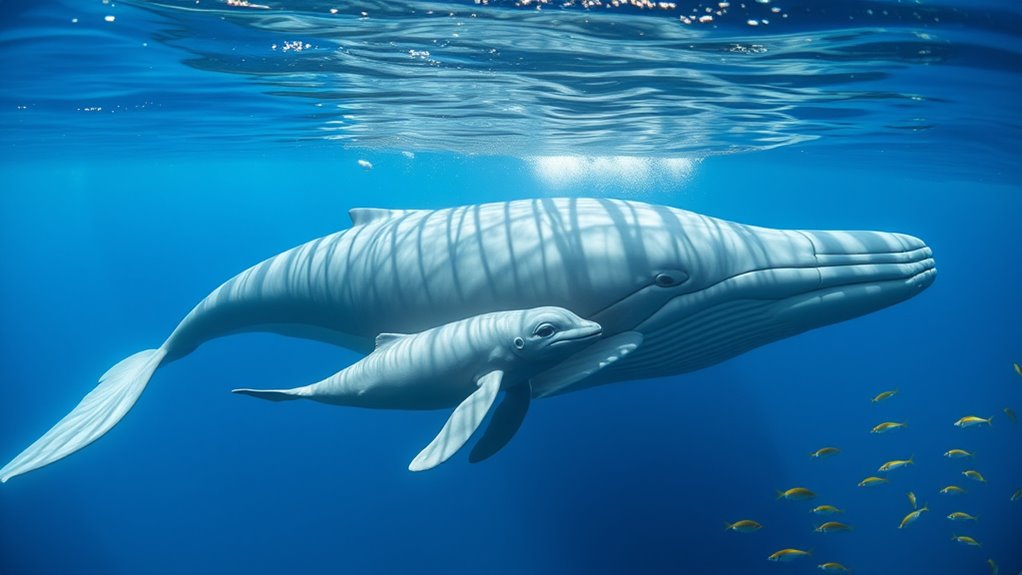
You’ll notice that whale calves depend entirely on their mother’s rich milk to fuel their rapid growth.
As you watch, you’ll see them practicing essential behaviors like breathing and nursing while staying close to their mothers. These early habits are vital for building the strength and skills they need to thrive in the wild.
Calf Nursing and Nutrition
A whale calf depends on its mother’s rich milk, packed with 50-60% fat, to fuel rapid growth right after birth. This high-fat nutrition lets the calf gain about 100 pounds daily, supporting its massive size of up to 1.5 tons at birth.
During nursing, the calf stays close to its mother for several months, ensuring it receives constant nourishment essential for development. This nursing period provides all the nutrition the calf needs before it gradually shift to solid food.
Weaning happens between 6 to 12 months, marking the calf’s move from milk to feeding independently on small fish and krill. This carefully balanced nursing and nutrition phase equips the calf with the energy and strength to thrive in the vast ocean ahead.
Early Behavioral Development
When whale calves enter the world, they instinctively cling to their mothers, learning essential skills like breathing, nursing, and interacting within their pod. During these early weeks, calves rely heavily on nursing, gaining strength from rich milk that fuels rapid growth.
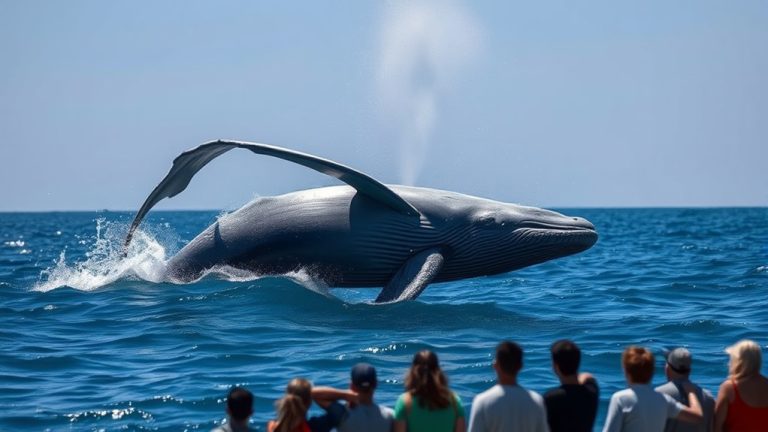
As you observe calves, you’ll notice them starting to explore active behaviors such as breaching and tail slapping, which help build muscle and communication skills. Social interactions play a crucial role, too; calves learn how to navigate their pod’s dynamics, developing bonds and communication methods.
Between six to twelve months, calves gradually wean off nursing and begin feeding independently on small fish and krill. This period of early behavioral development is vital, as it equips calves with the skills they need to thrive in their ocean environment.
Whale Migration: Timing and Reasons
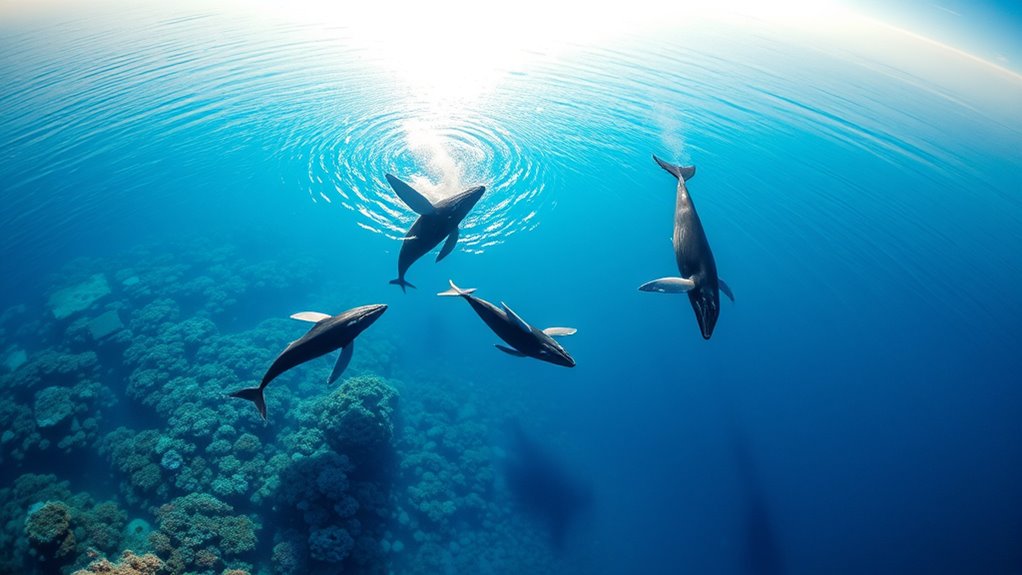
You’ll notice whales follow specific migration routes, traveling up to 5,000 miles between warm breeding waters and cold feeding grounds. Their journey usually happens from May to November, timed to make the most of feeding and breeding seasons.
Understanding why they migrate helps you see how they balance survival and reproduction throughout the year.
Migration Routes Overview
How do whales manage to travel thousands of miles every year between their breeding and feeding grounds? Their migration takes them along well-established routes connecting critical habitats.
For example, humpbacks in the Southern Hemisphere journey from Antarctic feeding areas to tropical breeding grounds like Tonga and Fiji. In the Northern Hemisphere, they migrate between Alaska and Hawaii or Baja California and the Pacific Northwest. These paths, often called “Blue Corridors,” guarantee whales reach safe breeding grounds to reproduce and rich feeding areas to refuel.
Along the way, whales use behaviors like breaching, tail slapping, and singing to communicate and navigate the vast oceans. Understanding these migration routes helps you appreciate the incredible endurance and precision whales demonstrate during their life cycles.
Seasonal Migration Timing
Because whales depend on specific environmental conditions, they time their migrations precisely each year. You’ll notice they move between breeding grounds in warm waters during winter and feeding grounds in colder polar regions in summer. Different species have varied migration seasons; for example, humpbacks travel up to 5,000 miles from May to November.
You can see their timing aligns closely with the availability of food in the feeding grounds and the ideal conditions for mating in the breeding grounds. Whales also respond to environmental cues like temperature, daylight, and ocean currents to decide when to start their journey. This careful timing helps them build fat reserves during feeding seasons, supporting fasting periods that can last 4–6 months during migration.
Purpose of Migration
Whales time their migrations carefully, but understanding why they make these long journeys reveals even more about their survival strategies. You see, migration is essential to their life cycle, allowing them to move between warm breeding grounds and cold feeding grounds. After breeding, whales travel up to 5,000 miles to nutrient-rich polar regions, where food like krill and small fish peaks in availability during summer.
This timing ensures they replenish energy stores critical for survival. During migration, whales communicate through breaching, singing, and tail slapping, helping them navigate vast oceans. By migrating, whales optimize reproductive success and survival, using specific habitats best suited for feeding or breeding depending on the season.
You can appreciate how migration shapes every stage of a whale’s life cycle.
Adult Whale Behavior and Reproductive Life Cycle
Once adult whales reach sexual maturity, which varies by species and gender, they engage in complex behaviors that are crucial for reproduction and social bonding. You’ll notice their mating behaviors include singing, breaching, and bubble blowing, all designed to attract a mate.
Females typically give birth every 2 to 3 years after a lengthy gestation, usually to a single calf. The reproductive cycle is closely tied to their lifespan, with females often living over 90 years and males between 30 to 60 years, influencing how often they reproduce and their roles within pods.
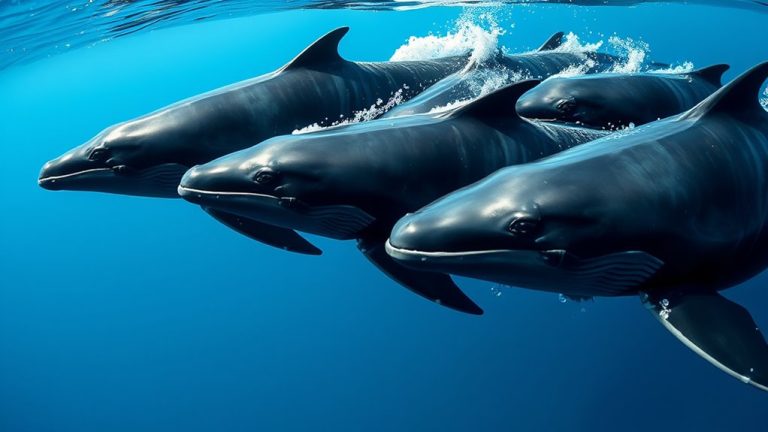
Beyond mating, adult whales form social groups, cooperate in hunting, and communicate through intricate songs, all essential for survival and maintaining strong social bonds.
Whales’ Role in Ocean Ecosystems
Although they spend most of their time beneath the waves, these majestic creatures play a crucial role in maintaining ocean health. As you follow a whale through its life cycle, you’ll see how it contributes to nutrient cycling. Whales, especially humpbacks, release nutrient-rich fecal plumes that stimulate phytoplankton growth.
This process, known as the “whale pump,” transfers nutrients from deep waters to the surface, boosting oxygen production and carbon sequestration. When whales migrate, they mix ocean layers and spread essential nutrients across vast distances, enhancing productivity in diverse ecosystems.
The Whale Fall: Life After Death in the Ocean
When a whale dies, its massive body sinks to the ocean floor, creating a phenomenon known as a “whale fall.” This sudden influx of nutrients fuels deep-sea ecosystems, offering an essential source of energy for scavengers and specialized organisms.
In the months following the whale fall, scavengers like sharks and hagfish rapidly consume the soft tissues, while the skeleton becomes home to bone-eating worms called Osedax. This decomposition process releases stored carbon, aiding long-term carbon sequestration on the ocean floor.
Over decades, the whale fall supports a diverse community of more than 200 species, making it a key biodiversity hotspot. By understanding this life after death, you see how whale falls sustain deep-sea ecosystems and contribute markedly to ocean health.
Frequently Asked Questions
What Are the Stages of the Whale Life Cycle?
You start as a newborn calf, nurse and grow fast, then become a juvenile learning to feed and migrate.
Once mature, you mate and sing, living decades before aging and contributing back to the ocean ecosystem.
Why Don’t We Eat Whale Meat?
You don’t eat whale meat because who wants mercury cocktails and endangered species guilt on their plate?
Plus, international laws say no, so unless you fancy jail time with a side of whale-watching guilt, skip it.
What Are the 4 Stages of Whale Fall?
You’ll see four stages in a whale fall: scavenger, where soft tissue’s eaten; enrichment, as bacteria break down bones; sulfophilic, with sulfide-producing bacteria; and finally, the reef stage, supporting diverse deep-sea life for decades.
Can a Whale Live for 200 Years?
Imagine meeting a grandparent who’s lived through centuries—bowhead whales can live over 200 years!
You won’t often see such longevity, but science confirms these majestic creatures can defy typical lifespans, aging like oceanic legends.
Conclusion
Think of a whale’s life as a grand ocean voyage—you start as a fragile calf, like a tiny boat setting sail, learning the currents and finding your way. As you grow, you navigate vast migrations and explore deep waters, becoming a wise captain of the seas.
Even in the end, your journey supports new life, like a lighthouse guiding others through the dark. In this endless cycle, you’re both traveler and guardian of the ocean’s story.
This life cycle of a whale showcases the stages from birth to maturity and eventually to the legacy left behind, emphasizing the importance of each phase in the whale’s life cycle.