
Are Whale Sharks Intelligent?
You might not expect it, but whale sharks show surprising intelligence through their complex brain structure and adaptable behaviors. Their large, folded brains help with advanced motor skills and sensory processing.
They recognize individual patterns, solve problems, and navigate thousands of kilometers using environmental cues and memory.
These abilities reveal a depth of cognitive skill you wouldn’t guess. As you explore their fascinating behaviors, you’ll uncover even more about what makes whale sharks remarkable creatures.
What Is Whale Shark Intelligence?
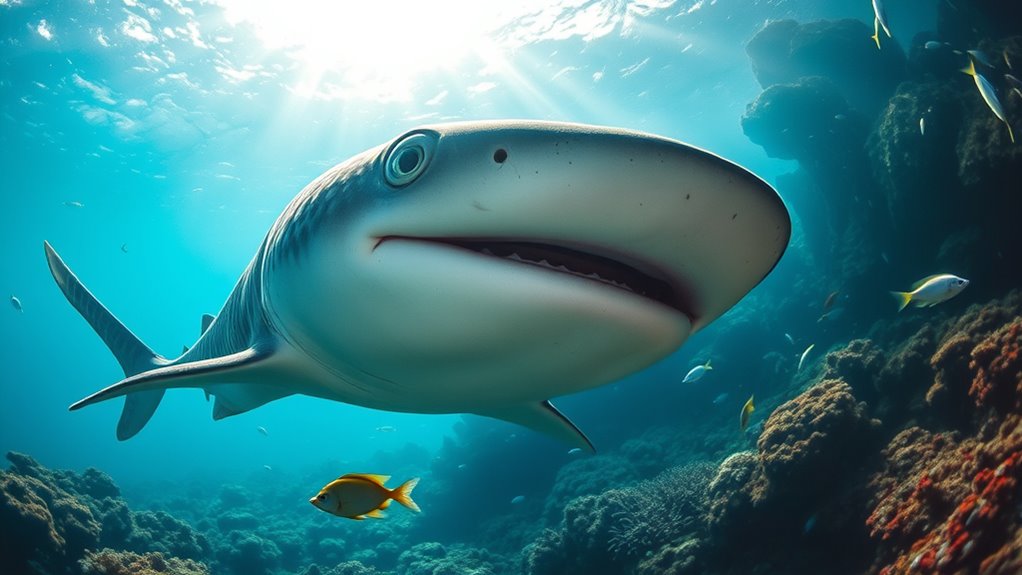
Although whale sharks are known for their massive size, their intelligence reveals a surprising complexity. You might not expect such a giant to show advanced behavior, but their brain tells a different story. With a highly folded, complex cerebellum, whale sharks control their movements with impressive precision.
You’ll notice their behavior includes recognizing individual peers and orienting themselves along vast migratory routes, which points to sophisticated learning abilities. Their brain isn’t static; it shows plasticity through ongoing neuron regeneration, helping them adapt to changing environments. Sensory regions specialized for vision and smell enhance their environmental awareness.
When you consider these traits, it’s clear that whale shark intelligence goes beyond size, demonstrating a level of cognitive complexity that supports their survival in diverse habitats.
How Whale Sharks’ Brain Structure Supports Intelligence
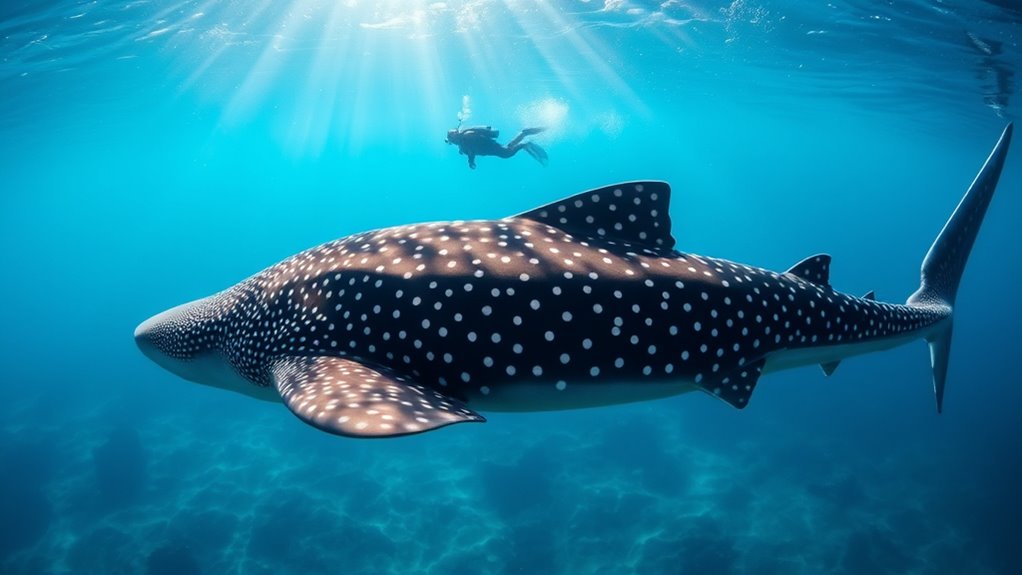
When you examine the whale shark’s brain structure, you’ll find a remarkably large and complex cerebellum that supports their intelligence. This cerebellum, the largest and most folded among sharks, plays a vital role in advanced motor coordination and spatial awareness. Despite their small brain-to-body size ratio, the whale shark’s brain structure shows specialized neural processing tailored for slow, deliberate movements in open water.
The intricate folding suggests a high capacity for behavioral flexibility, enabling them to adapt to complex tasks like migration and feeding. These features indicate that their brain structure isn’t just large—it’s finely tuned for integrating sensory information and charting vast environments, revealing intelligence that goes beyond what you might expect from their size alone.
Sensory Abilities That Reveal Whale Shark Intelligence
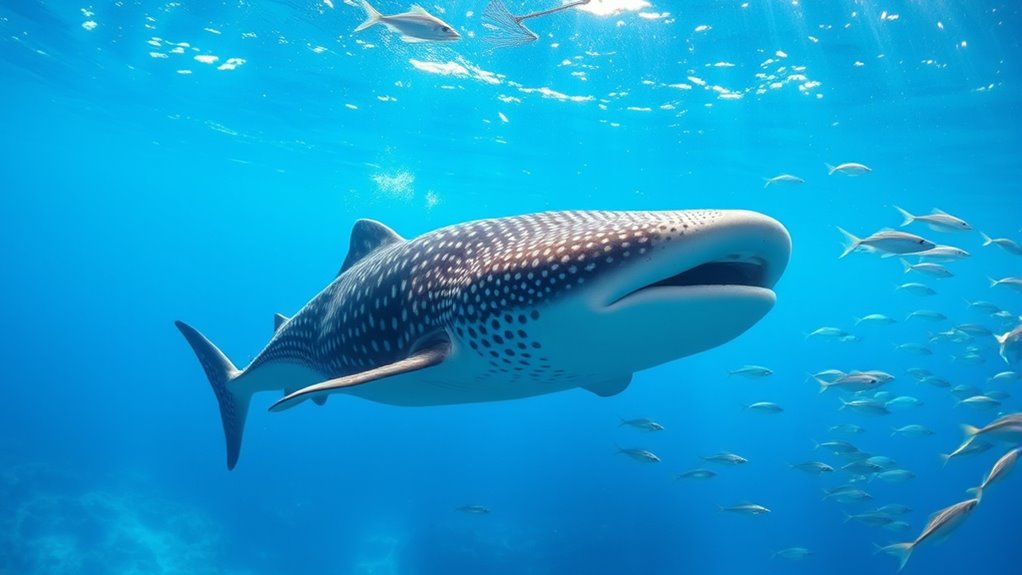
You might not realize that whale sharks see colors differently depending on how deep they swim, thanks to special pigments in their eyes. They also recognize individual spot patterns, which helps them communicate and identify each other.
These sensory skills show just how smart whale sharks really are.
Visual Adaptations Explained
How do whale sharks see the vast and varied world beneath the waves? They rely on specialized visual pigments that allow them to perceive both blue hues and full color across different depths. This means you’d experience their underwater view as vivid and detailed.
Their large optic lobes in the brain handle complex visual processing, helping them navigate and hunt effectively. While you might notice their distinctive spot patterns, these serve as visual identifiers rather than communication tools here.
Whale sharks also detect bioluminescence from plankton and small fish, using this ability to locate food in dim conditions. These visual adaptations show you that whale sharks don’t just see—they interpret a rich array of visual cues, highlighting their sensory sophistication and hinting at intelligent behavior.
Communication Through Spot Patterns
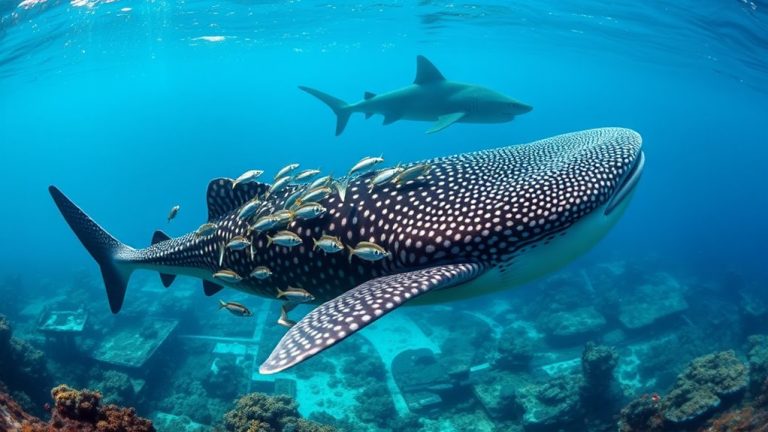
Why do whale sharks have those distinct spot patterns covering their massive bodies? These unique spot patterns act like fingerprints, enabling individual identification among whale sharks. When you observe these patterns, you’re witnessing a form of communication rooted in advanced visual recognition.
Whale sharks can distinguish one another by these markings, which remain stable over time, allowing for long-term social interactions. This ability isn’t just about recognizing appearance—it reflects complex sensory processing and cognitive abilities. By remembering and identifying each other through spot patterns, whale sharks demonstrate a surprising level of social awareness.
Evidence of Whale Shark Problem Solving and Learning
Although whale sharks are often recognized for their massive size rather than their intellect, they’ve shown impressive problem-solving and learning abilities. You can observe their cognitive skills when they navigate maze-like setups to reach food, highlighting their problem-solving talents. Their capacity for learning is evident as they associate visual cues with feeding, showing associative learning.
Additionally, their behavioral flexibility stands out when they adjust feeding strategies in response to environmental shifts. You’ll also find they recall migratory routes and feeding spots over time, demonstrating strong spatial learning.
- Solve complex problems to access food efficiently
- Learn and remember visual signals linked to feeding
- Adapt feeding behaviors based on changing environments
These abilities reveal a surprising depth to whale shark intelligence.
Whale Shark Navigation and Migration
You’ve probably wondered how whale sharks find their way across thousands of miles of open ocean. They follow seasonal migratory routes guided by cues like water temperature, salinity, and even magnetic fields.
Understanding these navigation mechanisms reveals just how remarkable their movements truly are.
Migratory Routes Patterns
When whale sharks migrate, they cover thousands of kilometers between key feeding sites like Ningaloo Reef and the Yucatán Peninsula, following the seasonal blooms of plankton and small fish. You can track their migratory routes using satellite tracking, revealing epic journeys across entire ocean basins. These sharks return annually to the same spots, showing they rely on environmental cues and a keen sense of navigation.
Their pattern isn’t random; it’s finely tuned to food availability and ocean conditions.
Here’s what you should know about their migratory routes:
- They travel between feeding grounds in the Atlantic, Indian, and Pacific Oceans.
- Environmental cues like water temperature guide their path.
- Their navigation suggests memory and recognition of celestial or magnetic signals.
Navigation Mechanisms Explored
Because whale sharks travel thousands of miles each season, they’ve developed remarkable navigation skills to find their way. You can imagine how they rely on Earth’s magnetic field as a natural compass, helping them maintain accurate navigation across vast oceans. Satellite tracking has confirmed their impressive ability to move between distant locations like the Azores and the Gulf of Mexico with precision.
Beyond magnetic cues, whale sharks likely integrate multiple sensory inputs—such as olfaction and vision—to detect environmental changes and locate plankton blooms. Their sophisticated navigation system combines magnetic awareness, ocean currents, and possibly celestial cues, allowing them to return to familiar feeding and breeding sites year after year.
Understanding these mechanisms highlights their complex environmental awareness and intelligence.
Social Interactions and Communication Among Whale Sharks
Although whale sharks mostly lead solitary lives, they do exhibit intriguing social behaviors that suggest more complex interactions than you might expect. You’ll notice they gather in large, predictable feeding aggregations, showing clear social interactions during these times. Researchers have observed them swimming closely together, even engaging in synchronized swimming and gentle contact, which hints at forms of communication.
Each whale shark’s unique spot pattern helps them recognize one another, much like fingerprints, adding another layer to their social behavior. While we’re still uncovering exactly how they communicate, these behaviors suggest more than simple coexistence.
- Gather in feeding aggregations indicating social behavior
- Recognize each other through unique spot patterns
- Exhibit synchronized swimming and gentle contact during encounters
How Whale Shark Intelligence Compares to Other Marine Animals
While whale sharks might not seem as intellectually striking as dolphins or seals at first glance, their brain structure reveals impressive capabilities. You’ll notice their large, highly folded cerebellum supports advanced motor coordination and sensory processing. Despite a small brain-to-body ratio, they recognize individual spot patterns and solve problems during feeding, showing practical problem-solving skills.
Their brains include regions specialized for olfaction, vision, and spatial learning, much like other marine animals. What’s fascinating is their neuroplasticity—the ability to adapt behavior and sensory functions to different environments—which points to intelligence that’s often overlooked.
Why Whale Shark Intelligence Matters for Conservation
When you recognize the intelligence of whale sharks, you also appreciate their complex behaviors like navigation and problem-solving that are essential for survival. Their brain complexity, especially the folded cerebellum, reveals advanced sensory processing and behavioral intelligence. This understanding boosts conservation awareness, helping you and others see whale sharks as more than just large fish.
It also builds public empathy, which drives stronger support for protecting them and their habitats. By valuing their intelligence, you encourage responsible ecotourism and policies that minimize human impact. Here’s why this matters:
- Enhances public empathy, motivating conservation action
- Informs policies that protect natural behaviors
- Guides research focused on preserving populations
Your awareness directly contributes to effective conservation of these gentle giants.
Frequently Asked Questions
How Smart Is a Whale Shark?
You’d find whale sharks moderately smart; they recognize individual patterns, have advanced motor control, and process complex sensory information.
While not the smartest, their brain structure supports notable cognitive abilities and environmental adaptability.
What Are the Most Intelligent Sharks?
If you’re asking which sharks would ace Shark University, it’s reef sharks like lemon, tiger, and reef sharks—they’ve got bigger brains and fancy vision skills.
You’ll find they’re smarter, with sharp problem-solving and social smarts, too!
Are Whale Sharks Friendly to Humans?
Yes, whale sharks are friendly to humans. You’ll find them gentle and curious, often swimming close without aggression.
Just remember, don’t touch or ride them—they appreciate respect and won’t harm you.
Are Whale Sharks Emotionally Intelligent?
Think of whale sharks as gentle giants who remember your face in a crowded sea. You’ll see they’re emotionally intelligent—they sense your calm, respond with curiosity, and navigate social waters with surprising emotional awareness.
Conclusion
You might be surprised to learn that whale sharks can travel over 12,000 miles during migration, showing impressive navigation skills. Their brain structure and sensory abilities hint at a level of intelligence that helps them solve problems and interact socially.
Understanding this intelligence isn’t just fascinating—it’s essential for protecting these gentle giants. By recognizing how smart whale sharks are, you can better appreciate why conserving their habitats matters for the ocean’s health and future.
Whale shark intelligence plays a crucial role in their survival and the marine ecosystem. Protecting whale shark habitats ensures these intelligent creatures continue to thrive, highlighting the importance of conservation efforts.