How Far Does a Whale Song Travel Underwater?
You can hear whale songs traveling over 10,000 miles underwater, thanks to powerful low-frequency sounds that glide through the ocean’s natural sound channels with little energy loss.
These long wavelengths face less scattering and attenuation, letting whales communicate across vast distances. Ocean conditions like temperature and pressure also shape how far sounds travel.
Different species use varied calls for social and mating purposes. If you’re curious about how whales produce these songs and how researchers track them, there’s more to explore.
Distance and Range of Whale Songs Underwater
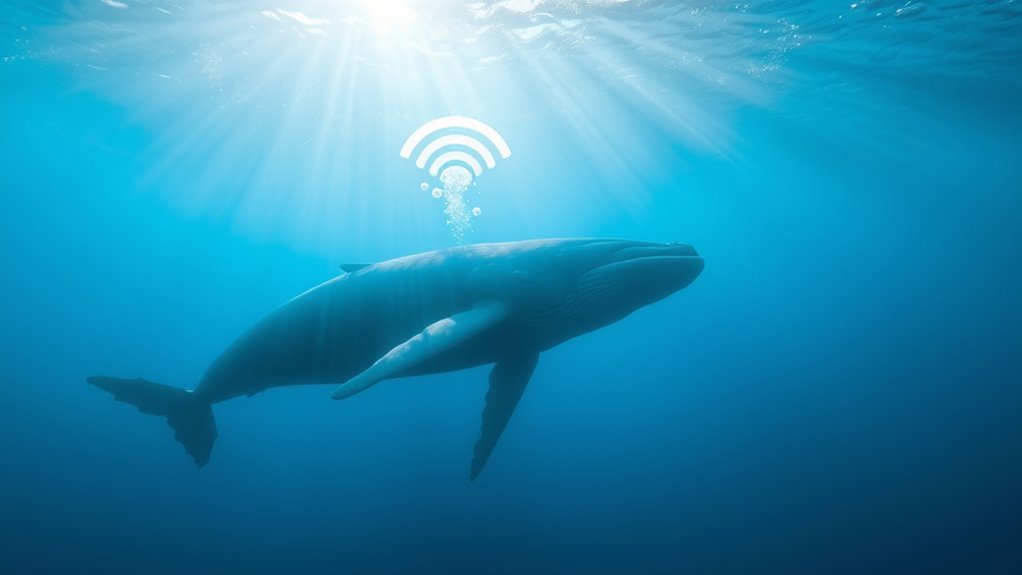
Although you might not realize it, whale songs can travel over 10,000 miles underwater, making them some of the longest-distance sounds in the animal kingdom. When whales sing, their sound waves move through the ocean’s depths, reaching far beyond what you might expect.
These sound waves are guided by the ocean’s natural sound channel, which traps and directs them efficiently. Because of this, hydrophones placed at specific depths can pick up whale songs from many kilometers away.
This incredible range allows whales to communicate across vast distances, helping them coordinate activities, attract mates, and maintain social bonds. So, when you hear about whale songs traveling thousands of miles, it’s the power and reach of these sound waves doing the work.
Why Low-Frequency Whale Songs Travel Farther
Whale songs can travel incredible distances underwater, but not all sounds cover the same range. Low-frequency sounds travel farther due to several unique properties of their sound waves:
- Their long wavelengths experience less attenuation and scattering, so they maintain strength over thousands of miles.
- The ocean’s sound channel traps these low-frequency sound waves, guiding them efficiently.
- These sounds pass through different water layers with minimal loss, unlike high-frequency sounds that dissipate quickly.
- Slow vibrations in low-frequency whale songs allow detection across entire ocean basins by other whales and hydrophones.
Because of these factors, whales like blue and baleen species use low-frequency songs to communicate over vast distances, making their calls some of the most far-reaching natural sounds underwater.
Ocean Conditions That Affect Whale Song Range
You’ll find that ocean temperature plays a big role in how sound travels underwater, with cooler temperatures generally slowing things down. Pressure also changes with depth, which can either help or limit the distance whale songs cover.
Understanding these factors is key to grasping why whale communication varies across different parts of the ocean.
Temperature Effects on Sound
When you dive deeper into the ocean, the temperature drops rapidly in a layer called the thermocline, which changes how sound travels underwater. This temperature shift affects the sound speed, influencing how far whale songs can travel. Here’s what you should know about temperature effects on whale song range:
- The thermocline causes sound waves to refract downward, limiting the horizontal distance whale calls can travel.
- Colder, deeper waters reduce sound speed, decreasing the effective range of vocalizations.
- Temperature profiles vary across oceans, creating unique sound channels that can enhance or restrict sound propagation.
- Below the thermocline, stable temperatures cause sound waves to refract upward, potentially increasing whale song travel distance.
Understanding these factors helps you grasp how temperature shapes underwater sound transmission.
Pressure Impact on Range
Although temperature plays a key role, pressure changes with ocean depth also particularly affect how far whale songs can travel. As you dive deeper, increased pressure causes sound waves to speed up, altering their path through the water. This pressure variation creates a natural sound channel that guides whale vocalizations over long distances with minimal loss.
You’ll notice that higher pressure bends sound waves downward, using refraction to extend the range of these underwater calls. Additionally, pressure impacts water’s physical properties, influencing how sound attenuates and propagates. When pressure profiles shift due to changes in temperature or salinity, the effective communication distance of whale songs adjusts accordingly.
Understanding pressure’s role helps you appreciate the complex ocean conditions shaping whale song travel.
How Whales Produce Their Powerful Songs
Because whales rely on sound to communicate across vast distances, they’ve evolved specialized vocal structures that produce powerful songs. When you listen closely, whale songs create sound waves that travel far underwater. Here’s how they do it:
- Baleen whales use their larynx and laryngeal sacs to produce low-frequency sounds.
- These low sounds, reaching up to 180 decibels, can travel thousands of miles through ocean sound channels.
- Toothed whales, like dolphins, emit high-frequency clicks and whistles from air sacs near their blowholes.
- Specialized vocal structures amplify these sounds, ensuring whale songs carry efficiently over long distances.
How Whales Use Songs to Communicate Over Long Distances
You might be surprised to learn that whale songs serve more than just a melodic purpose—they’re essential for communication across thousands of miles. These low-frequency sounds travel vast distances underwater, letting whales connect with others far beyond their immediate surroundings.
Understanding how these songs work helps you appreciate the impressive range and intent behind each call.
Purpose Of Whale Songs
When whales sing, they’re not just making noise—they’re sending messages across vast stretches of ocean. Whale songs play a vital role in long-distance communication, allowing these majestic creatures to connect despite the ocean’s immense scale.
Here’s how whale songs serve their purpose:
- Locate other whales by carrying sound over thousands of miles.
- Coordinate migration routes for the group’s safety and efficiency.
- Establish and maintain social bonds across wide ocean areas.
- Help males attract females and compete with rivals through powerful, low-frequency calls.
Thanks to the ocean’s sound channel, whale songs travel far with minimal loss, making them an effective underwater “long-distance radio” system. Understanding this helps you appreciate how whales use sound to thrive in their vast underwater world.
Distance And Range
Whale songs don’t just serve social and mating purposes—they travel incredible distances underwater, connecting whales across vast ocean expanses. You might be surprised to learn that whale songs can travel over 10,000 miles, thanks to the ocean’s unique sound channel called the SOFAR channel.
This natural underwater pathway traps sound waves, allowing whale songs to sound travel efficiently with minimal energy loss. When you consider how variations in temperature and pressure influence sound travel, you realize why low-frequency whale songs carry hundreds of kilometers away under ideal conditions.
Hydrophones detect these calls from many kilometers away, proving how whales use their songs to communicate over long distances, bridging vast ocean basins with their powerful acoustic signals.
Differences in Whale Song Range Across Species
Because different species produce sounds at varying frequencies and intensities, their songs travel vastly different distances underwater. When you listen to whale songs, you’re actually hearing sound waves that behave uniquely depending on the species.
Here’s how far their calls can travel:
- Blue whales emit extremely low-frequency sounds, allowing their songs to be detected up to 10,000 miles away.
- Humpback whale songs typically cover several hundred to a few thousand miles, influenced by environmental factors.
- Fin whales produce deep, powerful calls that can be heard over 1,000 miles in ideal conditions.
- Other species generate higher-frequency sounds that don’t travel as far underwater.
How Researchers Measure and Track Whale Song Travel
Although tracking whale songs across vast oceans can be challenging, researchers use hydrophones—specialized underwater microphones—to detect and record these sounds over long distances. You’ll find hydrophones deployed at various depths and locations, allowing scientists to analyze the time it takes for sound waves to travel from the whale to the device.
Since sound moves through seawater at about 1500 meters per second, you can calculate how far a whale’s call has traveled based on these travel times. Researchers also use acoustic modeling that factors in ocean temperature, pressure, and salinity to predict how sound waves bend and refract through different water layers.
Often, synchronized networks of hydrophones work together, capturing whale songs across vast ocean regions to provide an extensive picture of their underwater journey.
What Whale Song Range Reveals About Whale Behavior
Tracking how far whale songs travel underwater gives us insight into their behavior and social lives. These sounds enable long-distance communication across vast ocean basins, revealing key aspects of whale behavior.
Whale songs travel vast distances underwater, unlocking secrets of their social behavior and communication.
When you consider whale songs, you realize they:
- Facilitate social bonding and reproductive behaviors over thousands of miles.
- Help whales identify and attract mates within specific populations through song variations.
- Maintain social structure and territory, especially among males.
- Support a highly adaptive communication network for coordinating behaviors across enormous distances.
Why Understanding Whale Songs Matters for Conservation
How far do whale songs really reach, and why should that matter to you? Whale songs can travel over 10,000 miles underwater, allowing whales to communicate across vast ocean distances.
By understanding these songs, you help researchers track whale populations, migration, and social behaviors, which are crucial for conservation efforts. Noise pollution from ships disrupts this communication, threatening whales’ ability to mate, bond, and navigate.
When you support protecting the natural acoustic environment, you guarantee whale songs remain effective. Monitoring changes in these songs also reveals the health of our oceans and the impact of human activities.
Frequently Asked Questions
How Far Can Whale Songs Travel Through Water?
Whale songs can travel thousands of miles underwater, sometimes over 10,000 miles.
You’ll find their low-frequency sounds carry far due to water’s density and ocean layers, letting them communicate across vast distances easily.
Can a Whale Dive 3000 Feet?
Yes, you can dive 3,000 feet like some whales do. Sperm whales and others plunge that deep to hunt, using special adaptations to handle pressure and store oxygen during their impressive, deep ocean foraging dives.
These whales have evolved physiological traits that allow them to withstand the immense pressure found at such depths. Their bodies can efficiently store and utilize oxygen, enabling them to stay submerged for extended periods while searching for food.
Their ability to dive so deep is a remarkable example of adaptation to the marine environment, showcasing the incredible capabilities of marine mammals.
What Animal Sound Travels the Farthest?
Imagine the ocean as a giant concert hall—blue whales are the master musicians. Their songs travel over 10,000 miles underwater, making their calls the farthest-reaching animal sounds on Earth.
You’re hearing nature’s epic symphony.
Can You Hear a Blue Whale’s Heart From 2 Miles Away?
You can’t hear a blue whale’s heart from 2 miles away without special underwater microphones. Its heartbeats are too faint, unlike their loud songs, which travel far but still need sensitive equipment for you to detect.
Conclusion
You might be surprised to learn that some whale songs can travel over 1,000 miles underwater, crossing entire ocean basins! This incredible range shows just how powerful and important these sounds are for whale communication and navigation.
Understanding how far and why whale songs travel helps you appreciate their complex social lives. It also highlights the urgent need to protect their ocean habitats from noise pollution and other threats.
Your awareness can make a difference in conserving these majestic creatures. By protecting ocean habitats and reducing noise pollution, we help ensure that whale communication and navigation remain effective for generations to come.