How Long Can a Blue Whale Hold Its Breath?
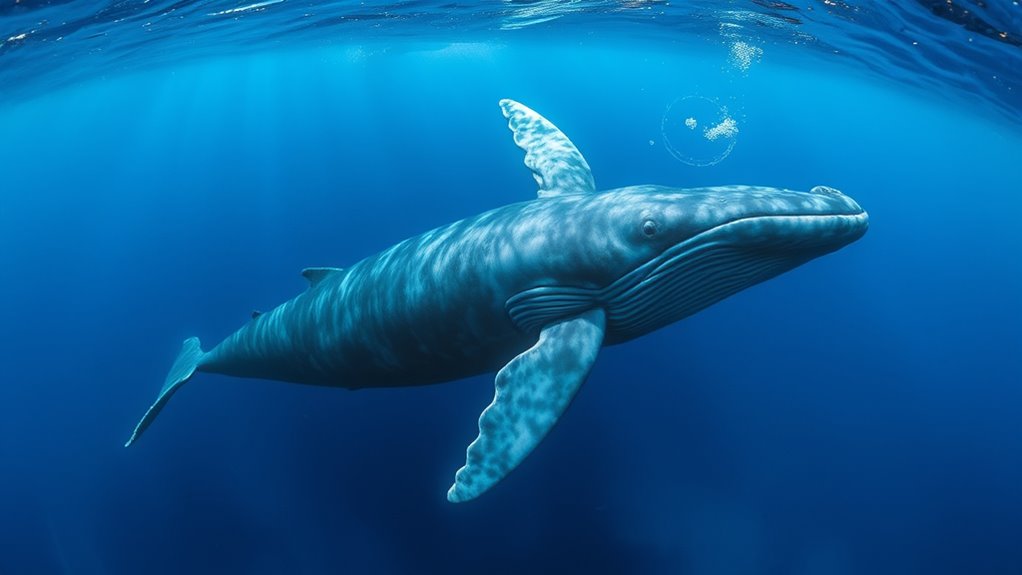
You can expect a blue whale to hold its breath underwater for around 10 to 20 minutes during typical dives, thanks to its huge lung capacity and oxygen-storing muscles. These incredible marine mammals have adapted to maximize their breath-holding ability. They slow their heart rate and limit blood flow to conserve oxygen.
Most dives last 5 to 15 minutes, with surface breaks lasting about 10 to 15 minutes to recover. Their dive times balance energy use and feeding needs. There’s plenty more to discover about how these giants manage their underwater stamina and hunting.
How Long Can a Blue Whale Hold Its Breath During a Dive?
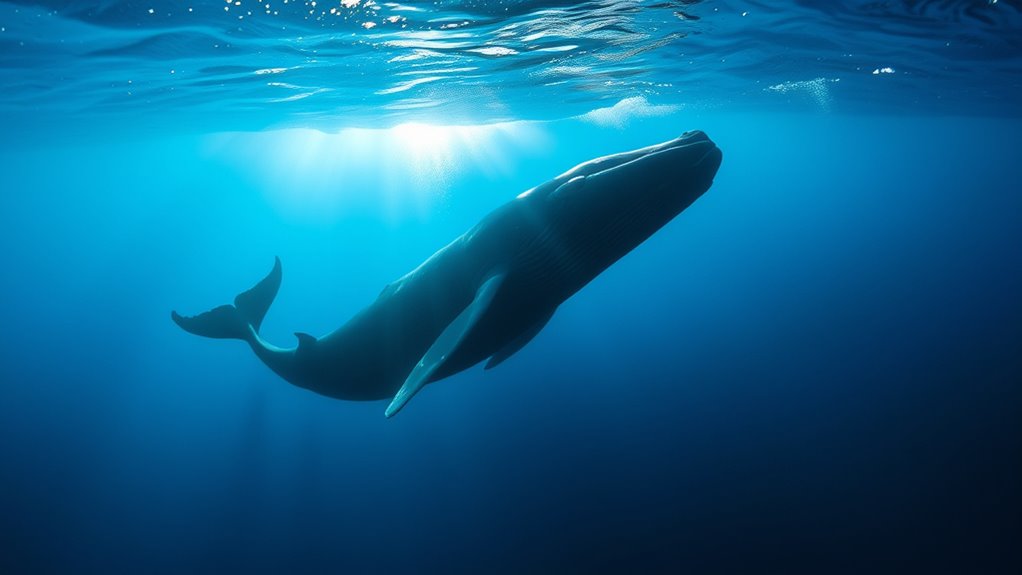
Although blue whales typically hold their breath for 10 to 20 minutes during a dive, they can extend this time up to 30 minutes when necessary. As marine mammals, blue whales rely on their impressive oxygen capacity and large lung capacity to manage their diving duration efficiently. Their respiratory system supports long dives by maximizing oxygen storage and minimizing energy use underwater.
You might be surprised to learn that while the average breath-hold lasts around 10 to 20 minutes, blue whales occasionally push their limits, with some rare long dives lasting over two hours. However, these extreme cases are exceptions. Generally, the balance between oxygen use and energy expenditure determines how long blue whales can hold their breath during each dive, showcasing their remarkable adaptation to life beneath the waves.
What Physical Traits Help Blue Whales Stay Underwater Longer
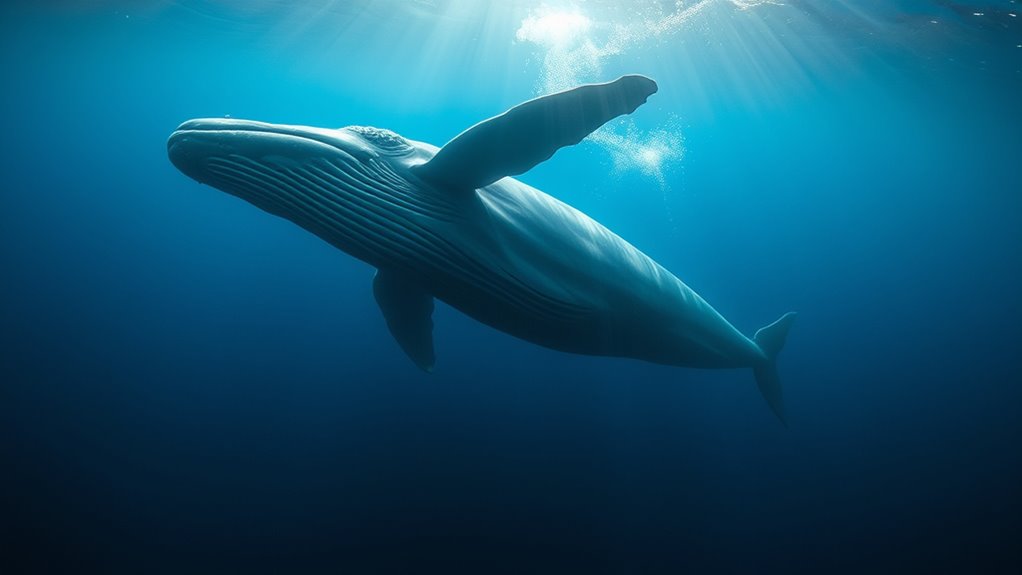
Several remarkable physical traits help blue whales stay underwater longer than most other animals. Their impressive lung capacity lets them take in vast amounts of oxygen before diving, while their muscular flaps tightly seal their blowholes underwater, preventing water entry and preserving oxygen. You’d notice their respiratory system is highly efficient, expelling up to 90% of stale air to maximize oxygen intake.
Blue whales maximize oxygen intake with huge lungs, sealed blowholes, and efficient air exchange.
Their muscles contain high levels of myoglobin, enhancing oxygen storage and usage during extended dive duration. Plus, blue whales slow their heart rate dramatically—down to just 2 beats per minute—to conserve oxygen for essential organs. Together, these features boost oxygen efficiency, enabling blue whales to hold their breath for extraordinary periods beneath the waves.
- Large lung capacity for greater oxygen storage
- Muscular flaps sealing blowholes underwater
- Efficient respiratory system expelling stale air
- High myoglobin concentration in muscles
- Slowed heart rate conserving oxygen
How Blue Whales Manage Oxygen to Extend Their Breath-Hold
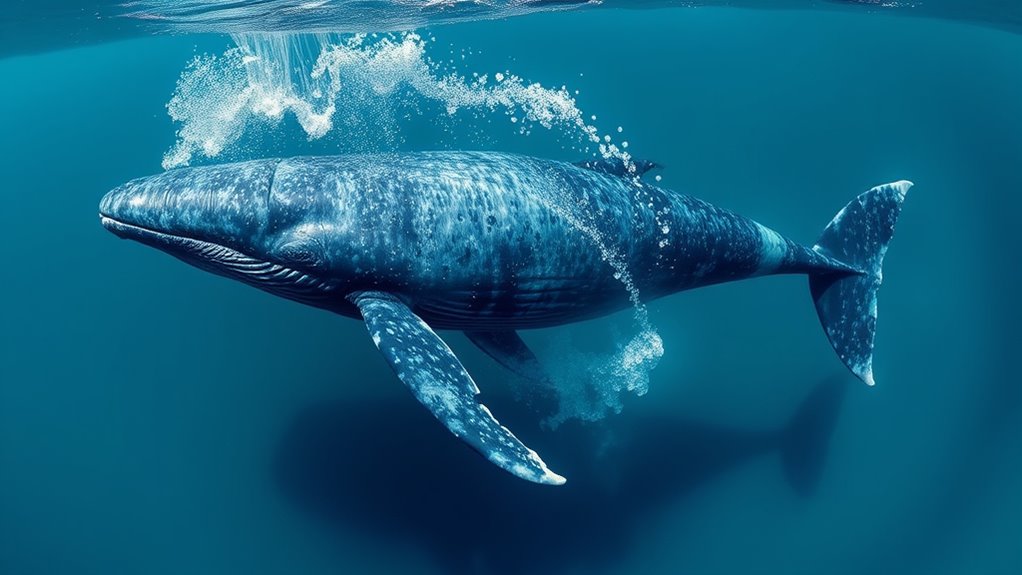
When blue whales dive, they manage oxygen with remarkable efficiency to stay underwater for up to 30 minutes. You’ll notice their large lung capacity allows rapid oxygen intake, filling their lungs with about 5,000 liters of air. Much of this oxygen—up to 90%—is stored in muscles thanks to high myoglobin levels.
During the breath-hold, blue whales reduce their heart rate to as low as 2 beats per minute, conserving precious oxygen. They also control blood flow by restricting it to essential organs, ensuring oxygen reaches where it’s most needed. These combined strategies let blue whales optimize oxygen use during each dive, effectively extending their breath-hold and enabling them to dive deep and long despite their massive size.
What Physiological Changes Happen During Deep Dives
You’ve seen how blue whales manage oxygen to stay underwater for long stretches. During deep dives, they trigger essential physiological adaptations to maximize oxygen conservation. Their heart rate slows drastically in bradycardia, sometimes dipping to just 2 beats per minute.
Vasoconstriction limits blood flow to non-essential organs, directing oxygen-rich blood to the brain and heart. Muscular flaps seal their blowholes tightly, preventing water entry and aiding efficient oxygen use. Their muscles hold abundant myoglobin, storing oxygen reserves for extended use.
Here’s what happens during deep dives:
- Heart rate drops markedly (bradycardia)
- Blood vessels constrict (vasoconstriction)
- Blowholes close with muscular flaps
- Muscles use myoglobin to store oxygen
- Oxygen reserves focus on critical organs
These changes help blue whales dive deeply and hold their breath longer.
Why Do Blue Whales Usually Dive Only 5 to 15 Minutes?
Although blue whales can hold their breath for extended periods thanks to their unique physiology, they usually dive for only 5 to 15 minutes. This is because their lung capacity and oxygen stores are optimized for these durations. Their feeding strategy involves lunge-feeding at relatively shallow depths, so longer underwater time isn’t necessary.
Physiological limits like oxygen conservation and avoiding lactic acid buildup also restrict dive length. You’ll find that blue whales balance their need to breathe with efficient oxygen use during these dives.
| Factor | Explanation | Impact on Dive Duration |
|---|---|---|
| Lung Capacity | Large lungs store ample oxygen | Supports 5-15 minute dives |
| Oxygen Efficiency | High myoglobin concentration | Maximizes oxygen use underwater |
| Feeding Strategy | Lunge-feeding at shallow depths | Limits need for long dives |
| Physiological Limits | Avoids lactic acid buildup | Caps dive time |
| Depth | Usually moderate, not extreme | Reduces energy and oxygen use |
How Energy Costs Limit Blue Whale Dive Durations
Because blue whales expend tremendous energy chasing and filtering krill during foraging dives, their underwater time remains limited. Even though they can theoretically hold their breath for over 30 minutes, their actual dive time averages around 7.8 minutes due to high feeding costs and oxygen costs.
The intense energy expenditure during foraging dives restricts their underwater duration and dive limits. You should know these key factors:
- Blue whales need about twice as long at the surface to recover.
- Oxygen storage in muscles and lungs aids breath holding.
- Larger size correlates with shorter dive times.
- High energy expenditure limits dive depth and length.
- Foraging dives demand substantial energy, capping underwater duration.
How Prey Availability Affects Blue Whale Diving Behavior
You’ll notice blue whales adjust their time underwater based on how dense their prey is, often staying closer to the surface when krill is plentiful. At night, they shift their feeding patterns since krill move deeper, requiring longer trips below.
Understanding these changes helps explain how whales manage their breath-holding during different foraging conditions.
Prey Density Impact
When prey is abundant near the surface, blue whales adjust their diving behavior to feed more efficiently by diving shallower and more frequently. High prey density means shorter dive duration and reduced surface intervals, enhancing feeding efficiency. You’ll notice their foraging behavior changes with krill concentration—when it’s low, they dive deeper and longer, increasing energy expenditure.
Seasonal shifts in prey availability also affect dive depth and timing. Here’s what prey density impacts:
- Shallower dive depth with high krill concentration
- More frequent but shorter dives
- Reduced surface intervals for quicker feeding cycles
- Lower energy expenditure due to easy prey access
- Adjusted foraging behavior responding to prey availability
Understanding these patterns helps you see how blue whales optimize breath-hold times based on prey density.
Nighttime Foraging Shifts
Blue whales adjust their feeding habits not only based on prey density but also on the time of day. At night, krill—their main prey—move closer to the surface, causing a vertical shift in prey distribution. This shift leads blue whales to hold shorter dives, often staying within the upper 50 meters, optimizing energy use and prey capture.
During nighttime foraging, their diving patterns become shallower and shorter compared to daytime deep dives.
| Time of Day | Dive Depth (m) | Dive Duration (min) |
|---|---|---|
| Daytime | 100-200 | 8-12 |
| Nighttime | 0-50 | 3-5 |
| Surface | 0-10 | Brief holds |
You’ll notice these adjustments let blue whales maximize feeding while conserving energy.
How Blue Whales Recover at the Surface After Long Dives
Although they spend long periods underwater, these giants recover effectively by surfacing for about 10 to 15 minutes after each dive. During this surface interval, blue whales engage in surface recovery to restore their oxygen levels and manage carbon dioxide buildup from their breath hold. Thanks to their large lung capacity, they inhale vast amounts of air quickly, maximizing oxygen stores.
Their diving behavior includes slowing their heart rate and using myoglobin to absorb oxygen efficiently. You can visualize their recovery process through these points:
- Rapid, deep breaths at the surface
- Efficient expulsion of carbon dioxide
- Lung capacity enabling quick air intake
- Surface interval lasting twice the dive time
- Use of oxygen stores and myoglobin to sustain activity
This balance ensures blue whales thrive beneath the waves.
Frequently Asked Questions
What Animal Holds Its Breath the Longest?
The animal that holds its breath the longest is the Cuvier’s beaked whale.
You might be surprised, but it can dive over three hours underwater, far surpassing blue whales or any other marine mammals you know.
How Do Whales Sleep if They Have to Come up for Air?
You’ll find whales sleep by resting one half of their brain at a time, keeping the other alert to breathe. They consciously surface every 10 to 15 minutes, ensuring they get enough air while still resting.
How Long Can a Blue Whale Go Without Oxygen?
You can expect a blue whale to go without oxygen for about 10 to 20 minutes, but sometimes it can hold its breath up to 30 minutes. This ability is thanks to its large lungs and efficient oxygen use during dives.
The whale’s physiology is specially adapted to conserve oxygen and manage long periods underwater. This allows it to dive deep and stay submerged while searching for food.
Could a Human Survive in a Blue Whale?
You couldn’t survive inside a blue whale; its body isn’t meant for humans, and you’d quickly run out of oxygen.
Plus, the environment would be hostile, making it impossible for you to live or breathe there.
Conclusion
When you watch a blue whale dive, remember it’s like a master of the deep, holding its breath as if cradling a secret beneath the waves. Though it can stay submerged for up to 15 minutes, it chooses shorter dives, balancing energy like a dancer on a tightrope.
You see, the whale’s breath is more than air—it’s a rhythm of life, a pulse connecting the vast ocean to its mighty heart. This incredible ability to hold its breath allows the blue whale to explore the depths of the ocean, making it a true giant of the sea.
Understanding how long a blue whale can hold its breath reveals not just a fact but a glimpse into the remarkable adaptations of one of nature’s most magnificent creatures.