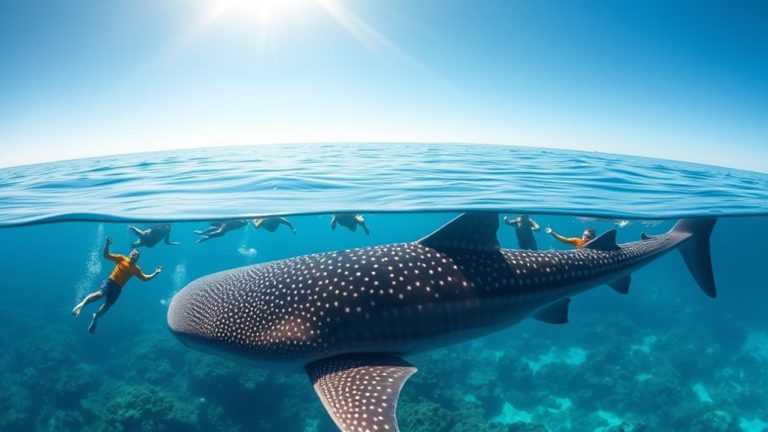
What Type of Carnivore Diet Does a Whale Have?
If you want to know what type of carnivore diet a whale has, it depends on whether it’s a baleen or toothed whale.
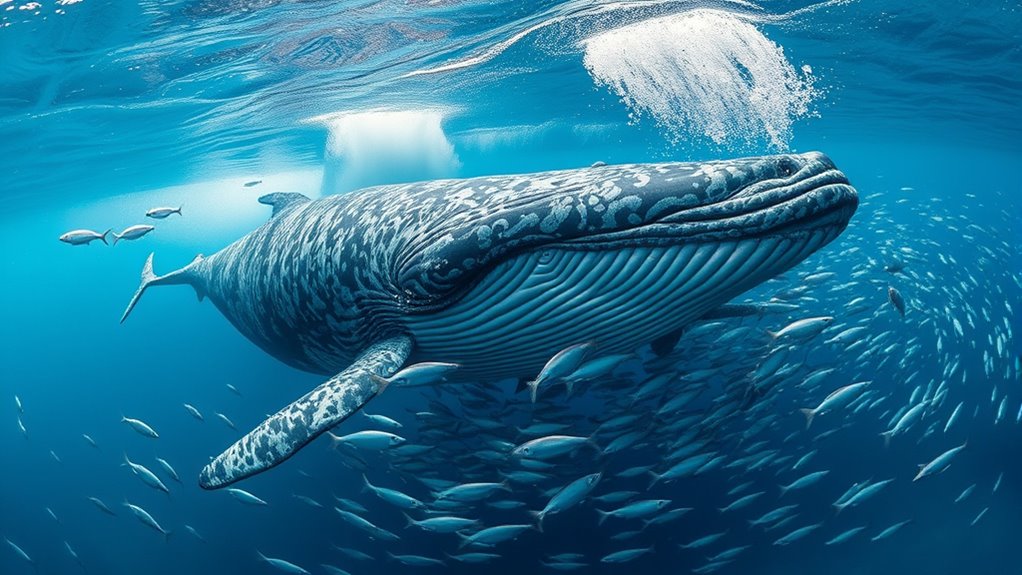
Baleen whales filter tiny prey like krill and small fish using baleen plates, eating huge amounts daily.
Toothed whales hunt larger prey—fish, squid, seals—using echolocation and teeth.
Both have specialized gut microbes to digest their carnivorous diets efficiently.
Keep learning to discover how these feeding habits shape their behavior and migrations.
What Do Whales Eat? An Overview of Their Diet
What exactly do whales eat? As a whale, your diet depends on your species. Baleen whales primarily consume tiny prey like krill and small fish, filtering massive amounts of water through their baleen plates.
This diet shapes the baleen whales’ microbiome, which helps break down these small creatures efficiently. On the other hand, toothed whales, such as dolphins and sperm whales, actively hunt larger individual prey like fish, squid, and even marine mammals using echolocation.
Killer whales’ diets vary by region, including fish, seals, and occasionally large whales. Each whale species adapts its feeding strategy to its environment, whether it’s bubble-net feeding or deep-sea hunting.
This diversity reflects the whale’s carnivorous nature and their essential role in marine ecosystems.
How Baleen Whales Filter and Digest Their Prey
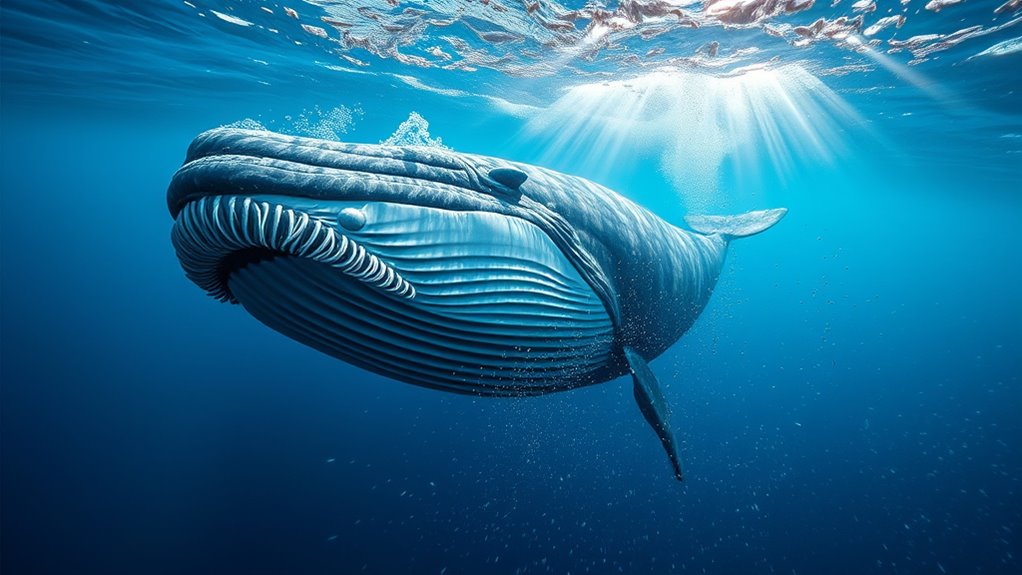
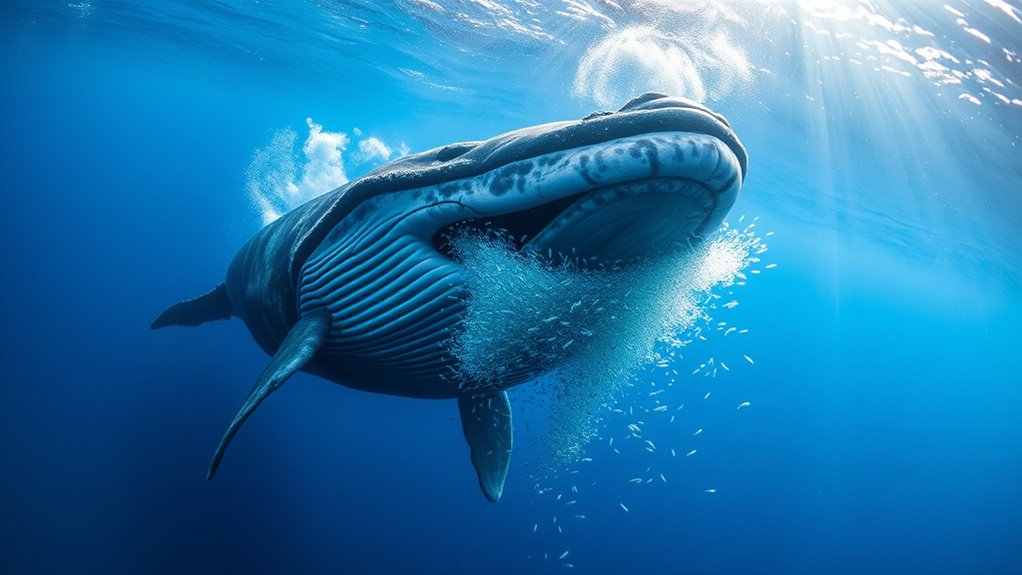
Although baleen whales consume vast amounts of tiny prey, they rely on a unique filtering system to separate food from seawater. As filter feeders, they take in huge gulps of water filled with small fish and krill. Then, they close their mouths and push the water out using their tongues.
The baleen plates, made of keratin with hair-like fringes, trap the prey while letting water escape. This method allows species like blue whales to consume up to four tons of krill daily. Some baleen whales, such as humpbacks, use bubble-net feeding, blowing bubbles to herd prey into tight balls before gulping.
This efficient filtering system guarantees they gather enough food to fuel their massive bodies.
Baleen vs. Toothed Whales: Different Feeding Strategies
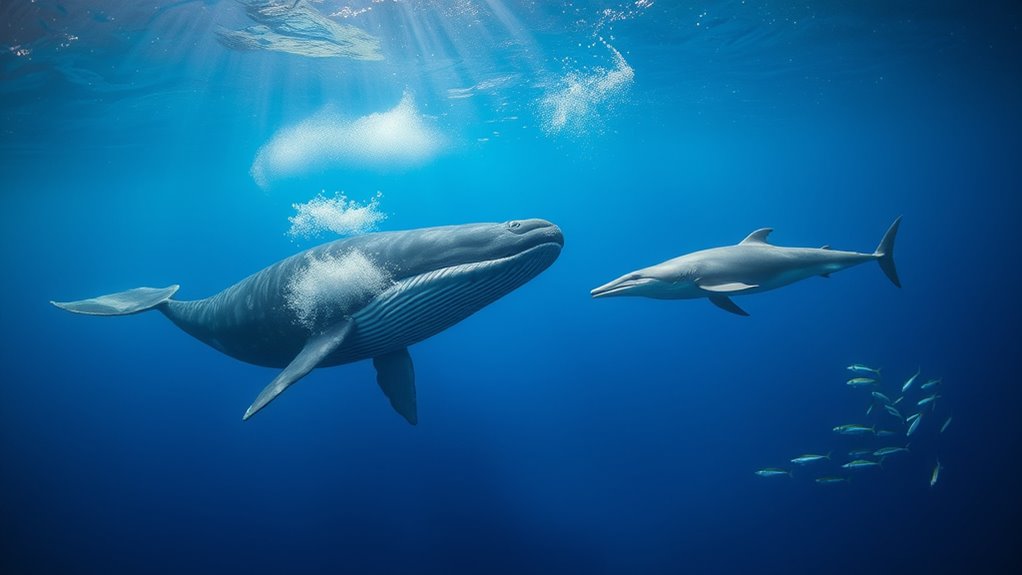
When you compare baleen and toothed whales, their distinct feeding strategies quickly stand out. Baleen whales use baleen plates to filter thousands of tiny prey like krill from large volumes of water, relying on passive filter feeding.
In contrast, toothed whales actively hunt individual prey such as squid and fish, often using echolocation and sometimes cooperating in pods.
| Aspect | Baleen Whales | Toothed Whales |
|---|---|---|
| Feeding Method | Filter feeding with baleen | Active hunting with teeth |
| Prey Type | Small prey (krill, small fish) | Larger prey (squid, fish, mammals) |
| Hunting Style | Passive, filter large volumes | Active, targeted hunting |
Understanding these differences helps you appreciate how each adapts to its ecological niche.
What Toothed Whales Eat and How They Hunt
Since toothed whales rely on active hunting, they use echolocation to pinpoint prey like fish, squid, and crustaceans in the vast ocean. As carnivores, toothed whales grasp and tear their prey with sharp teeth, employing high-speed chases and complex social tactics.
For example, sperm whales dive deep to catch large squid, sometimes consuming up to 750 daily. Killer whales, apex predators among toothed whales, hunt a wide range of animals including fish, seals, and even large whales. Smaller toothed whales like dolphins often cooperate to herd schooling fish or crustaceans.
You’ll find that these carnivores rely heavily on their keen senses and teamwork to succeed in the hunt, making their feeding strategies diverse and highly effective under different ocean conditions.
How Baleen Whales Digest Chitin in Their Diet
You might wonder how baleen whales break down chitin from krill exoskeletons in their diet. Their gut hosts specialized microbes that ferment chitin, turning it into simpler compounds they can absorb.
Notably, these microbial communities resemble those in herbivores, showing an unexpected link between their carnivorous diet and herbivorous digestion.
Chitin Digestion Mechanisms
Although baleen whales primarily consume animal prey, they’ve developed a unique way to digest chitin, the tough polysaccharide in krill exoskeletons. You might assume their carnivorous diet wouldn’t require breaking down such complex carbohydrates, but their microbiome plays a vital role here. Specialized gut microbes produce enzymes that specifically target chitin, breaking it down much like how herbivores digest cellulose.
This microbial fermentation occurs in the whales’ multi-chambered stomachs, enabling them to extract valuable nutrients from chitin-rich prey efficiently. These microbes retain traits typical of herbivores, reflecting an evolutionary adaptation that allows baleen whales to process animal-based polysaccharides effectively. This mechanism highlights the fascinating balance between their carnivore diet and microbial assistance in digesting otherwise tough material.
Microbiome Role In Digestion
When baleen whales consume krill, their specialized gut microbiome kicks into gear, breaking down chitin—the tough material forming the exoskeletons of their prey. This microbiome retains traits similar to herbivores, equipped to digest complex polysaccharides like chitin. Specific microbes produce chitinases, enzymes that facilitate chitin digestion, showcasing an evolutionary adaptation in their digestion system.
| Microbiome Trait | Function | Example Microbe |
|---|---|---|
| Herbivorous traits | Digest complex polysaccharides | Cellulose/chitin digesters |
| Enzyme production | Chitinase enzymes | Chitin-degrading bacteria |
| Evolutionary adaptation | Efficient crustacean digestion | Specialized microbial communities |
This unique microbiome composition enables baleen whales to efficiently extract nutrients from their crustacean-rich diet.
Comparison To Herbivores
Baleen whales rely on a gut microbiome that closely resembles those found in herbivores to break down chitin from their krill-rich diet. Even though baleen whales are carnivorous, their microbiome has evolved to digest the tough polysaccharide chitin, similar to how herbivores process cellulose. Here’s how this comparison unfolds:
- Baleen whales’ microbiota includes microbes specialized in polysaccharide breakdown, mirroring those in herbivores.
- Their digestive system structure supports fermentation, like herbivores, facilitating chitin digestion.
- The baleen plates filter krill, rich in chitin, requiring microbial assistance for effective nutrient extraction.
- This evolutionary adaptation lets baleen whales efficiently digest animal-based polysaccharides, blending carnivore diet traits with herbivore-like microbiome functions.
Understanding this helps you see how baleen whales uniquely bridge carnivore and herbivore digestion strategies.
How Whale Size Affects Their Dietary Needs
Since whales grow to enormous sizes, their dietary needs expand dramatically to keep up with their energy demands. Take blue whales, for example—they consume thousands of pounds of tiny prey like krill daily to fuel their massive bodies. As your size increases, so does the volume of prey you need to eat, often exponentially.
Your filter-feeding adaptations allow you to efficiently process large amounts of water filled with small animals, making it easier to meet these intense energy requirements. Even though you’re huge, your diet mainly consists of small creatures, showing that bigger size means you rely on consuming vast quantities rather than large prey.
Plus, your large fat reserves let you fast for long periods when food is scarce.
Whale Diets Across Different Marine Habitats
Your whale’s size and feeding style shape where and what it eats across the oceans. Baleen whales and toothed whales adapt their diets to different marine habitats, targeting prey best suited to their feeding methods.
- Baleen whales thrive in cold, nutrient-rich waters, filtering tiny krill and small fish through baleen plates. Blue whales, for example, consume up to 4 tons of krill daily during feeding seasons. Humpback whales use bubble-net feeding near the surface to trap schooling fish and krill.
- Toothed whales hunt larger prey like squid, seals, and fish in deeper or coastal waters, using echolocation to find their meals.
Understanding these habitat-based dietary habits helps you appreciate how diverse and specialized whale carnivore diets truly are.
How Whale Diets Shape Behavior and Migration
You’ll notice that whales travel vast distances to reach feeding grounds rich in prey, like polar regions bursting with krill. Their migration isn’t random—it’s closely tied to where their food moves throughout the year.
Understanding these feeding patterns helps you see how diet shapes both their behavior and migration routes.
Feeding Patterns and Locations
Although whales inhabit vast oceans, their feeding patterns revolve around seasonal migrations to areas rich in prey. You’ll notice that their location choices are vital to maximizing food intake. Here’s how feeding patterns and location shape whale behavior:
- Baleen whales travel to high-latitude feeding grounds in summer where krill and small fish abound.
- Toothed whales track prey like squid, following their seasonal movements to shallow waters.
- Blue whales cover thousands of miles between breeding and feeding sites to access rich prey zones.
- Migration routes form predictably around prey availability, ensuring whales arrive where food is plentiful.
Migration Linked to Prey
Because whales depend heavily on specific prey, their migrations closely follow the seasonal abundance of these food sources. When you observe baleen whales, you’ll notice they head toward polar waters in summer to feast on krill and small fish, then move to warmer regions during winter.
Toothed whales, like orcas and sperm whales, migrate to deep-sea or coastal areas where squid and large marine mammals are plentiful. You can see how changes in prey availability due to ocean conditions directly trigger whale migration. This behavior guarantees they access enough food while optimizing energy use.
What Whale Gut Microbiomes Reveal About Their Carnivorous Diet
How do whale gut microbiomes support their carnivorous diet? By hosting microbes similar to those in terrestrial carnivores, whales efficiently digest animal prey. Their gut microbiome reflects a deep evolutionary link to meat-eating ancestors, helping break down proteins and lipids essential for their survival.
Here’s what you should know:
- Whale gut microbiome contains chitin-digesting bacteria, aiding in digesting krill and small fish.
- Microbial diversity in whales is specialized for processing high-protein diets.
- Comparative studies show whale gut microbes align more with carnivores than herbivores.
- These microbes adapt whales’ digestion to their meat-based carnivorous diet effectively.
Understanding their microbiome gives you insight into how whales thrive on a strictly carnivorous diet.
Frequently Asked Questions
What Do Whales Eat Carnivores?
You eat a variety of marine animals if you’re a whale—fish, squid, krill, and even seals. Your diet depends on your species, but you’re always a carnivore feeding on other animals in the ocean.
Is a Whale a Carnivore, Herbivore, or Omnivore?
You might think whales eat everything, but they’re strict carnivores—devouring fish, squid, or krill. Their diet’s like a finely tuned orchestra, hunting or filtering prey, never dabbling in plants or omnivorous meals.
What Type of Diet Do Whales Have?
You have a carnivorous diet if you’re a whale, feeding on fish, squid, or krill. Baleen whales filter small prey, while toothed whales actively hunt larger animals using echolocation and powerful hunting skills.
Why Don’t Orcas Eat the Whole Shark?
You might think orcas eat whole sharks, but they don’t. They target nutrient-rich parts like livers to avoid injury and save energy.
This selective feeding keeps you safe and maximizes nutrition during hunts.
Conclusion
You might be surprised to learn that some baleen whales can consume up to 4 tons of krill daily, showcasing just how intense their carnivore diet is. Whether they’re filtering tiny crustaceans or hunting fish and squid, whales have evolved unique feeding strategies to thrive.
Understanding these diets not only reveals their role in marine ecosystems but also highlights how their size and behavior depend heavily on what—and how much—they eat.
In conclusion, the type of carnivore diet a whale has is specialized and varies between species, emphasizing the importance of their feeding habits in maintaining oceanic food chains and ecological balance.