What Does a Whale Penis Look Like?
If you wonder what a whale penis looks like, it’s massive—up to 16 feet long in blue whales—and flexible, tucked inside a genital slit until needed. It’s thick, strong, and can twist during mating, helping whales align properly.
Different species show variations in size and shape, from the huge, sturdy humpback organ to the more flexible dolphin’s.
These features support complex mating strategies and social signals. There’s much more fascinating detail behind this unique adaptation.
What Does a Whale Penis Look Like?
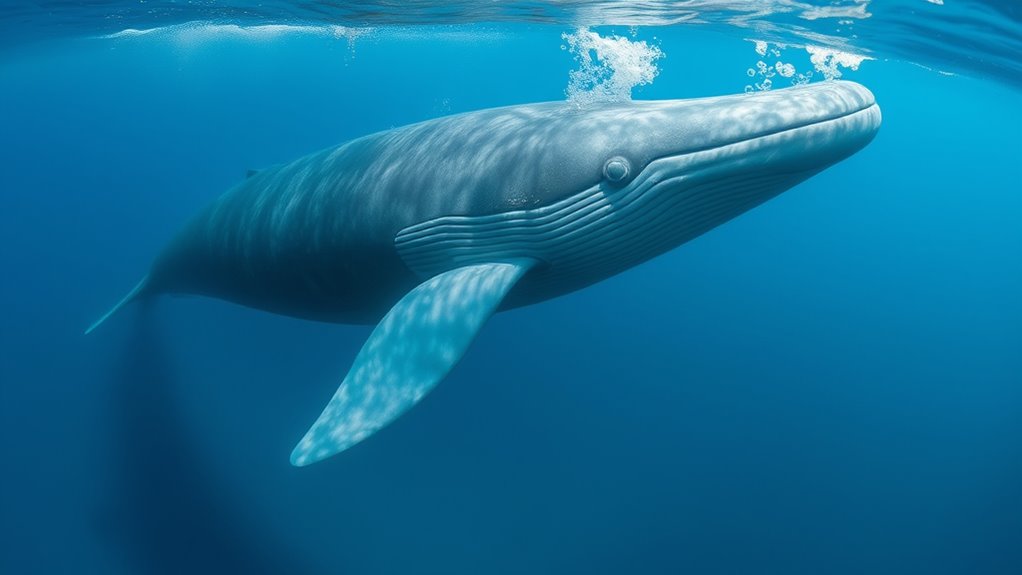
Although whale penises are rarely visible since they stay tucked inside a genital slit, you might be surprised to learn that a blue whale’s penis can reach up to 10 feet long and nearly 3 feet in diameter when erect. This massive organ is fibroelastic, meaning it’s flexible and can change shape without bones inside.
When mating, the blue whale penis extends out of the genital slit, sometimes twisting in a spiral form. Its tough, fibrous tissue supports its large size and elasticity, allowing precise positioning. You won’t usually see a whale penis since it stays hidden, but when it emerges, its impressive length and fibrous texture are unmistakable.
The fibroelastic structure helps whales manage this extraordinary organ efficiently during mating.
Where Is the Whale Penis Located and How Is It Stored
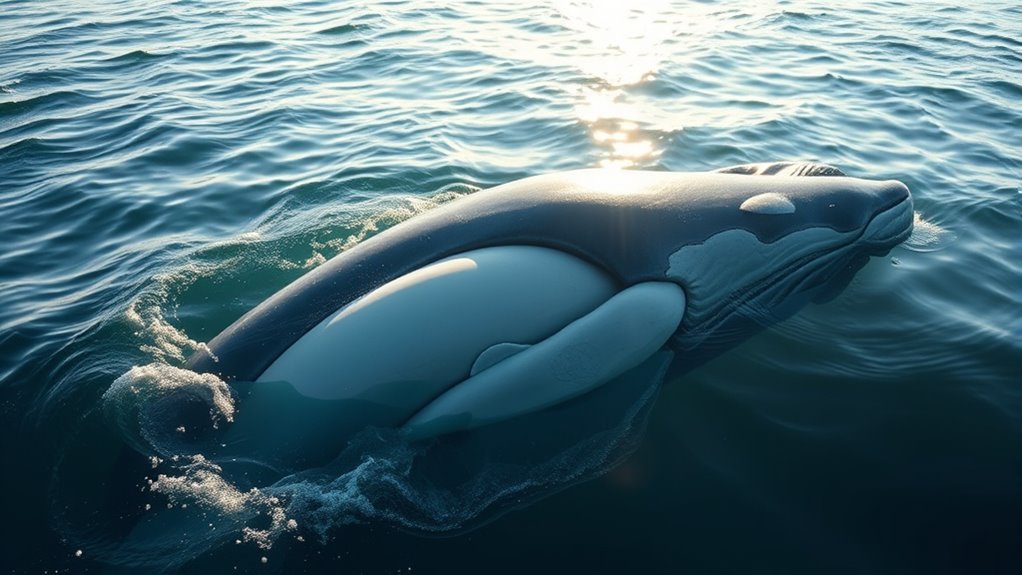
You’ll find a whale’s penis tucked safely inside a genital slit on the underside of its body. This retractable organ remains hidden until needed, thanks to the whale’s unique internal storage system. The genital slit, located near the abdomen, protects and conceals the penis, reducing drag while the whale swims.
When mating or excited, the penis extends smoothly from this slit.
Imagine this setup as:
A streamlined genital slit hides a retractable penis, ensuring protection and smooth swimming for the whale.
- A smooth genital slit along the whale’s belly
- A retractable penis concealed within the body
- Muscles near the pelvis aiding movement
- Internal storage shielding the organ from damage
- Streamlined design enhancing swimming efficiency
This clever storage ensures the whale stays agile underwater while safeguarding its reproductive organ until the moment arrives.
How Whale Penis Size and Shape Vary Across Species
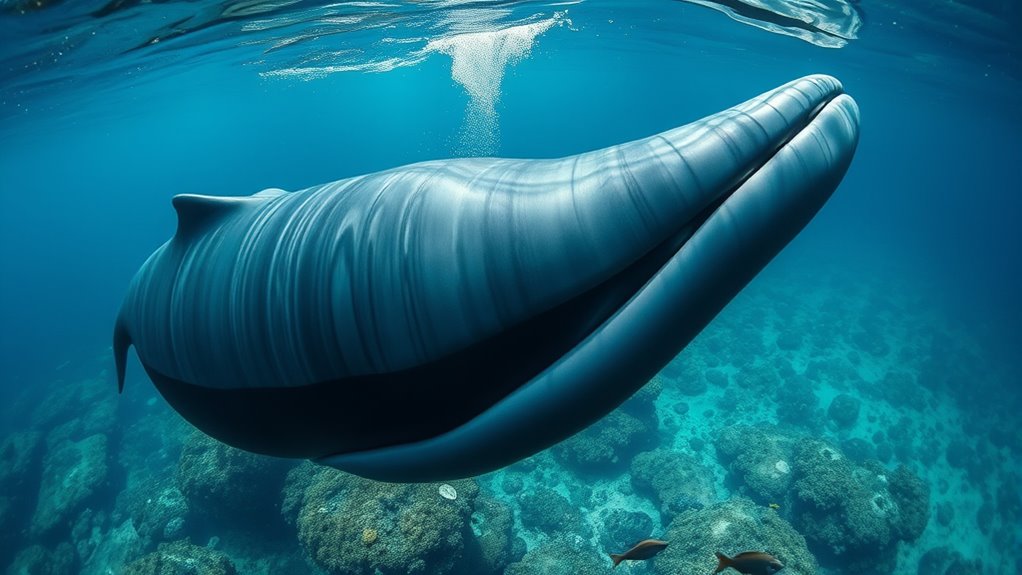
While the whale’s penis remains hidden inside its body until needed, its size and shape can vary dramatically between species. For instance, blue whales have the largest penis size, reaching up to 16 feet, with an S-shaped organ when retracted. In contrast, humpback whales boast penises around 10 feet long, often used during mating displays.
The shape ranges from straight to curved, adapting to each species’ reproductive needs. These variations aren’t random; they correlate with mating behaviors and testes size. The penis’s structure includes elastic and fibroelastic tissues, enabling flexibility and strength.
How Do Whales Use Their Penises During Mating?
When whales mate, males control and position their penises with impressive precision, extending them through a genital slit using strong muscles and elasticity. You’ll notice they can adjust or steer to guarantee successful copulation, even while swimming.
In competitive situations, males may also display their penises as part of dominance rituals to attract females.
Penis Control And Positioning
Although you might not see it, whales expertly control their penis position during mating by using muscles attached to their pelvis, allowing precise alignment with the female’s genital opening. Their penis control relies on specialized musculature and remarkable elasticity. The penis, hidden within a genital slit when not in use, emerges through strong muscle contractions.
Its fibroelastic nature lets it bend and steer to navigate the female’s vaginal folds for successful copulation. Imagine this control as:
- Muscles contracting to extend and retract the penis
- Steering the penis tip with subtle muscular adjustments
- The genital slit opening only during mating
- Elasticity allowing shape changes without damage
- Precise alignment for fertilization
This combination of musculature and elasticity ensures whales achieve proper positioning despite underwater challenges.
Mating Competition Behavior
You might expect whales to use their penis solely for mating, but males also display it prominently during competition. When you’re whale watching, you might notice males extruding their penises aggressively to intimidate rivals or assert dominance. This behavior isn’t just for show—it signals strength and reproductive fitness to both competitors and females.
During territorial disputes or courtship rituals, a whale may use its erect penis to physically block rivals from accessing a female. Such displays are essential in the complex competition for mates, combining visual cues with physical presence to maximize reproductive success.
Elasticity And Function
Because whale penises are fibroelastic, they can bend and stretch in ways that help males position themselves precisely during mating. This elasticity allows whales to control their genital shape and direction, making copulation more effective. Unlike many animals, their penises often stay hidden inside the genital slit, extending only during mating or display.
This flexibility lets whales maneuver in tight underwater conditions, ensuring successful copulation. For example, blue whales can curve their penises in an S-shape when retracted and then extend them outward when needed.
Picture this:
- Penis tucked neatly inside the genital slit
- Smooth extension during copulation
- Flexible bending to align with the female
- S-shaped curves when retracted
- Precise control in underwater mating
This unique function helps whales reproduce efficiently despite their massive size.
Blue Whale Penis Size Compared to Other Whales
When you compare blue whale penises to those of other whale species, you’ll notice they’re markedly larger, measuring up to 3 meters on average and even reaching 5 meters in rare cases. Their size dwarfs that of sei whales and smaller species like gray or right whales, which have penises less than 2 meters long.
This massive anatomical difference highlights just how unique blue whales are among their marine relatives.
Blue Whale Penis Dimensions
How large can a blue whale’s penis get compared to other whales? The blue whale boasts some of the largest penises in the animal kingdom, with an impressive penis length that far exceeds other whale species. Here’s a snapshot to help you visualize:
- Typically 2.4 to 3 meters (7.9 to 9.8 feet) long when erect
- Diameter around 30 to 36 centimeters (12 to 14 inches)
- Entire organ can reach up to 5 meters (16.4 feet) in length
- Weighs between 350 to 450 kilograms (770 to 990 pounds)
- Nearly three times longer than the sei whale’s penis
Compared to gray, right, and killer whales whose penises measure about 1.8 meters (6 feet), the blue whale’s penis length truly stands out as the largest penises among whales.
Comparison With Other Species
Now that you’ve seen just how massive a blue whale’s penis can get, it’s worth comparing it to those of other whale species. Blue whales have the largest penis size among whales, averaging 7 to 10 feet, with some reaching up to 16 feet.
In contrast, humpback whales’ penises max out around 10 feet, and sei whales have organs nearly three times smaller than blue whales. This significant difference in penis size reflects the overall body size of each species, with blue whales being the largest marine mammals.
Anatomical Size Significance
Although you might already know that blue whales are the largest animals on Earth, their impressive size extends to their reproductive anatomy as well. The anatomical significance of the blue whale’s penis size is truly remarkable when compared to other whales. You’ll find that:
- The blue whale’s penis averages 2.4 to 3 meters (7.9 to 9.8 feet) in length.
- When fully erect, it can reach up to 5 meters (16.4 feet).
- This length is about twice that of gray or right whales.
- Their testes weigh up to 70 kilograms (154 pounds).
- Such size supports intense reproductive competition.
This immense penis size highlights the blue whale’s dominance not just in size but also in reproductive anatomy among cetaceans.
Unique Penis Features in Dolphins and Humpback Whales
When you look at dolphins, you’ll notice their penises aren’t just large—they’re incredibly flexible and controllable, allowing precise movements during mating. This flexibility is key in the whale family, enabling complex reproductive behaviors. Male dolphins can even tow swimmers with their erect penises, showcasing strength and control.
Female dolphins have special penile folds that regulate mating, adding another layer to reproductive success.
| Species | Penis Feature | Function |
|---|---|---|
| Dolphin | High flexibility | Precise movement during mating |
| Dolphin | Penile folds (female) | Control penetration |
| Dolphin | Large size | Towing swimmers/objects |
| Humpback Whale | Massive, but less flexible | Structural support |
| Humpback Whale | Smooth surface | Efficient copulation |
These unique features highlight the incredible diversity in whale penis anatomy.
How Whales Keep Sperm Viable in Their Environment
Because sperm viability is crucial for successful reproduction, whales have evolved specialized ways to keep their sperm healthy despite their aquatic environment. You’ll find that whales carefully regulate blood flow and temperature regulation to maintain ideal sperm viability.
Here’s how they do it:
- Control blood flow through fins and flukes to cool the testes
- Use specialized arterial and venous circulation for temperature regulation
- Keep testes cooler than body temperature to prevent overheating
- Store sperm internally to protect it from the surrounding ocean environment
- Rely on fibroelastic penises that support internal sperm protection
These adaptations ensure sperm motility stays high and fertilization chances improve, even in the challenging conditions of the ocean. You can see how critical precise blood flow and temperature control are to whales’ reproductive success.
What Whale Penis Behavior Reveals About Reproduction
If you’ve ever wondered how whales communicate reproductive intentions, their penis behavior offers clear signals of dominance and readiness to mate. Whales use penis extrusion during competition to assert dominance and indicate reproductive availability. These displays aren’t just random; the size and frequency of penis behavior can influence female choice and male social ranking.
Although an erect whale penis is usually concealed, males rapidly deploy it during mating or competitive encounters. Protrusion and movement aren’t merely physical acts—they help whales secure reproductive access and ward off rivals.
Understanding these behaviors reveals how essential physical signaling and size are in whale reproduction, shaping mating strategies and social dynamics within their groups. So, when you see penis behavior in whales, you’re witnessing a fundamental part of their reproductive communication.
Frequently Asked Questions
How Does a Male Whale Penetrate Another Male Whale?
You’ll see a male whale use his flexible, muscular penis to steer and penetrate another male during dominance displays. He controls it precisely, often in aggressive interactions, to establish social hierarchy or compete within the pod.
What Animal Has the Biggest Private?
If size truly matters, you’ll find the blue whale’s private parts take the crown, stretching up to 16 feet long.
No other animal comes close to this ocean giant’s impressive “flagpole” in the sea.
How Big Are Whale Balls?
Whale balls, especially in blue whales, can weigh up to 70 kilograms each, totaling around 140 kilograms.
They’re huge but concealed inside the body, designed for massive sperm production to ensure reproductive success in the ocean.
What Does a Whale Vigina Look Like?
You might guess a whale vagina’s hidden, and you’d be right—it’s tucked inside a genital slit, flexible and able to stretch during mating.
Its folds help control access, making it both secretive and selective.
Conclusion
Now that you know a whale’s penis can reach up to 10 feet long—like the blue whale’s, the largest animal on Earth—you can appreciate just how extraordinary these creatures are.
Stored inside their bodies when not in use, whale penises vary greatly in size and shape across species, adapting perfectly for underwater mating. Understanding these unique features gives you a fascinating glimpse into the complex world of whale reproduction and their incredible biology.
In conclusion, a whale penis is not only remarkable in size but also specialized in form and function, highlighting the diversity of marine life and the fascinating anatomy of whales.