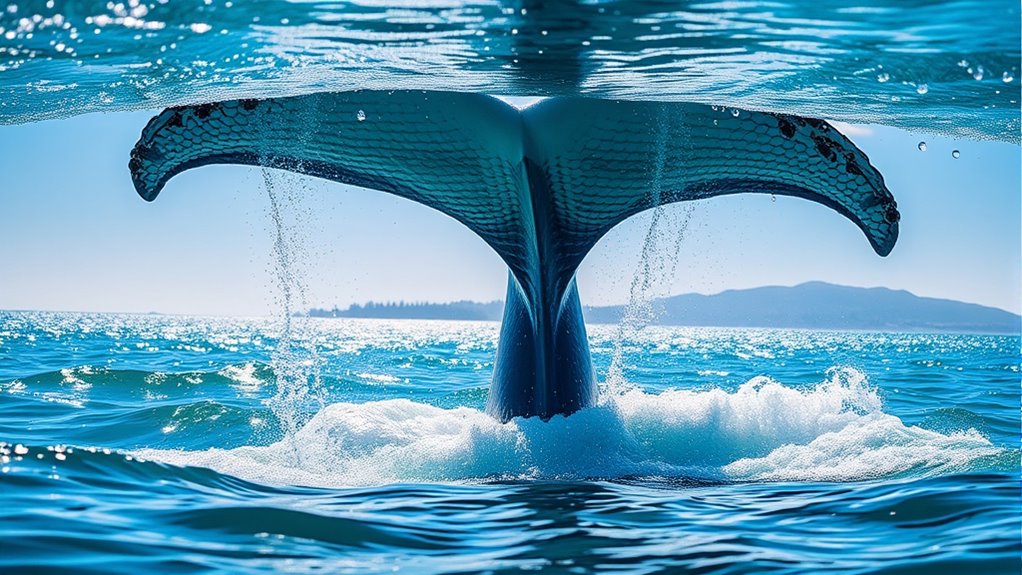
What Is a Whale Tail Called in Nature?
You call a whale’s tail a “fluke,” which is a broad, powerful fin that moves up and down to propel the whale through the water. In nature, the whale tail fluke is distinct from fish tails, which move side to side.
Flukes have two lobes connected to tail vertebrae with unique patterns that help identify individual whales. These flukes aren’t just for swimming—they play a key role in communication, feeding, and behavior.
Keep exploring to discover how these amazing structures impact a whale’s life.
What Is a Whale Tail Called?
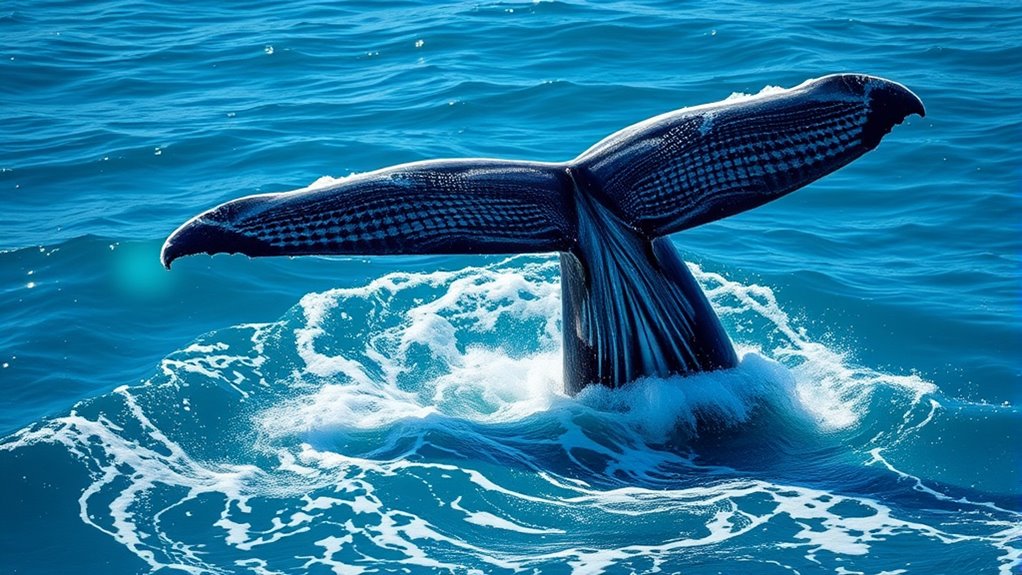
What do you call a whale’s tail? In marine biology, it’s known as a “fluke,” a term rooted in the German word “flugel,” meaning wing. The whale tail fluke is a broad, flat, and muscular extension of the whale’s tail vertebrae.
You rely on this powerful fluke to propel the whale through water with strong up-and-down movements. When you see a whale’s fluke, you’ll notice it has two lobes with serrated or notched trailing edges.
The underside of the whale tail fluke displays unique black, gray, and white pigmentation patterns, much like fingerprints. These distinctive patterns help researchers identify individual whales. Whether swimming, breaching, or tail-slapping, the fluke plays an essential role in the whale’s movement and behavior.
How Do Whale Flukes Differ From Fish Tails?
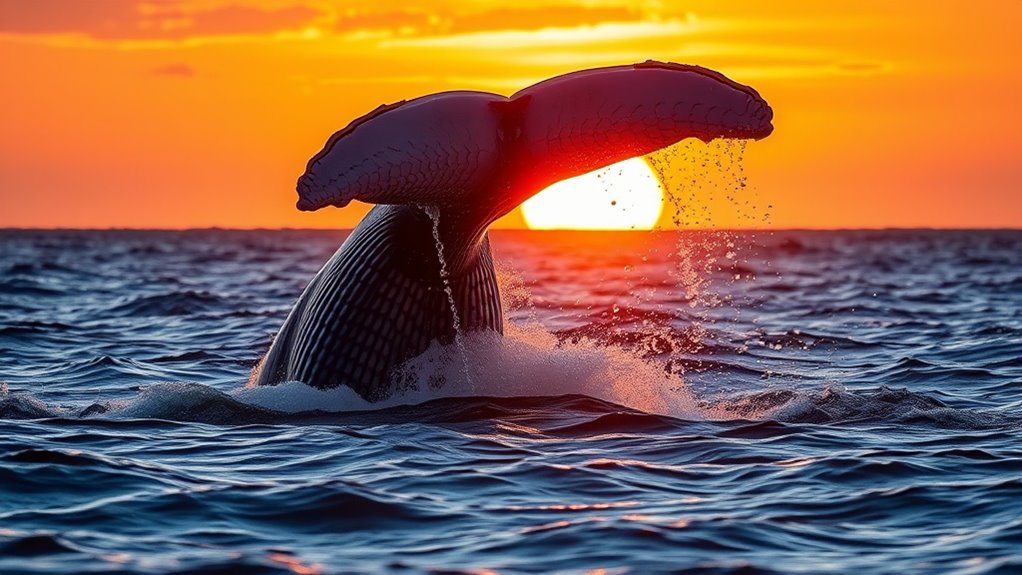
You’ve learned that a whale’s tail, or fluke, is a powerful tool for swimming. Whale flukes differ markedly from fish tails in structure and movement. Here’s how:
- Whale flukes are horizontal fins moving up and down, while fish tails are vertical, moving side to side.
- Whale flukes are broad, flat, and often patterned with scars; fish tails are narrower and less distinct.
- The powerful thrust in whale flukes comes from large, chevron-shaped tail vertebrae; fish tails rely on simpler cartilage or bones.
- Fish tails typically have forked or rounded shapes, contrasting with the flat, muscular design of whale flukes.
Understanding these differences helps you appreciate the unique adaptations whale flukes have for efficient swimming.
What Is the Anatomy of Whale Flukes?
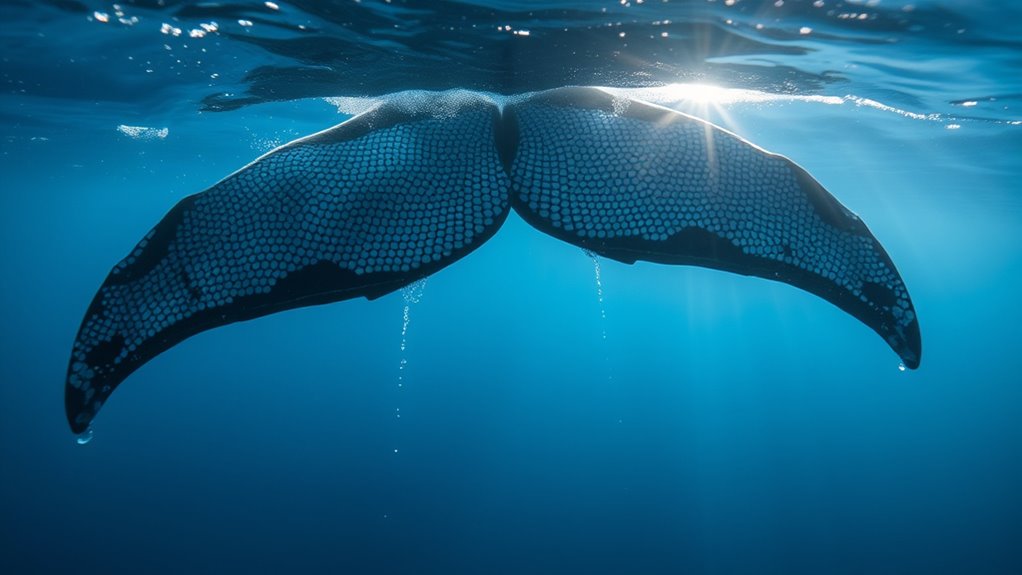
Although whale flukes might look simple at first glance, their anatomy is quite complex and perfectly designed for powerful swimming. These whale tails, called flukes, are horizontal, muscular extensions of the tail vertebrae with two lobes: the left lobe and right lobe.
Humpback whales, famous in whale watching, have flukes with serrated edges and pointed tips that help them well dive and perform acrobatics. The fluke’s surface often shows unique pigmentation patterns, allowing researchers to identify individual whales.
These majestic creatures rely on their flukes’ flexibility and strength to navigate the fascinating world beneath the waves.
| Feature | Description |
|---|---|
| Structure | Two lobes connected to tail vertebrae |
| Function | Provide thrust and maneuverability |
| Identification | Unique pigmentation on surface |
Why Are Whale Flukes Essential for Movement?
Because whale flukes move up and down powerfully, they serve as the main source of propulsion, pushing whales through water with impressive speed and control. When you observe whales, you’ll notice their flukes generate thrust that can reach speeds up to 30 miles per hour. These movements aren’t just about speed; they provide essential functions that keep whales thriving.
Here’s why whale flukes are essential for movement:
- Their broad surface area enables strong, efficient strokes.
- Muscular flexibility allows dynamic behaviors like breaching and tail slapping.
- Precise control helps whales maneuver during feeding and migration.
- Efficient fluke design conserves energy on long journeys and profound dives.
Understanding this helps you appreciate how crucial flukes are to whales’ survival and mobility.
Why Are Whale Fluke Patterns Unique?
When you spot a whale’s fluke, you’re actually looking at a unique pattern that works like a natural fingerprint. Each whale’s fluke displays distinctive black or dark gray areas mixed with white pigmentation that varies in shape and coverage. These white patches can cover less than 20%, between 20% and 60%, or more than 60% of the fluke, helping distinguish individuals.
What’s fascinating is that these patterns stay relatively stable over time, allowing researchers to track whales through years. While you might not realize it, these unique markings play a vital role in monitoring whale populations worldwide. So next time you see a whale’s tail, remember, you’re witnessing an exclusive design that tells the story of that individual’s identity.
How Do Scientists Identify Whales by Fluke Patterns?
How exactly do scientists identify individual whales by their fluke patterns? They rely on the unique black-and-white pigmentation on the underside of each whale’s fluke, which acts like a fingerprint.
Here’s how they do it:
- Capture high-quality photographs of the flukes during whale sightings.
- Upload images to databases such as Happywhale for matching and long-term tracking.
- Categorize fluke patterns based on white coverage—less than 20%, 20-60%, or over 60%—to streamline identification.
- Note distinctive scars, notches, or deformities along the fluke’s trailing edge for extra precision.
What Role Do Whale Flukes Play in Communication and Behavior?
Beyond their unique patterns that help identify individual whales, flukes play an essential role in communication and behavior. When a whale slaps its fluke on the water—called lobtailing—it sends signals you can’t hear but whales pick up over long distances. You’ll notice that tail slapping can mean aggression, courtship, or a warning about danger nearby.
The way a whale moves or positions its flukes during breaches also acts as a visual cue to others, helping convey social or territorial messages. These fluke behaviors, including slapping and waving, don’t just communicate; they help whales bond socially and establish dominance within their groups.
How Do Whale Flukes Help With Feeding?
You’ll see whales use their flukes to slap the water, herding fish into tight groups for easier feeding. They also create bubble nets with powerful strokes, trapping schools of prey right where they want them.
These tail movements boost feeding efficiency by helping whales control and capture more food at once.
Tail Slapping Techniques
When whales slap their tails against the water, they’re not just making noise—they’re skillfully herding and stunning prey to make feeding easier. This tail slapping, known as lobtailing, plays a vital role in their feeding strategy.
You’ll notice how the powerful force from their flukes can stun or disorient fish, helping whales capture them more efficiently. Here’s how tail slapping enhances feeding:
- Herds prey into tight groups for easier capture.
- Stuns or confuses fish, reducing their escape chances.
- Assists in creating bubble nets by agitating the water surface.
- Serves as communication during coordinated feeding efforts.
Bubble Net Formation
Tail slapping not only stuns prey but also plays a key role in creating bubble nets, a clever feeding method whales use to trap fish. You’ll see whales use their powerful flukes to slap the water surface, producing bubbles that rise and form a circular net around schools of fish.
The large surface area and strength of the flukes let whales generate the force needed for these vigorous tail movements. As you watch, notice how precise fluke motions help maintain the bubble net’s shape and herd the fish upward.
This teamwork between fluke power and control makes bubble net feeding an effective way for whales to corral and capture prey with remarkable efficiency.
Feeding Efficiency Boost
Although whale flukes serve many purposes, their role in feeding efficiency stands out. When you observe whales feeding, you’ll notice how their flukes enhance their ability to catch prey effectively. Here’s how they help:
- Tail slaps herd fish into tight schools, making them easier to capture.
- The loud noise from slapping disorients prey, increasing capture success.
- Slapping breaks water surface tension, dislodging hidden prey.
- Powerful thrusts position whales strategically during feeding.
This combination of forceful tail movements and bubble-net feeding allows whales to consume large amounts of prey quickly.
What Causes Scars and Injuries on Whale Flukes?
Because whale flukes often bear scars and injuries, you can learn a lot about their lives by examining these marks. Many scars come from predation—killer whales leave rake marks while sharks and other predators cause bite wounds or punctures. You’ll also notice circular scars where barnacles have embedded themselves in the skin, especially on the fluke’s underside.
Injuries often result from human interactions too, like entanglement in fishing gear or ship strikes, which can cause deformities or deep cuts. Over time, these scars heal but remain visible, creating unique patterns that help researchers identify individual whales. By paying close attention to these details, you can uncover stories about the whale’s encounters and challenges in the wild.
How You Can Help Protect Whales and Their Flukes
You can make a real difference by choosing sustainable seafood that keeps whales safe from harmful fishing gear. When you join responsible whale watching tours, you help protect their natural behaviors and habitats.
Supporting conservation programs also funds essential research and protection efforts for these magnificent creatures.
Sustainable Seafood Choices
When you choose sustainably sourced seafood, you help reduce the risk of whales getting entangled in fishing gear, protecting their flukes and populations. Making informed choices supports ocean health and whale survival.
Here’s how you can make a difference:
- Avoid overfished species to maintain balanced ecosystems essential for whales.
- Support fisheries that adopt whale-safe gear to minimize accidental bycatch.
- Look for certifications like MSC (Marine Stewardship Council) on labels to ensure eco-friendly sourcing.
- Reduce overall seafood consumption to lessen fishing pressure and habitat disruption.
Responsible Whale Watching
Though whale watching offers a unique chance to connect with these majestic creatures, maintaining a respectful distance and minimizing disturbances is essential to protect their wellbeing. You can help by staying at least 100 yards away, avoiding sudden movements, and keeping noise to a minimum.
Using quiet engine modes and following local guidelines ensures you don’t stress the whales or harm their delicate flukes. Supporting eco-tourism operators committed to sustainability also benefits these gentle giants.
| What to Do | Why It Matters |
|---|---|
| Maintain 100-yard distance | Prevents stress and disturbance |
| Use quiet engine modes | Reduces noise pollution |
| Follow local regulations | Ensures safe, respectful viewing |
| Avoid sudden movements | Protects whales and their flukes |
Supporting Conservation Programs
Because whale populations face numerous threats, supporting conservation programs plays an essential role in protecting their habitats and preserving their iconic flukes. You can actively contribute to these efforts in several impactful ways:
- Join whale watching tours that fund research, helping track whale fluke patterns and overall health.
- Donate to organizations like Happywhale, which use unique fluke markings to monitor individual whales.
- Choose sustainable seafood to reduce fishing gear entanglement, preventing scars and deformities on flukes.
- Educate your community about whale conservation to promote responsible behavior that minimizes human impact.
Frequently Asked Questions
What Is a Whale Tail Called?
A whale tail is called a fluke. You’ll notice it’s horizontal, unlike fish tails. You can spot individual whales by their fluke’s unique patterns.
It helps them swim and steer through the water efficiently.
What Is Slang for Whale Tail?
You’ve probably seen the most infamous fashion faux pas ever—“whale tail” slang means that thong peek above your low-rise jeans.
It’s like your underwear’s shouting, “Look at me!”—a trend that dominated early 2000s culture.
What Is a Whale Tail From the Front Called?
You call a whale tail from the front a “fluke.” It’s the broad, wing-like part that helps whales swim powerfully.
You’ll notice its two symmetrical lobes and unique markings when the tail’s raised.
What Is the Tail Fin of a Whale Called?
The tail fin of a whale is called a fluke. You’ll notice it’s horizontal, unlike fish tails, and it helps you propel through water powerfully.
Each fluke’s shape and markings can even help identify individual whales.
Conclusion
Now that you know a whale’s tail is called a fluke, you can appreciate its graceful dance beneath the waves. These majestic fins aren’t just for show—they’re the whale’s secret to gliding through the ocean’s embrace, communicating, and even dining with style.
By understanding and protecting these gentle giants and their flukes, you’re helping preserve a beautiful rhythm of life that flows quietly beneath the surface. This effort is crucial for marine conservation and the wellbeing of ocean ecosystems.
Embracing the wonder of whale tails, or flukes, invites you to be part of their timeless story and the vibrant natural world they inhabit. Protecting these incredible creatures ensures future generations can witness the magic of the ocean’s giants.