How Big Does a Minke Whale Get?
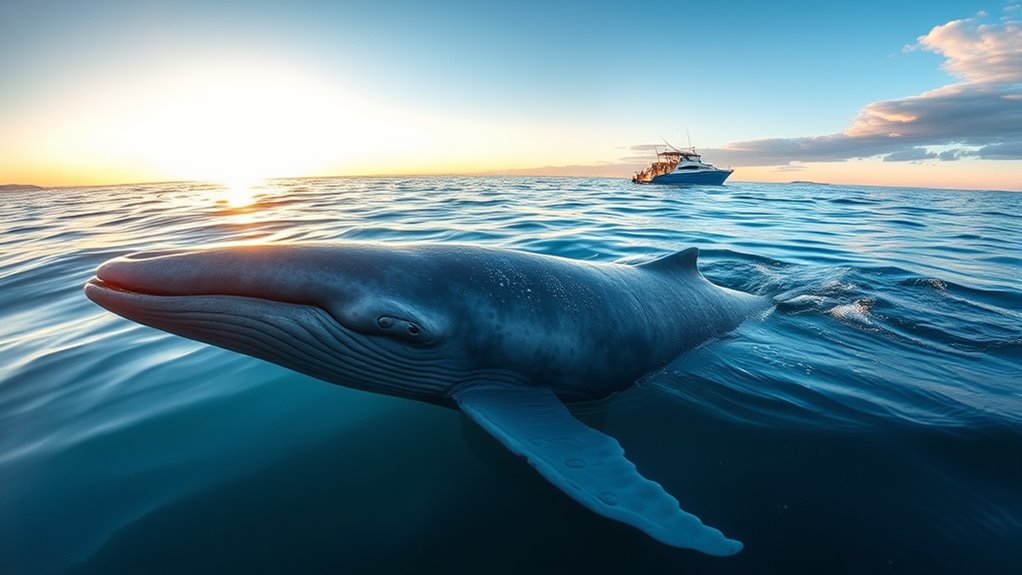
You’ll find minke whales typically grow between 8 and 9 meters (26-30 feet) long, with females usually larger than males, often reaching around 8.9 meters.
Some individuals, especially Antarctic minkes, can exceed 10 meters (33 feet).
Calves start small but grow quickly to adult size over several years.
Their size varies by region and subspecies, influencing their behavior and survival.
If you want to understand more about their growth and significance, there’s plenty to explore.
How Big Do Minke Whales Typically Grow?
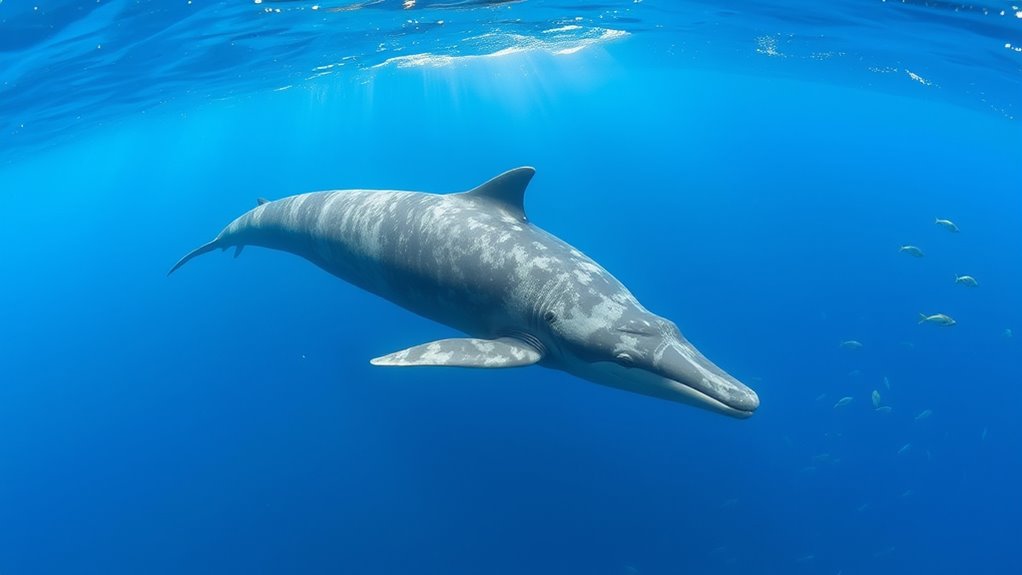
Although sizes vary, minke whales typically grow between 8 and 9 meters (26 to 30 feet) long. When you consider their size, adult males usually measure around 8.35 meters (27.4 feet), while females tend to be slightly larger, reaching about 8.9 meters (29.2 feet) in length.
You might be interested to know that dwarf minke whales are smaller, generally growing up to 7.8 meters (26 feet). These size differences highlight the diversity within the species. While most minke whales fall within this range, the maximum size recorded for some individuals exceeds 10 meters (33 feet), showing that they can grow even larger under certain conditions.
Minke Whale Size Differences Between Males and Females
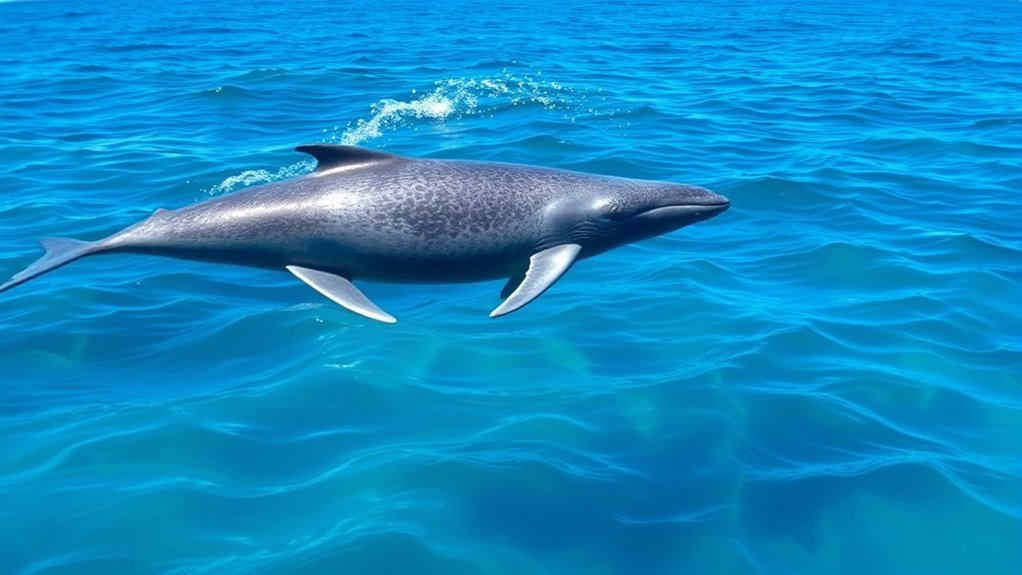
While both male and female minke whales grow impressively large, females typically outsize males by several inches to nearly a foot in length. This size difference is a clear example of sexual dimorphism, where the female’s whale length averages about 8.9 meters compared to the male size of roughly 8.35 meters.
The female larger body weight, around 8.25 tons versus males’ 7 tons, gives her a reproductive advantage, supporting calf development and nursing. You can see this size difference consistently across most minke whale populations.
Females weigh about 8.25 tons, aiding calf development and nursing compared to males’ 7 tons.
- Females are generally heavier and longer than males
- Sexual dimorphism benefits females reproductively
- Male size averages about 27.4 feet in length
- Female larger size enhances calf survival
- Body weight difference supports nursing demands
Size Differences Among Common, Dwarf, and Antarctic Minke Whales
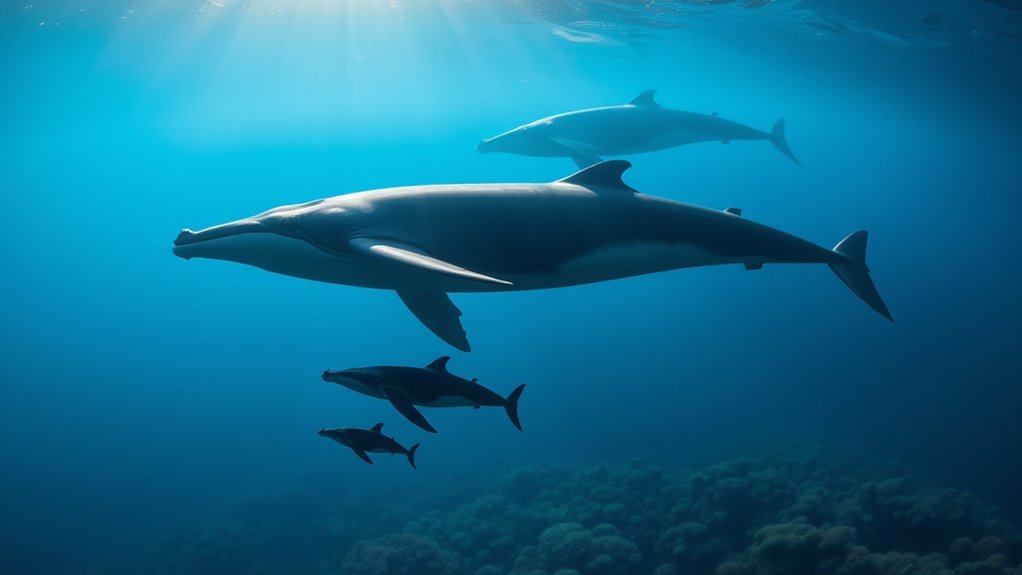
Understanding the size differences between male and female minke whales sets the stage for comparing the three main species: common, dwarf, and Antarctic minke whales. The common minke whale grows up to 35 feet long, with females generally larger than males, weighing around 20,000 pounds.
Dwarf minke whales are noticeably smaller, reaching lengths of about 26 feet. Antarctic minke whales fall in between, typically ranging from 30 to 33 feet in length and weighing slightly more than the common minke. These size and weight differences highlight the diversity among minke whale species.
When you consider the length and weight, the Antarctic minke whales are the largest, the common minke whale follows, and the dwarf minke whales are the smallest of the three.
How Minke Whale Size Varies Across Oceans and Populations
You’ll notice that minke whale sizes change depending on where they live, with some subspecies growing larger than others. Regional factors like ocean conditions and food availability play a big role in their growth.
Understanding these differences helps explain why some populations are bigger or smaller across the globe.
Regional Size Differences
Because minke whale size varies across regions, you’ll notice distinct differences depending on where these whales live. Regional variation in minke whales affects their length and overall growth, influenced by environmental conditions and prey availability. Different populations show unique size ranges, reflecting adaptation to their habitats without diving into subspecies distinctions.
- North Atlantic minke whales usually measure around 8.5 meters (28 feet).
- North Pacific populations often exceed 9 meters (30 feet).
- Antarctic minke whales can surpass 10 meters (33 feet).
- Dwarf minke whales rarely grow beyond 8 meters (26 feet).
Size differences arise due to genetic factors paired with local conditions. Understanding these regional size variations helps you appreciate the diversity within minke whale populations worldwide.
Subspecies Size Variation
While regional differences give a glimpse of how minke whale sizes change, looking at subspecies reveals even clearer patterns across oceans and populations. The common minke whale typically reaches a body length of 8 to 9 meters, with females generally larger than males. In contrast, the dwarf minke whale maxes out around 8 meters and sports a distinctive white patch on its pectoral fin.
Antarctic minke whales stand out among marine mammals, often exceeding 10 meters in length and boasting more baleen plates than other subspecies. North Atlantic populations tend to be slightly larger than those in the North Pacific. Notably, hybridization between Antarctic and Arctic minkes hints at gene flow, influencing subspecies size variations over time.
Understanding these patterns helps you appreciate the diversity within this fascinating species.
Environmental Impact on Growth
Although minke whales belong to the same species, their size can vary considerably depending on where they live. You’ll notice that regional size differences arise from a combination of genetics and environment. Growth rates depend heavily on prey availability and habitat quality, influenced by local climate conditions.
For example, whales in colder polar waters tend to grow larger due to richer prey, while tropical populations remain smaller. Human activities can also affect size by removing larger individuals from populations.
Consider these factors shaping minke whale growth:
- Prey availability varies by ocean region
- Habitat quality impacts nutrition and health
- Climate influences metabolic demands
- Genetics determine potential size limits
- Human impacts alter population size distribution
Understanding these helps explain why minke whales’ size isn’t uniform worldwide.
How Minke Whales Grow From Calves to Adults
When you observe a minke whale calf, you’ll notice it starts life at about 2.4 to 2.8 meters long and weighs between 300 to 650 pounds. Calves nurse for 4 to 10 months, fueling rapid growth.
As they become juveniles, their length increases steadily until they reach sexual maturity between 3 to 8 years of age. At this point, they’re around 23 to 25 feet long. Adult size varies, with males growing up to 8.35 meters and females reaching 8.9 meters, though some exceed 10 meters and weigh over 10 tons.
| Stage | Length (meters) | Weight (pounds) |
|---|---|---|
| Calves | 2.4 – 2.8 | 300 – 650 |
| Nursing | Rapid growth | Rapid growth |
| Juvenile | ~7 – 7.6 | Increasing |
| Sexual Maturity | 7 – 7.6 | Increasing |
| Adult | 8.35 – 10+ | Up to 20,000+ |
What Affects How Big Minke Whales Get
As minke whales grow from calves into adults, you might wonder why some individuals reach impressive lengths while others remain smaller. Several factors affect their size, including genetics and the subspecies they belong to. The environment plays a vital role too—water temperature and prey availability directly impact their growth rates.
Age and overall health also influence how large a minke whale gets over time.
Consider these key influences on minke whale size:
- Different subspecies, like the dwarf minke, vary in maximum size.
- Genetic makeup affects individual growth potential.
- Water temperature can speed up or slow down growth.
- Availability of food in the environment supports size development.
- Age determines how much a whale can grow before growth slows.
How Scientists Measure Minke Whale Size
When scientists measure minke whale size, they rely on techniques like aerial surveys and photo identification to accurately gauge length. You’ll find they use tools such as laser rangefinders or scaling objects in photos to get precise measurements from a distance.
Weight estimates often come from correlating these length measurements with known data, giving a clearer picture of the whale’s overall size.
Length Measurement Techniques
Although measuring a minke whale’s length might seem challenging, scientists have developed precise techniques to do so. They focus on capturing accurate length measurements, from the whale’s snout to the tail fluke, to determine its size. Photogrammetry plays a key role, especially aerial photogrammetry, where drones or aircraft capture images used to estimate length without disturbing the whale.
Laser photogrammetry adds accuracy by projecting laser points onto the whale’s body, calculating size based on known distances between points. Here are some common methods used:
- Aerial photogrammetry with drones or planes
- Measuring snout to tail fluke when the whale surfaces
- Laser photogrammetry for precise size calculations
- Underwater tapes or poles during close research dives
- Genetic and acoustic data to infer length indirectly
These techniques ensure reliable length data on minke whales.
Weight Estimation Methods
Because you can’t easily weigh a minke whale directly, scientists rely on weight estimation methods that use measurements like length and girth taken during sightings or biopsies. They often apply biometric proxies, such as fluke or dorsal fin size, to infer total body size.
Photogrammetry, using aerial or drone images, provides precise measurements without disturbing the whale. Biopsies not only assist with size approximations but also supply genetic data supporting anatomical studies of different populations.
Researchers combine these measurements with known growth rates to estimate weight accurately. Tagging further refines size estimates by tracking movement patterns tied to body mass.
Altogether, this multi-method approach lets you understand minke whale weight despite the challenges of direct measurement in the wild.
How Minke Whale Size Compares to Other Baleen Whales
While minke whales aren’t the largest baleen whales, their size still surprises many. You might expect all baleen whales to be huge, but minke whales stand out as the second smallest species. When you compare their body length and adult weight to other whale species, the differences become clear.
- Minke whales reach up to 35 feet in body length.
- Dwarf minke whales are smaller, maxing out around 26 feet.
- Blue whales, the giants, can exceed 100 feet.
- Adult minke whales weigh about 20,000 pounds.
- Fin whales can weigh up to 80,000 pounds.
This size comparison highlights the minke whale’s unique position among baleen whales, especially within the rorqual family.
Why Minke Whale Size Matters for Behavior and Survival
Since minke whales are the smallest baleen whales, their size plays an essential role in how they behave and survive. Their body length, typically up to 35 feet, lets them move swiftly and efficiently, which helps during long migrations and feeding sessions. You’ll notice that their smaller size gives them an edge in escaping predators because they’re more agile than larger whales.
This agility also allows minke whales to access varied feeding depths and prey, enhancing their survival across diverse environments. Subspecies with different sizes, like dwarf minkes, show how size influences social behavior and habitat choices. Plus, their relatively smaller size helps reduce the risk of ship strikes and entanglements.
Minke Whale Size as a Health and Conservation Indicator
You can learn a lot about minke whales’ health by watching how their size changes over time. When you track growth trends, you spot signs of environmental shifts or food shortages.
Noticing size variations helps you understand how well these whales are coping with their surroundings.
Size Variation Insights
Although minke whales generally grow between 8 to 10 meters, their size can tell you a lot about their health and environment. Size variation among individuals and subspecies, like the smaller dwarf minke whale, reveals important regional differences. By monitoring these variations, you can track the population’s overall health and detect environmental impacts.
- Size differences can indicate age, reproductive status, and health conditions
- Subspecies show distinct regional size ranges
- Monitoring size helps identify environmental stressors
- Population shifts may reflect changes in prey availability
- Deviations from normal size ranges can signal human or climate impacts
Understanding these size variations gives you valuable insights into minke whale conservation and ecosystem health.
Growth Trends Monitoring
Tracking changes in minke whale size over time reveals much about their health and the state of their environment. By monitoring growth trends, you can detect shifts in population health and spot early signs of environmental stress. Variations in average size often reflect food availability—smaller whales might indicate nutritional stress or declining prey populations.
Consistent size measurements, gathered through photo identification and genetic sampling, give you valuable data to assess how climate change and habitat alterations impact these whales. When you notice declines in average size or stunted growth, it signals potential ecosystem imbalances or emerging threats.
Staying on top of these trends helps guide effective conservation efforts, ensuring the minke whale population remains healthy and resilient in a changing environment.
Frequently Asked Questions
How Rare Is a Minke Whale?
Minke whales aren’t very rare globally, with about 515,000 around. You might find them common in many areas, but in some regions, like the western U.S. Pacific, they’re less frequently seen.
Which Whale Lives 500 Years?
You won’t find any whale living 500 years; the Greenland shark holds that record at around 400 years.
Most whales, including blue whales, usually live up to 100 years, so 500 is just a myth.
Are Minke Whales Friendly?
Yes, minke whales are friendly and curious. You’ll often see them approach boats, surfacing nearby or spyhopping.
Just remember to keep a respectful distance to avoid disturbing these inquisitive creatures during your encounters.
What Whale Is 30 Feet Long?
A whale that’s about 30 feet long is usually a minke whale.
You’ll find they’re one of the smaller baleen whales, often measuring between 26 to 30 feet when fully grown or mature.
Conclusion
Now that you know how minke whales grow and vary in size, you can picture them as the ocean’s graceful dancers—each one moving with strength shaped by their unique size and environment.
Their size isn’t just a number; it’s an essential sign of their health and survival. By understanding their growth, you’re helping keep the ocean’s rhythm alive.
This knowledge supports efforts to protect these majestic creatures. Ensuring that minke whales continue to glide through the waves for generations to come depends on appreciating their size and role in the marine ecosystem.