Where Do Whale Sharks Give Birth
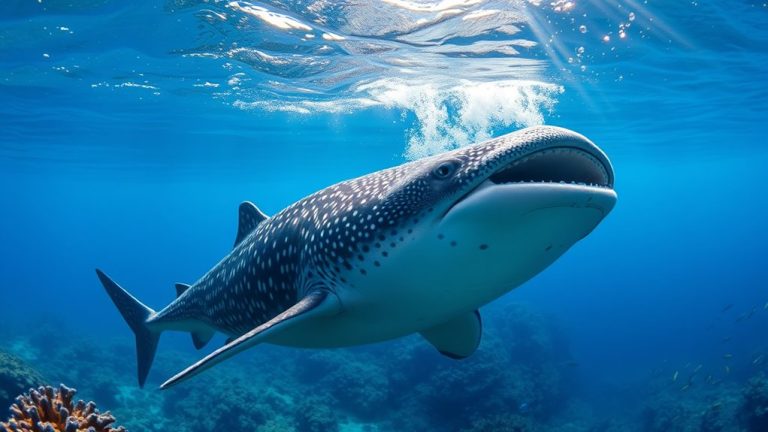
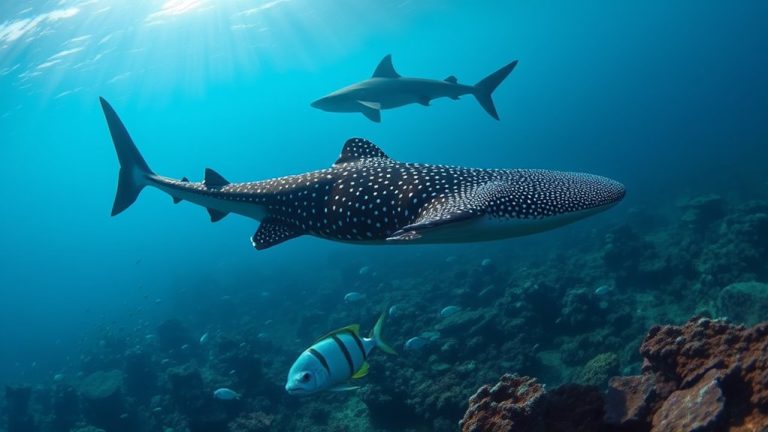
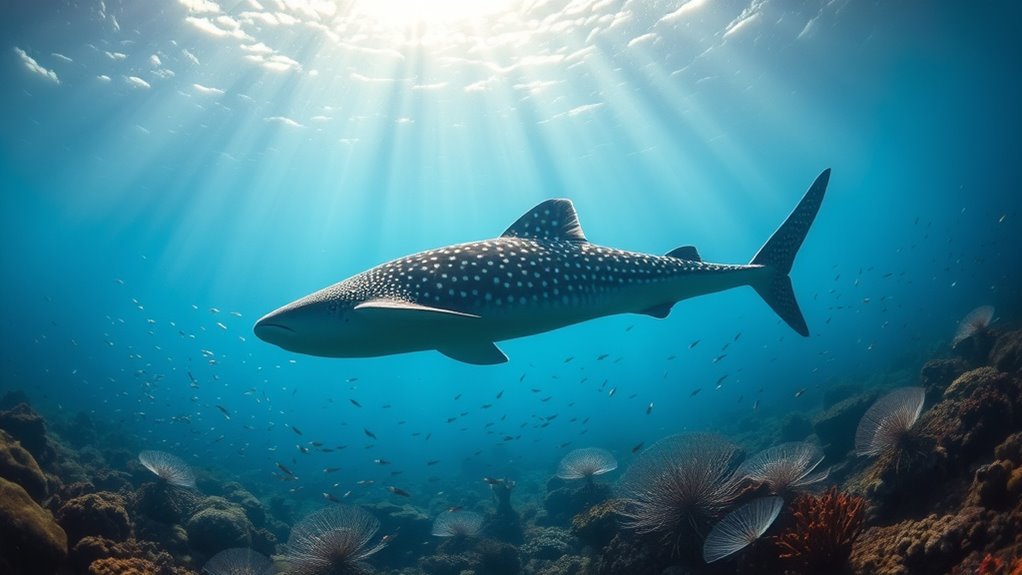
You’ll find whale sharks giving birth in warm, deep tropical waters near continental slopes and oxygen-rich zones. These areas serve as important nursery habitats where the pups can thrive.
Whale sharks prefer these safe nurseries because the conditions support the survival of their young, which are born fully formed but tiny compared to adults.
Since birthing happens far offshore in hard-to-reach spots, sightings are rare. These areas also have abundant food and suitable oxygen levels to help pups grow.
Keep exploring to uncover more about these mysterious nursery habitats and what makes them special.
How Do Whale Sharks Reproduce?
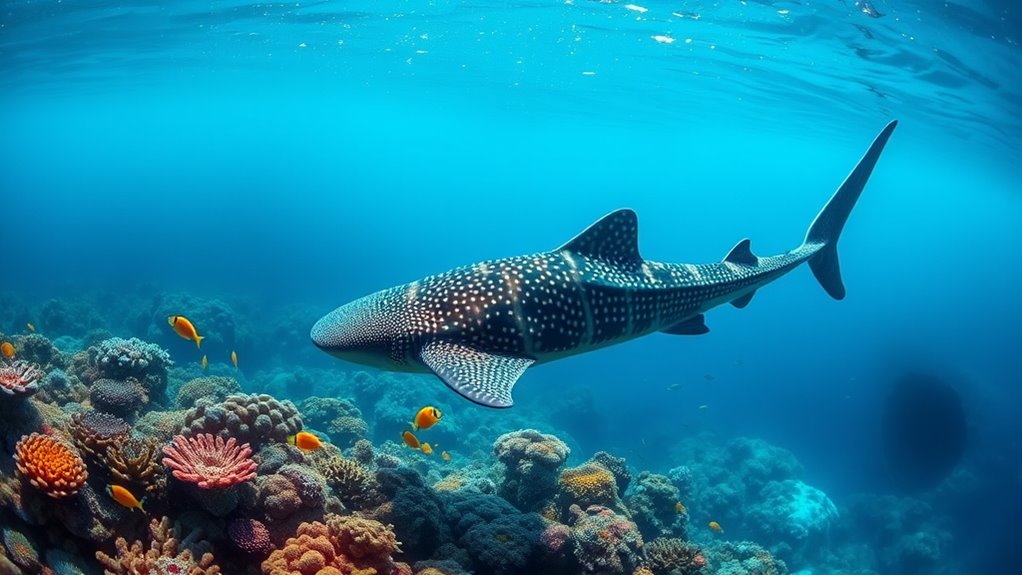
Although whale sharks reproduce in a unique way, you might be surprised to learn they’re ovoviviparous—they develop eggs inside the female’s body that hatch internally before she gives birth to live pups.
As a result, you won’t find whale sharks laying eggs externally like many fish. Instead, a pregnant female carries hundreds of embryos, sometimes around 300, each developing from fertilized eggs nourished by yolk sacs.
These embryos grow inside her until they’re ready to be born as neonate whale sharks, fully formed and measuring between 40 and 70 centimeters. Fertilization happens gradually, with eggs maturing over time rather than all at once.
Although researchers have found pregnant females, the exact pupping grounds remain a mystery, believed to be in deep, tropical waters.
What Size Are Whale Shark Pups at Birth?
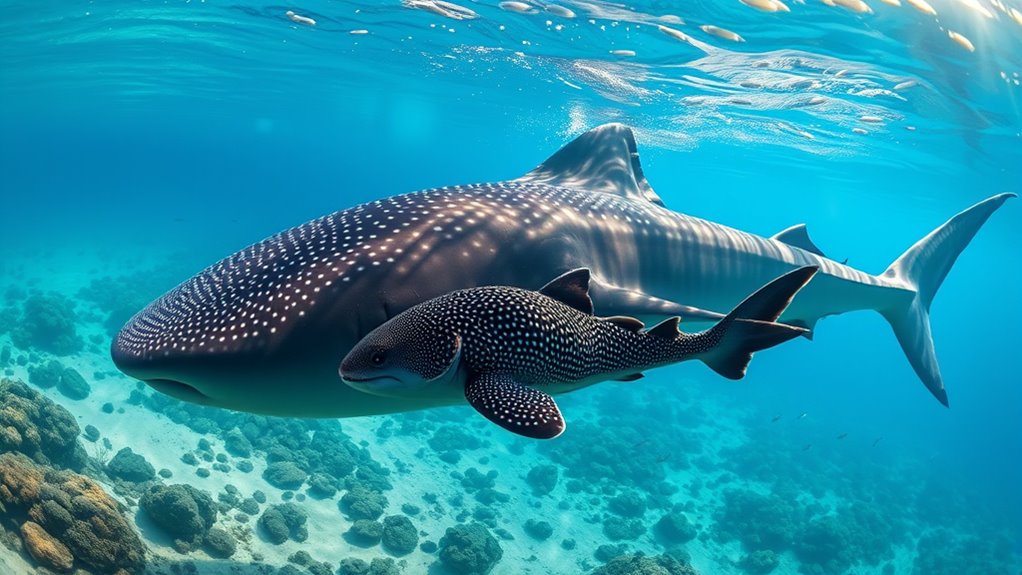
When whale shark pups are born, they measure between 40 and 70 centimeters long, which is tiny compared to adults that can reach 12 meters. You might be surprised to learn they’re fully formed and ready to swim on their own right from birth.
As you follow their growth stages, you’ll see just how quickly they grow from these small beginnings.
Newborn Whale Shark Length
If you’ve ever wondered how big whale shark pups are at birth, they typically measure between 40 and 70 centimeters long. This size at birth means a newborn whale shark is relatively small compared to adults but fully formed and ready to swim independently. Whale shark pups vary in size, with the smallest recorded neonate measuring about 60 centimeters.
Despite their modest size at birth, these pups grow quickly, reaching over 2 meters within a few years. Knowing the length of a newborn whale shark helps you appreciate their early development and survival skills. So, when you think about whale shark pups, remember they start off small but are well-equipped to thrive from day one.
Embryo Size Comparison
Understanding the size of newborn whale sharks gives you a clear picture of their early life, but comparing these pups to embryos inside pregnant females reveals even more. Embryo size in pregnant females can reach up to 64 centimeters just before birth, closely matching the neonate length observed in newborns.
In fact, the smallest recorded neonate was about 60 centimeters long, indicating that pups are nearly full-grown embryos when born. This similarity highlights how whale sharks develop markedly inside the mother before entering the world.
Although newborns measure between 40 and 70 centimeters, they’re still tiny compared to adult males, which rarely exceed 8 meters. This comparison emphasizes the substantial growth that occurs before birth and the relatively large size of whale shark pups at birth.
Growth Stages Afterbirth
Although whale shark pups are born relatively small, ranging from 40 to 70 centimeters in length, they’re already fully formed and ready to swim on their own. Marine biologists note that these pups grow rapidly during their early life, quickly reaching several meters in size within a few years. The smallest recorded neonate measured 60 centimeters.
Despite this growth, early life stages remain poorly documented, leaving many questions about their development. Here’s a quick look at the growth stages afterbirth:
| Stage | Size Range (cm) | Notes |
|---|---|---|
| Neonate | 40–70 | Fully formed, independent |
| 1 Year | 200–300 | Rapid growth phase |
| 3 Years | 400–600 | Approaching juvenile size |
| Adult | 5000+ | Full maturity, several meters |
Why Are Baby Whale Sharks So Rarely Seen Near Birthplaces?
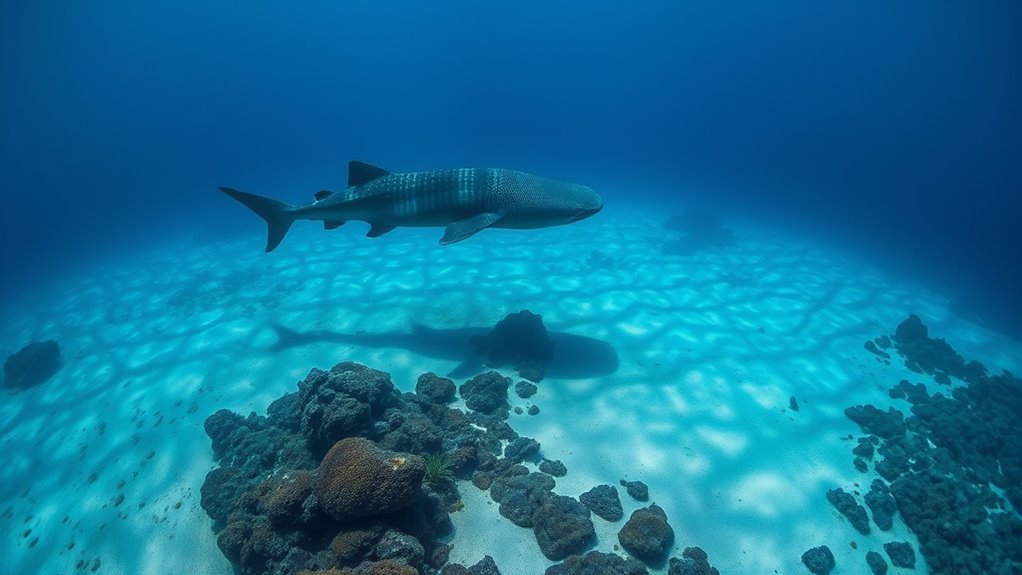
Because baby whale sharks are born in deep, offshore waters, you rarely see them near birthplaces or shallow nursery sites. Whale sharks give birth in deep waters, far from coastal areas where you might expect to find newborns. No divers have witnessed births near shallow nurseries, and most neonates turn up only as bycatch in remote deep-sea locations.
The initial stages of a baby whale shark’s life happen in these challenging, inaccessible deep waters, making direct observation nearly impossible. Even the smallest recorded whale sharks, around 60 cm, are rarely spotted and usually found accidentally.
Where Do Scientists Believe Whale Sharks Give Birth?
While no one has directly observed whale sharks giving birth, scientists believe these gentle giants deliver their pups in deep, warm tropical waters far from shore. You should know that the exact birth sites remain unknown, but sightings of neonate whale sharks near nursery areas in the Philippines, India, and Australia give clues.
The only confirmed pregnant female was caught near Taiwan, hinting it might be a birthing region. Researchers think whale sharks may choose areas with specific oceanographic features, like upwelling zones or deep offshore waters, for birth.
Even with ongoing studies, no one has documented whale shark birth or neonatal emergence in the wild. So, while it’s clear birth happens in deep tropical waters, the precise locations stay a mystery.
Why Are Oxygen Minimum Zones Ideal Whale Shark Nurseries?
You’ll find that Oxygen Minimum Zones offer neonate whale sharks a safe haven by keeping large predators away thanks to low oxygen levels. These zones also provide abundant plankton, giving young sharks plenty of food to grow.
Because neonates can tolerate low oxygen, they stay close to these areas, balancing safety and nourishment perfectly.
Neonate Safety Advantages
If you look closely at Oxygen Minimum Zones (OMZs), you’ll see why they serve as ideal nurseries for whale shark neonates. These low-oxygen areas boost neonate safety by creating natural refuge zones where many predators can’t survive, making OMZs essential nursery habitats.
By staying near OMZs, newborn whale sharks reduce their risk of predation and competition, increasing their chances of survival during these vulnerable early stages.
- OMZs limit presence of larger predatory fish due to low oxygen
- Reduced predation pressure enhances neonate safety
- Oxygen-depleted conditions lower competition among marine species
- OMZs create safer nursery habitats supporting early development
You can appreciate how Oxygen Minimum Zones provide critical protection for these gentle giants at birth.
Food Availability Benefits
Because Oxygen Minimum Zones (OMZs) concentrate plankton and small fish, they offer a rich food supply that supports the growth of neonate whale sharks. When you’re a juvenile whale shark, finding enough food is vital for development, and OMZs provide just that.
These zones boost primary productivity through nutrient upwelling, creating dense prey patches that young sharks rely on. The abundance of food means juvenile whale sharks can feed efficiently without straying far, conserving energy during this vulnerable stage.
Plus, the concentrated prey keeps them in these safe nurseries longer. By staying near oxygen minimum zones, neonates take advantage of an ideal environment where food is plentiful, setting a strong foundation for their survival and growth in the ocean’s early life stages.
Low Oxygen Tolerance
While low oxygen levels might seem hostile, oxygen minimum zones (OMZs) actually offer neonate whale sharks a unique advantage. These low oxygen areas serve as natural nurseries where young sharks can grow with fewer threats. You’ll find neonates favoring OMZs because many predators avoid these hypoxic zones, giving the pups a safer environment.
Plus, the low oxygen influences their behavior, keeping them near depths where survival chances are higher.
Consider why OMZs make ideal nurseries:
- Reduced predator presence increases neonate survival
- Low oxygen levels limit competition from larger marine animals
- Encourages neonates to remain in safe, oxygen-tolerable depths
- Provides abundant food resources for growing pups
These factors make OMZs essential habitats for whale shark nurseries.
How Do Environmental Factors Affect Whale Shark Birthing Grounds?
Environmental factors play a crucial role in determining where whale sharks choose to give birth, often guiding them toward warm, tropical deep waters near continental slopes or deep-sea nurseries. You’ll find that variations in temperature, oxygen levels, and prey availability heavily influence these birthing grounds.
Seasonal events like plankton blooms and coral spawning attract pregnant females, creating ideal nursery habitats rich in food. Oceanic features such as Oxygen Minimum Zones and upwelling further shape these environments by affecting water quality and nutrient flow.
As climate change shifts oceanographic conditions, traditional birthing grounds may alter, impacting where newborn whale sharks can safely thrive. Understanding how environmental factors affect these nursery habitats helps reveal the delicate balance whale sharks depend on for successful reproduction.
What Challenges Exist in Locating Whale Shark Birthing Sites?
Tracking down whale shark birthing sites poses a tough challenge since no one has ever directly observed these locations. You face obstacles because whale sharks reproduce in deep, remote habitats, making direct sightings nearly impossible. Pregnant females are elusive, and the species’ migratory behavior further complicates pinpointing birthing sites.
Most neonatal whale sharks appear only as rare bycatch or sightings, giving limited clues. Researchers must rely on indirect methods like tracking movement patterns and habitat preferences to infer where births might occur.
- Deep, inaccessible habitat limits direct observation
- Elusive pregnant females avoid detection
- Migratory behavior scatters potential birthing sites
- Neonate sightings are rare and incidental
These challenges make locating whale shark birthing sites a complex puzzle for conservationists and scientists alike.
How Are Whale Shark Nursery Areas Being Protected?
Because whale shark nursery areas are essential for the species’ survival, many regions have established marine protected areas (MPAs) that limit fishing and boat traffic to keep these habitats safe. These marine protected areas often cover key nursery zones in warm, shallow waters near the Philippines, Australia, India, and eastern Africa.
Conservation efforts include working closely with local communities and fisheries to reduce bycatch and accidental injuries to juvenile sharks. Some nursery zones, like Ningaloo Reef in Australia, even hold UNESCO World Heritage status, ensuring stronger protection.
Researchers also conduct satellite tracking and underwater surveys to monitor these areas and identify new nursery sites. By supporting these conservation efforts, you help safeguard whale sharks’ future and preserve their critical breeding habitats.
Frequently Asked Questions
Do We Know Where Whale Sharks Give Birth?
No, we don’t know exactly where whale sharks give birth. You’ll find only rare sightings of newborns, suggesting deep offshore waters.
However, researchers haven’t pinpointed specific birthing or nursery sites yet.
Will a Shark Eat a Remora?
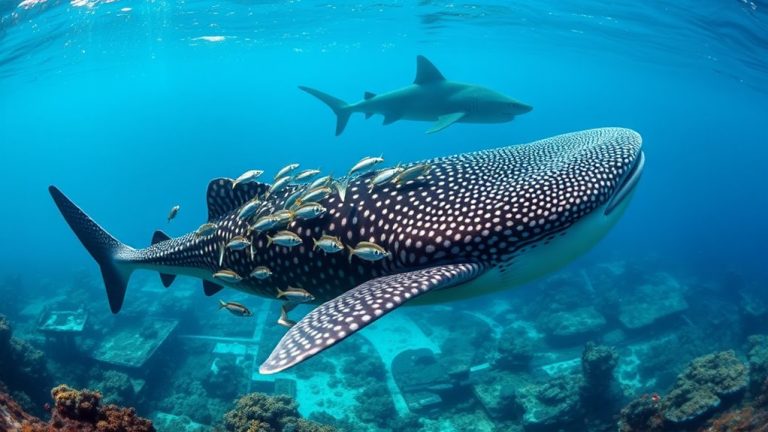
No, sharks generally won’t eat remoras. You’ll find remoras clinging to sharks, feeding on leftovers and parasites. This mutual relationship keeps remoras safe, especially with whale sharks, who rarely pose a threat to them.
Are Whale Sharks Born Alive?
Yes, whale sharks are born alive. They develop inside eggs within the mother, hatch internally, and then she gives birth to fully formed, free-swimming pups.
You won’t find whale sharks laying eggs externally.
How Long Do Baby Whale Sharks Stay With Their Mom?
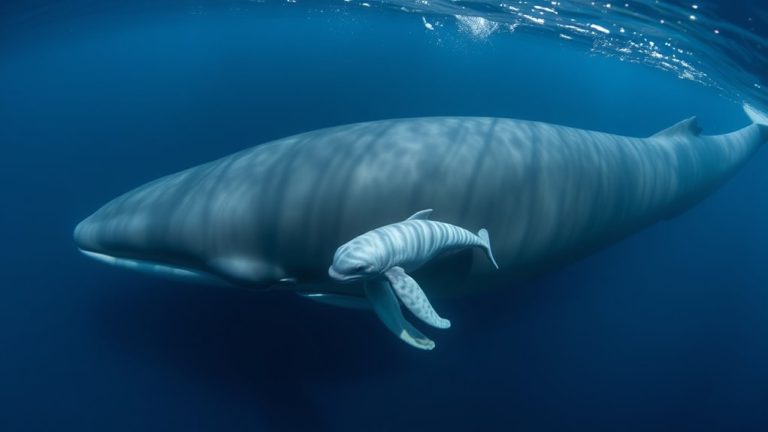
Think of baby whale sharks as little ships setting sail alone—they don’t stay with their mom at all.
You’ll find them steering nursery waters solo right after birth, growing strong before venturing into the vast ocean.
Conclusion
You might picture the vast ocean as a hidden cradle, where whale sharks gently bring new life into the world. These mysterious birthing grounds, often cloaked in deep, oxygen-poor waters, symbolize nature’s quiet sanctuary—fragile yet essential. Protecting these secret nurseries means safeguarding the future of gentle giants.
So, when you think of whale sharks, remember their silent beginnings beneath the waves, a reminder of how precious and delicate life truly is. Understanding where whale sharks give birth helps us appreciate the importance of conserving these critical habitats. Protecting whale shark birthing grounds ensures the survival of these magnificent creatures for generations to come.